
First Xenoglaux Seen Alive In Wild
Posted by: Loren Coleman on March 23rd, 2007
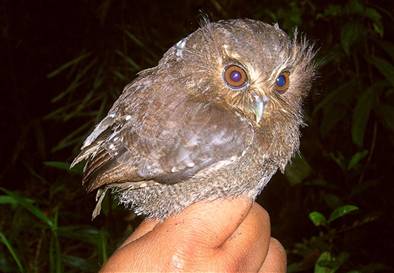
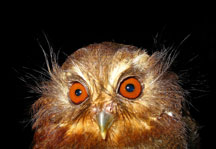
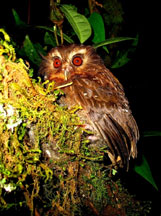
American Bird Conservancy is reporting the first live sighting a few weeks ago of what is “considered a holy grail of South American ornithology,” Xenoglaux loweryi.

Commonly called the long-whiskered owlet – alone in its own genus Xenoglaux, meaning “strange owl” – it was first discovered in 1976. Researchers have caught a few specimens in nets after dark but had not seen it in nature, until was spotted in February in a northern Peruvian rainforest. It was encountered three times during the day and its calls recorded at night in the Alto Nieva’s Peruvian reserve, known locally as the Area de Conservación Privada de Abra Patricia.

One of the world’s smallest owls, Xenoglaux loweryi has long wispy feathers around its reddish-orange eyes (quite visible in the new photos, above).
Seeing the long-whiskered owlet is a huge thrill. Its population is estimated to be less than 1000 birds and possibly as few as 250. Due to the rapid destruction of its forest habitat and its tiny range, it is inferred that the species is in serious decline. Until recently, the owlet’s key habitat was completely unprotected.David Geale, Association of Andean Ecosystems, member of the research team
Photos of the actual first live observed specimen, at top, credited to Asociación Ecosistemas Andinos/American Bird Conservancy.
 About Loren Coleman
Loren Coleman is one of the world’s leading cryptozoologists, some say “the” leading living cryptozoologist. Certainly, he is acknowledged as the current living American researcher and writer who has most popularized cryptozoology in the late 20th and early 21st centuries.
Starting his fieldwork and investigations in 1960, after traveling and trekking extensively in pursuit of cryptozoological mysteries, Coleman began writing to share his experiences in 1969. An honorary member of Ivan T. Sanderson’s Society for the Investigation of the Unexplained in the 1970s, Coleman has been bestowed with similar honorary memberships of the North Idaho College Cryptozoology Club in 1983, and in subsequent years, that of the British Columbia Scientific Cryptozoology Club, CryptoSafari International, and other international organizations. He was also a Life Member and Benefactor of the International Society of Cryptozoology (now-defunct).
Loren Coleman’s daily blog, as a member of the Cryptomundo Team, served as an ongoing avenue of communication for the ever-growing body of cryptozoo news from 2005 through 2013. He returned as an infrequent contributor beginning Halloween week of 2015.
Coleman is the founder in 2003, and current director of the International Cryptozoology Museum in Portland, Maine.











Let’s hope Peru can do more to save this wonderful little owl than we did to save the Ivory Bill Woodpeckers.
Cool little dude !!! Is it a bug eater or is it big enough to eat mice ???
It’s always wonderful news when an animal or a plant that was presumed lost is rediscovered, or an entirely new species is discovered. Hmm… they didn’t even have to kill one …