
Wondering About Wudéwásá
Posted by: Loren Coleman on December 12th, 2011
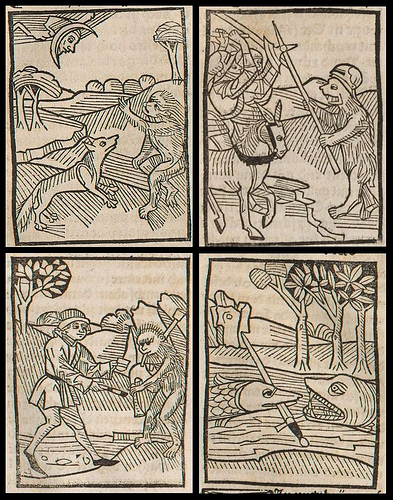
In December 2011, an intriguing woodcut was discovered. Above you can see details taken from Das buch der Natürlichen weißheit (The Book of Natural Wisdom), published in 1490 by Ulrich von Pottenstein (Munich).
The creatures certainly appear to resemble the wudéwásá, woodwose, the “hairy ones,” more popularly known as the “Wildman of the Woods” or “Wildpeople.”
But they also have characteristics of monkeys. Nevertheless, they serve as an entry point to discuss and ponder the Wildpeople of the 1600s in Europe. The Harz Mountains of Germany were an area of active sightings of these “hairy ones,” and it was reflected in the art and coinage of the day.
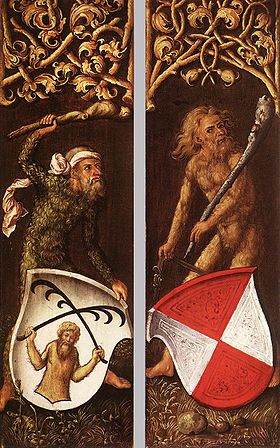
The European wudéwásá are to be found in the art from that time period (see above and below).
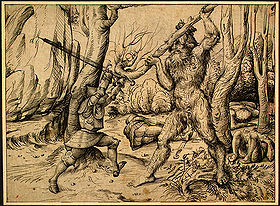
Hominologists have theorized that the art showing these creatures may represent examples of the late survival of Neandertals.
Source of Das buch der Natürlichen weißheit image: BibliOdyssey
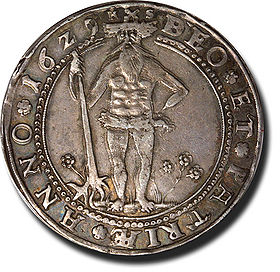
Update: 2018. I have been mentioning in my lectures in this last decade that Bigfoot researchers need to do more research on these “Wildman Thalers.” (Thaler is the word that eventually gave us dollar.)
A Wudéwásá coin similar to the one above, and several others are now on display at the International Cryptozoology Museum. A concerned effort has occurred to gather and study these important artifacts.
Thank you!
 About Loren Coleman
Loren Coleman is one of the world’s leading cryptozoologists, some say “the” leading living cryptozoologist. Certainly, he is acknowledged as the current living American researcher and writer who has most popularized cryptozoology in the late 20th and early 21st centuries.
Starting his fieldwork and investigations in 1960, after traveling and trekking extensively in pursuit of cryptozoological mysteries, Coleman began writing to share his experiences in 1969. An honorary member of Ivan T. Sanderson’s Society for the Investigation of the Unexplained in the 1970s, Coleman has been bestowed with similar honorary memberships of the North Idaho College Cryptozoology Club in 1983, and in subsequent years, that of the British Columbia Scientific Cryptozoology Club, CryptoSafari International, and other international organizations. He was also a Life Member and Benefactor of the International Society of Cryptozoology (now-defunct).
Loren Coleman’s daily blog, as a member of the Cryptomundo Team, served as an ongoing avenue of communication for the ever-growing body of cryptozoo news from 2005 through 2013. He returned as an infrequent contributor beginning Halloween week of 2015.
Coleman is the founder in 2003, and current director of the International Cryptozoology Museum in Portland, Maine.








These are only some pages of the book they are but interesting.
manticora
I don´t think the hairy “humanoids” in the woodcuts are actually wild men or wudewasa. If you look at the other plates, it seems this is are only animals acting like humans, for example the bear with the sallet and the halberd. It seems more probable to me those creatures are just monkeys, which were already at medieval times known in Europe, and often used for allegories and fables, and this book in particular was a collection of fables.
The book is showing a fable (Cyrillus Fabel). And as I can read in the other pages from the link above them talking about “Affen” the german word for monkey. I will get some literature about the “Buch der natürlichen Weissheit” the next days! manticora
Seems these coins were made for quite some time.
They are from BRUNSWICK-LUNEBURG.
Some quick research on the coins and the area they are from leads me to believe that the woodwose is an old pagan god.
Apparently, the woodwose is possibly connected with the Green Man and is pre-Christian.
John Mathew’s Taliesin: The Last Celtic Shaman from 2002 might give some ideas of the origin of the woodwose.
Definitely not a long shot because pre-Christian cultures in North Europe borrowed from each other.
And for the museum: 625$
A bit hefty in my opinion. 🙂
P.S. Taler (daler in Scandinavia) is the etymological origin of the dollar.
Great article! I particularly liked the collection of pictures. That coin is too cool.
Anyway…Interesting set of woodcuts there, folks—certainly proves that “hairy creatures” were not confined to just NOW.