
Update: Baffin Mystery Skull Identified
Posted by: Loren Coleman on September 2nd, 2006
Update
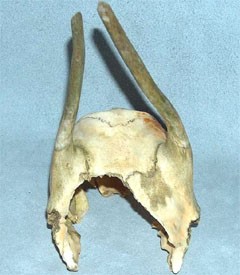
Regarding the “Bizarre Baffin Skull” entry posted on May 30, 2006, the enigma has been solved. The mystery skull is discussed in an article in the Nunatsiaq News of Iqaluit, Nunavut, and it is a skull of a caribou calf.
The scientist who confirmed this is Richard Harrington, an archeologist with the Museum of Nature in Ottawa. At first Harrington was hopeful it was a skull of an animal he is researching.
The newspaper observed that Harrington has
….spent over a decade excavating an ancient beaver pond on Ellesmere Island, where he found the remains of several extinct species, resembling modern horses, wolverine and bears, believed to be about 4 million years old. At the Ellesmere site he also discovered the remains of an extinct species of deer, which would only stand as tall as your knee. Instead of antlers, these creatures had long teeth, “like fangs.”
But as it turned out the new mystery skull is of nothing unusual, just a youthful caribou’s.
 About Loren Coleman
Loren Coleman is one of the world’s leading cryptozoologists, some say “the” leading living cryptozoologist. Certainly, he is acknowledged as the current living American researcher and writer who has most popularized cryptozoology in the late 20th and early 21st centuries.
Starting his fieldwork and investigations in 1960, after traveling and trekking extensively in pursuit of cryptozoological mysteries, Coleman began writing to share his experiences in 1969. An honorary member of Ivan T. Sanderson’s Society for the Investigation of the Unexplained in the 1970s, Coleman has been bestowed with similar honorary memberships of the North Idaho College Cryptozoology Club in 1983, and in subsequent years, that of the British Columbia Scientific Cryptozoology Club, CryptoSafari International, and other international organizations. He was also a Life Member and Benefactor of the International Society of Cryptozoology (now-defunct).
Loren Coleman’s daily blog, as a member of the Cryptomundo Team, served as an ongoing avenue of communication for the ever-growing body of cryptozoo news from 2005 through 2013. He returned as an infrequent contributor beginning Halloween week of 2015.
Coleman is the founder in 2003, and current director of the International Cryptozoology Museum in Portland, Maine.









These mysteries that have been coming up are being picked off at an alarming rate! This is a perfect example of how all mundane things have to be explored before jumping to plesiosaurs and cryptids. I have been following this particular story for awhile, and though it pains me to see it’s not a cryptid, this sort of scientific scrutiny is needed to maintain the integrity of this field.
And another one bites the dust and as always, Next Please. Is there a better site out there than this??? No Way!!!!!
This is “The Best Of The Best”!!!!
I still think this is the skull of a beluga. Or a sturgeon.
Just a thought, but what is an archeologist doing making a determination on a paleontologists area of study? Also, just curious, but are caribou antlers like deer antlers, and fall off each year? I am asking, because I am no zoologist.
Most archeologists have to be fairly well-versed in paleontology, as the overlap that occurs when digging a site is frequent. Some archeologists, indeed, are paleontologists, and this gentleman appears to have a speciality in fossil and near-fossil species.
As to this specific skull, one of the clues was that baby caribou first grow small, spiky antlers during their first three months. Yearlings develop larger spiked antlers, as seen on this Baffin skull.
Caribou/reindeer males and females both grow antlers, whereas other antlered species such as moose, deer, and elk only have males with antlers. Caribou do not grow horns, as do pronghorns, sheep, goats, and a few other animals.
Thank you Loren.