A Natural History Museum Is Really Two Museums
Posted by: Loren Coleman on February 12th, 2009
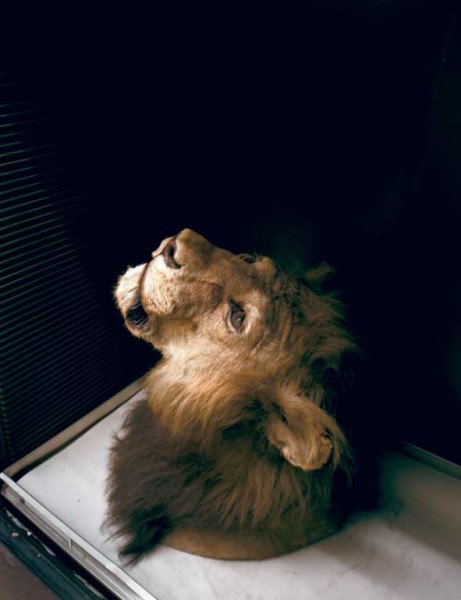
African lion (Panthera leo); label – no data attached. Photo by Justine Cooper.
Well-known science journalist and blogger (The Loom) Carl Zimmer has written a remarkable little contribution to Seed Magazine about visiting the “hidden side of natural history museums, where the unfathomably vast collections of scientific specimens are kept.”
His article begins:
A natural history museum is really two museums, and when you’re in one of them, you can hardly imagine the other. I don’t know how many times I’ve wandered around the halls of the American Museum of Natural History, among the armored fish and the stegosaurs. But it wasn’t until I was a 26-year-old science writer that I had the chance to pass through to the other side. I wanted to learn about pterosaurs, those stork-faced, bat-bodied reptiles that soared for 150 million years. I found out about a Brazilian man named Alexander Kellner who was getting his Ph.D. at the museum, studying new fossils of pterosaurs from the Santana Formation. Kellner invited me to the museum, to take a look at the bones and talk about his ideas about what pterosaurs had actually been like in life.
You can continue reading his insights at “The Awe of Natural History Collections.”
It has been paired with the beautiful, amazing, and outstanding slideshow by Justine Cooper, entitled “Saved by Science.” Be certain to turn the sound up, and listen to Justine Cooper’s wonderful hypnotic voice as she takes you with her during her behind-the-scenes photographic trek through the American Museum of Natural History.
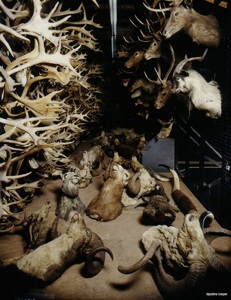
Photo by Justine Cooper.
Cooper was earlier profiled in 2005 by Boing Boing buddy David Pescovitz here. It is good to see her slideshow put to excellent use again. The Zimmer piece and Cooper slideshow are nice frames surrounding the specialness of the “other” AMNH.
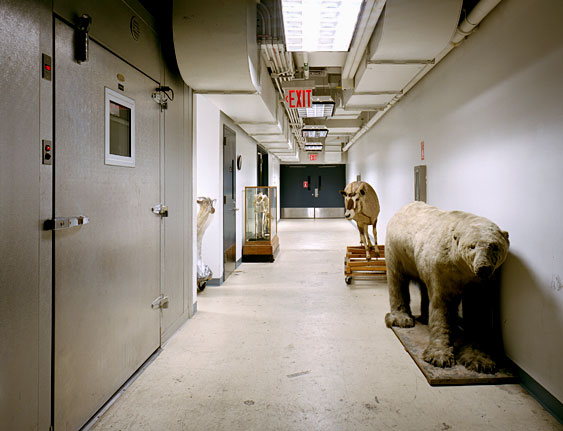
Photo credit: Justine Cooper
I have a special love for the AMNH, for it was the first stop I made when I visited New York City for the first time. I enjoy the fact years later, in December 2007, I was able to give the first lecture there, for their Mythic Creatures exhibition, entitled, “Introduction to Cryptozoology.”
Long ago, I once got to visit a back room at the AMNH, where they were working on cleaning and re-working a Tyrannosaurus rex skull, for a new exhibition. That “second museum” does have an entirely different feel to it than the static exhibitions, which, of course, I like deeply too.
Treasures and life do exist in museums.
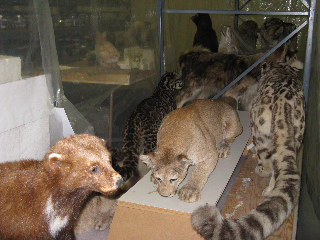
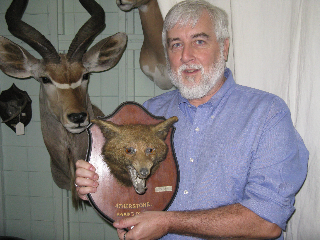
Last summer I wrote about my similar sense of this wonder here in “Secrets of Room N008,” where I talked about my tour of the back rooms of the Royal Alberta Museum (images above and below), when I was hosted by Education director Chris Robinson and museum director Bruce McGillivray. It truly is another world.
Thanks to all who still remember the need continues for the Save The Museum fund.
Donations via PayPal to
LColeman@maine.rr.com
or snail mailed to
Loren Coleman/International Cryptozoology Museum
PO Box 360,
Portland, ME 04112, USA
are appreciated.
 About Loren Coleman
Loren Coleman is one of the world’s leading cryptozoologists, some say “the” leading living cryptozoologist. Certainly, he is acknowledged as the current living American researcher and writer who has most popularized cryptozoology in the late 20th and early 21st centuries.
Starting his fieldwork and investigations in 1960, after traveling and trekking extensively in pursuit of cryptozoological mysteries, Coleman began writing to share his experiences in 1969. An honorary member of Ivan T. Sanderson’s Society for the Investigation of the Unexplained in the 1970s, Coleman has been bestowed with similar honorary memberships of the North Idaho College Cryptozoology Club in 1983, and in subsequent years, that of the British Columbia Scientific Cryptozoology Club, CryptoSafari International, and other international organizations. He was also a Life Member and Benefactor of the International Society of Cryptozoology (now-defunct).
Loren Coleman’s daily blog, as a member of the Cryptomundo Team, served as an ongoing avenue of communication for the ever-growing body of cryptozoo news from 2005 through 2013. He returned as an infrequent contributor beginning Halloween week of 2015.
Coleman is the founder in 2003, and current director of the International Cryptozoology Museum in Portland, Maine.







My friend works in the entomology department there and last year I had the rare and wonderful experience of taking a private tour after hours through both sides of the museum (after viewing the Mythic Creatures exhibit no less).
We walked through the dinosaurs with the lights dimmed, the place completely empty. It was really haunting.
Then she took me to see the behind the scenes in the insect wing. There were massive sliding cabinets with metal drawers filled with every type of beetle known to man including some dazzling little guys with golden and shimmering shells. There were also some live specimens near her office, including some pretty big spiders.
That’s a great article, and the photos are amazing. Thanks for sharing.
I work in the museum field. Usually less than 5%-10% of the collection is on display at one time in any of the mid to large museums. Potentially some of the best discoveries in natural science remain to be found hidden away in the basements, drawers and vaults of museums. Stuff has been collected, given a catalog number and then forgotten. Sometimes people didn’t know exactly what they were looking at other than something general like “dinosaur femur.” Sometimes no one has seen these things since they were stored away and some collections may have started in the 1850s. Treasure awaits.