
Top Twelve Black Bobcat Hot Spots
Posted by: Loren Coleman on January 14th, 2007
UPDATED: January 14, 2007.
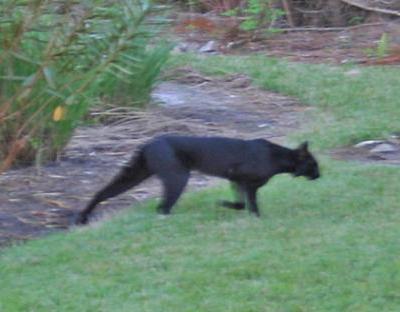
Photograph of a cryptid black felid taken late in 2005 in Florida, by a Georgia professor (credit Ben Willis) that probably is a melanistic bobcat (Lynx rufus floridianus).
Based on one of yesterday’s melanistic bobcat blog comments, here are my promised suggestions for the hot spots to go observe these black felids.
Top Twelve Locations To See Black Bobcats
1-10. South Florida.

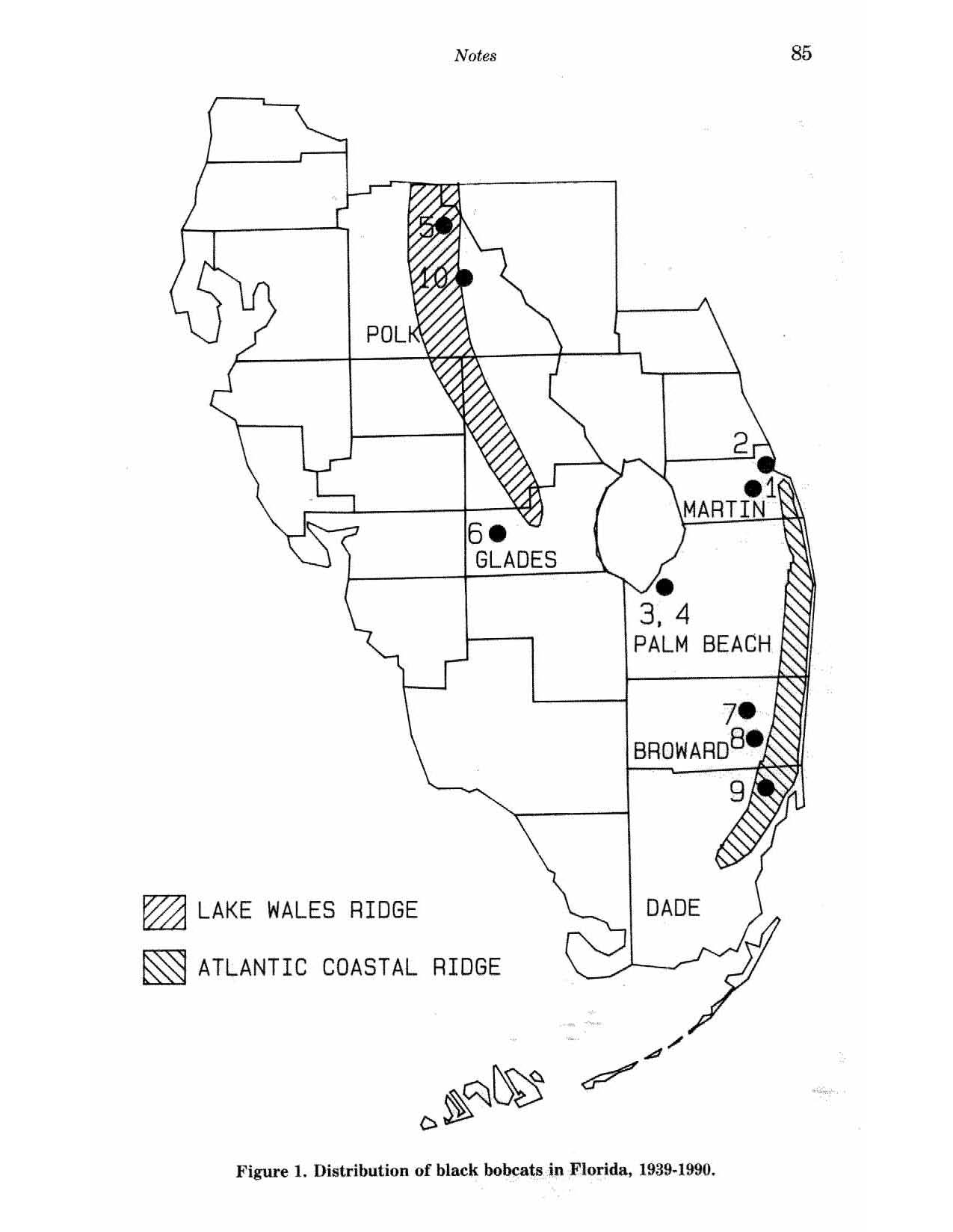
If there’s one place that has produced the most melanistic bobcats, it would be this south central east Florida coast county that lies next to the Okeechobee Swamp region, specifically, Martin County, Florida. Ten black bobcats have been documented in southern Florida, six since 1970. In the early days, most of these were from Martin County.
Update: Here’s more about the mystery photograph (above) from 2005. As noted here, it was taken in Martin County, Florida.

Click on map for full size version
Zoologist Fred A. Ulmer, Jr. wrote "Melanism in the Felidae, with Special Reference to the Genus Lynx" in the Journal of Mammalogy, Vol. 22, No. 3, August 1941, pp. 285-288. Ulmer noted that on April 18, 1939, Vincent Nelson and J. Townsend Sackett live-trapped a black male Florida bobcat (Lynx rufus floridianus) in Martin County, Florida, 14 miles above the mouth of the Loxahatchee River. An experienced trapper, Nelson had not previously seen a melanistic bobcat.
A black bobcat obtained by Sackett for the Zoological Society of Philadelphia was exhibited at their zoo from late April through to August 3, 1939, before it died. Its skin and skull went to the collection of the Acadamy of Natural Sciences of Philadelphia (specimen no 19842).
In January 1940, Nelson live-trapped another melanistic female bobcat in the same region. Famed herper Raymond L. Ditmars obtained the melanistic female for the Bronx Zoo. This one was caught about two miles from where the first specimen was obtained, in swampy jungle close to the confluence of Kitchen Creek and Loxahatchee (or Jupiter) River.
On this specific 1990 map, the locations within southern Florida where melanistic bobcat have been found are noted; source for pdf, here. The numbers 1 and 2 are from 1939-1940 – Martin County.
Click on image for full size version
11. New Brunswick, Canada.
One black bobcat was discovered and taken in New Brunswick in the early 1990s.
12. South Louisiana.
There is a rumored record of a black bobcat being obtained in Louisiana in the 1940s.
^^^^^^^^^^^^^^^^^^^^^^^^^^^^^^^^^^^
Thanks to Ben Willis, Sarah Hartwell, and Bob Pickett for various components of this data.
 About Loren Coleman
Loren Coleman is one of the world’s leading cryptozoologists, some say “the” leading living cryptozoologist. Certainly, he is acknowledged as the current living American researcher and writer who has most popularized cryptozoology in the late 20th and early 21st centuries.
Starting his fieldwork and investigations in 1960, after traveling and trekking extensively in pursuit of cryptozoological mysteries, Coleman began writing to share his experiences in 1969. An honorary member of Ivan T. Sanderson’s Society for the Investigation of the Unexplained in the 1970s, Coleman has been bestowed with similar honorary memberships of the North Idaho College Cryptozoology Club in 1983, and in subsequent years, that of the British Columbia Scientific Cryptozoology Club, CryptoSafari International, and other international organizations. He was also a Life Member and Benefactor of the International Society of Cryptozoology (now-defunct).
Loren Coleman’s daily blog, as a member of the Cryptomundo Team, served as an ongoing avenue of communication for the ever-growing body of cryptozoo news from 2005 through 2013. He returned as an infrequent contributor beginning Halloween week of 2015.
Coleman is the founder in 2003, and current director of the International Cryptozoology Museum in Portland, Maine.










Interesting. I did not know about the New Brunswick specimen.
Thanks Loren, I think there may be more out there.
Wow, and I thought my cat was weird looking!
Waupaca County, Wisconsin. Sightings of a large black “panther” for years – even a few rather good photos, not to mention secondary evidence such as dead pets and ripped up chicken coops, etc. Seems to have quieted down in the past 5 years or so, however. But was big news throughout the late 80s and 90s.
LarryKat, sorry, nope, this is not a list of “black panther” locations (which would be a good exercise and I’ve made some of those elsewhere). This list, however, is an attempt at listing all the known and verified locations where black bobcat have been discovered.
Anyone know of any of black bobcat sites, anywhere? Any living black bobcat examples in captivity?
This January 14th updated version now notes the specific best dozen locations to go find these melanistic felids.
Now I am convinced that many of the black panther sightings are these bobcats.
Funny how these beautiful creatures were overlooked all these years. How long did that one guy say he’s been studying them (past blog)? Is there a reason they aren’t readily known to the general public? I can understand some of the large cat reports we have been hearing lately. The officials told a lie to get people to move into the area and now would have to eat crow if the truth were to come out, or they really were wiped out and others have taken their places, but once again to admit that would be humiliating to the officials. Does someone just not want to admit we haven’t found all the animals on planet earth?
I never know they was so rare or I would have talked about them before this. I have lived in Martin county and St Lucie county (the county north of Martin) most of my life and have seen a couple of Black Bobcats over the years. A friend of mine even killed one when we was in high school (hit it with his truck one night).
I even seen what I would call a cross between a bobcat and panther one time. My father in law and I was going fishing one morning about 15 or so years ago when it ran across the road in front of us just at dawn. This happened on Walton road that runs through part of the savannas. Here is a link to the park there so you know what it is.
I have seen panthers in there even when “officially” they are not there. Plus I know of one that was shot by a guy there back in maybe 1974 or 1975 not sure it has been so long ago.
The state also says that Bear are not around here yet I know of at least 2 that have been killed (one shot and one hit by a car) in Martin county and have heard many tales of them in St. Lucie as well over the years.
We live next to the Cypress Creek wellfield in Pasco County. It is west of sites 5 and 10 in Polk County on the map.
Yesterday my son saw a black bobcat standing approx 25 yards away at the edge of the woods on a small hill he uses to jump his bike.
He came in and told me about a black panther with pointy ears and a funny tail that looked at him for about 30 seconds then walked back into the woods. I asked if it could have been a large regular cat, as we have seen strays before. He said no, this one was MUCH bigger.
So I came to this sight and bingo! I showed him the latest picture of the black bobcat you have posted and he agreed he had seen the same thing.
The Cypress Creek wellfield is the southern dead end of a series of large pastures, wellfields and conservation areas that are slowly being connected by “wildlife freeways”. These go north and east connecting into the huge Withlacoochee Forest area and the Green Swamp.
I’ve sighted what looks to be a black bobcat here in southern Oregon on Wednesday, March 11, 2009.
I could hardly believe it and thought I might have been seeing some other kind of creature, but it looked just like a bobcat, only black. Never heard of a black bobcat, so I’ve been inquiring around and haven’t come across any thing until this site on the internet. Anybody else seen black bobcats in this part of the country?
Just spotted one on my front porch this evening around 6pm.
AMAZING is all I can say. Never thought in my wildest dreams that I would ever see one here. (Port St Lucie, Florida).
SO COOL>>>
I have seen one of these back in 2005 or 2006 they are big one was sitting in my lawn when we drove by it, it didnt even flinch it sat in the same spot for about and hour which was wierd, it always puzzled what it was until i read this article im in charlotte county