
New “Lion” Sighting in Tennessee
Posted by: Loren Coleman on October 23rd, 2007
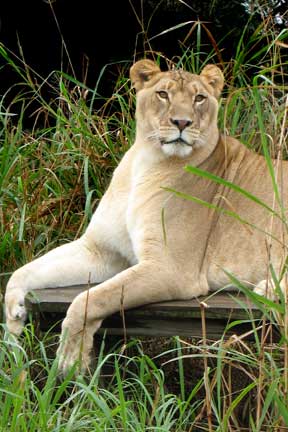
Adult female lion at Big Cat Rescue in Florida.
I have just been contacted by an eyewitness, DJCB, regarding a new mystery cat sighting.
On Friday, October 19, 2007, the witness saw a “female lion” on the shoulder of the northbound side of I-65 approximately .5 miles north of exit 98 (10 miles north of Nashville, Tennessee). As DJCB drove south, the large cat stood watching cars zoom by on the highway.
The eyewitness described what happened next:
I debated on whether or not to call local authorities. Three hours later, I called the TN Wildlife office. As expected, the officer handling my call spoke to me like I was the village idiot. I have zero doubt that the animal was a lion.DJCB
Anyone else hear of any new mystery cat activity from Tennessee?
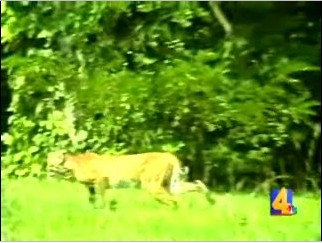
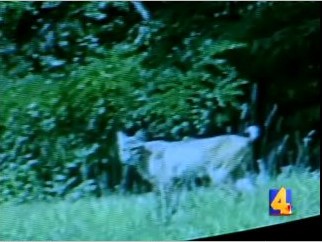
If you will recall, eleven months ago, back on November 19, 2006, I wrote about the sightings and then videotape of a large short-tailed cat seen in Nashville, Tennessee. Speculations covered caracal, lynx, and bobcat.
The two images below are from the video taken of the Tennessee Mystery Cat[link may be dead now]:
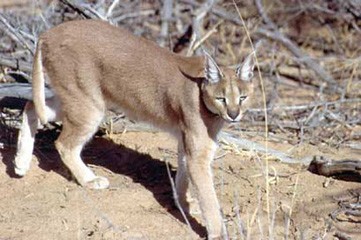
For comparative purposes, below is a photograph of a caracal, which could appear to be a mountain lion or female African lion from a distance (if the tail is not seen).
 About Loren Coleman
Loren Coleman is one of the world’s leading cryptozoologists, some say “the” leading living cryptozoologist. Certainly, he is acknowledged as the current living American researcher and writer who has most popularized cryptozoology in the late 20th and early 21st centuries.
Starting his fieldwork and investigations in 1960, after traveling and trekking extensively in pursuit of cryptozoological mysteries, Coleman began writing to share his experiences in 1969. An honorary member of Ivan T. Sanderson’s Society for the Investigation of the Unexplained in the 1970s, Coleman has been bestowed with similar honorary memberships of the North Idaho College Cryptozoology Club in 1983, and in subsequent years, that of the British Columbia Scientific Cryptozoology Club, CryptoSafari International, and other international organizations. He was also a Life Member and Benefactor of the International Society of Cryptozoology (now-defunct).
Loren Coleman’s daily blog, as a member of the Cryptomundo Team, served as an ongoing avenue of communication for the ever-growing body of cryptozoo news from 2005 through 2013. He returned as an infrequent contributor beginning Halloween week of 2015.
Coleman is the founder in 2003, and current director of the International Cryptozoology Museum in Portland, Maine.









It’s a bobcat.
more than likely….
definitely a bobcat. I see them all the time around here. the head is too big to be the caracal, not to mention I think the tail is totally different. The caracal’s tail is almost touching the ground. The 2 pics above the tail is shorter.
I agree that the bottom stills taken from the film resemble a carcal. I wonder if DJCB traveling down the freeway may have mistaken one of these for a “lion”. Interesting story!
looks like a lynx.. or a Puma/Lynx hybrid.. ??
Without question this is a bobcat. The tail is a dead giveaway. I live in Louisiana and they’re all over the woods down here. They can get as long as four feet, which isn’t small. I don’t doubt the sincerity of the witness, but it’s simply a bobcat.
They have wildly varying coat patterns that range from plain dark brown to highly stylized spot patterns that look like a leopard, so if it was a bigger example of the species with a very light pattern, there might be some confusion, but when it doubt look at the tail.
No ways a lynx (caracal, same species, lynx being the incorrect name given, know in South Africa as the Rooikat or translated the red cat) forequaters are to muscular, lynx have much smaller forequaters and this animal is far more muscular than any lynx I have seen. Lynx are slim due the amount jumping they do after birds in flight.
Caracal (lynx) are active mainly at night and early evenings and are almost never seen during the day, particularly in areas which have constant traffic and humans walking around. I have them living around our house on the game farm and they regularly take our small domestic and farm animals, you might be lucky to see them at night under spot lights (usually a red beam spot light). I have only been very lucky to see one during the early evening after a number of years living on a game farm. They are extremely secretive.
You cannot at any distance confuse a lynx for a lion (any lion), no matter what distance is involved, a lynx stands up to 46inches (and thats a big one) at the shoulder, is far less muscular and has white on its belly and chest and is far more “red” in colour, they would stand tall under a lions belly and the black ear tufts are a dead give away. Lynx are mainly found in rocky or mountainous areas where they lay up during the day in crevices etc. Use this link to read about them, http://www.krugerpark.co.za/africa_caracal.html. They make good pets till they are about a year old and then become very aggressive and will return to the bush on thier own, particularly males.
No they dont taste good either.
Looks a bit too large for the bobcats in that area.
Kolobe- Excellent information on lynxes! As for the last part of your comment about keeping these types of animals as pets, it pretty much stands true for most wild animals. When kept as pets, we tend to anthropomorphize them and think that they are our buddies, but what we fail to understand is that in the case of big cats, they are PREDATORS. They were born to hunt. They have not been domesticated and selectively bred for generations like house cats and dogs have been and therefore have strong natural instincts that can make them dangerous. Even professional animal trainers have to be careful around their charges as I’m sure Sigfried and Roy will attest to.
They don’t even have to be large predators to be dangerous. I once kept an orphaned baby raccoon as a pet, nursed it all the way to adulthood. As it got older, it got more and more vicious towards being handled until it was no longer safe as a pet. This can sometimes cause the problem of people releasing their pets into the wild, although I would hope that no one would do that with a pet lion!
Bobcats can get much bigger than most people think. Up to four feet long and up to a foot-and-a-half tall at the head (yes, their height is measured at the shoulder, but someone dirving down the road isn’t going to be looking at that, especially if the head is up and looking around).
Granted, such a bobcat would be a very large one, but not unprecedented.
I live in middle TN and drive along I-65 all week long. I have not heard of this particular sighting until now. I have had stories told to me about sightings in other parts of the state, so it is definetely some strange animals in my state.
Actually, caracals are no longer considered to be lynxes, nor to be within the lynx lineage. Instead they are classified in the African Golden Cat lineage, and the similarity to lynxes is probably due to both species having evolved for lightning speed and power when jumping to catch their respective prey.
Don’t forget those beautiful tufted ears on caracal and lynx, which are two wonderful examples of similar evolutionary solutions for the need to pick up sounds in the deserts of the sands and snows.
Hey, I Googled the wild cats to try and figure out what I saw running across the road here in Kentucky (we are about 30 miles north of the Tennessee border)… this is how I ended up here and what I saw has the tufted tail like the “mystery cat” photos. The tail is white underneath. The ears looked like rounded cub ears. The bobcat and lynx baby photos I looked at all had the stumpy tail (not sticking up like the photo here). My husband think I’m nuts too, as I also saw a bear cub not too long ago and he told me it must have been a dog. Turns out the bear lives in a cave near the lake.
Also as Drew S mentioned this kitten was a plain dark brown (no spots of any kind)
I have seen this big cat yesterday. I’m sure of it. Not a bob cat, but a caracal. The head had an egyptian look and the body long and sleek, color greyish and tan, black tufts on the ears and the short tail kind of curling up with a little black on the edges. Beautiful looking animal. It probably weighed 30-40 lbs. It’s coat was smooth and sleek and not furry like a bobcat. It could be another one, but they’re so rare. Anyway no one is interested in my story, but I thought maybe you would be. Oh yeah I live in Cane Ridge, TN about 15 miles SE of Nashville.
Oh my gosh! Alisa Fillmore, I live in Cane Ridge too, and was driving north on Edmondson Pike between Concord Rd. and Holt Rd. yesterday, May 20, and I saw this very same animal. It ran across the road several yards in front of my car. I did different searches online trying to identify the cat, and finally came across this page and your post. From the brief reading I did, it seems that caracals can actually be kept as pets?! So perhaps this was once someone’s pet in this area?
Hi midtnteach. Wow I just found your message and I’m so glad to hear you saw it, too. I called the TWA and they weren’t really interested, said it was probably a bobcat. I actually just stopped telling people about it, because I could tell they didn’t believe me. Oh well, it was something I’ll never forget and like my brother said most people go a lifetime without seeing a rare and beautiful creature like that. Take care
We were going down McGavock Pike off Murfreesboro Road tonight heading toward Harding Pike when a large wild cat crossed in front of us and paused before going into the bushes. I was so shocked I could hardly speak! My husband saw it too. It was very spotted, had the rounded ‘cub’ ears, and a tail too long to be a bobcat. It was much larger than a housecat, but not as large as a puma. Besides, it was quite spotted. What could it be?
That is a truly nice picture of an adult bobcat, I’m guessing around thirty five pounds or so. However rest assured there are a few mtn. lions here in our lovely state of TN. I’m an avid outdoorsman with over thirty five years in the woods and mtn’s and I have been blessed in seeing the cats on two occasions. I mean the big cats. Both were around seven feet long including the tail, and weighed in around one hundred and forty to sixty pounds. My gut tells me that on one of these faithful meetings I was actually being stalked by the big boy. I have taken somewhere around forty bobcats and over a hundred coyotes on my predator hunts. I also reported my first black bear over twenty years ago so believe me, there is no mistaken idents here. The ironic thing is, fish and wildlife agents laughed at me twenty years ago when I reported the bear. A truck struck and killed the old boy two weeks later a quarter mile from the location I gave them. Now we have lots of the big bears here in campbell co. Make no mistake you will soon hear more about the big cats in Tn. Ps. Both cats were rusty sable and sported a three by three track. I have friends who have seen tracks and one other sighting in the same general area around the cumberland mtn. and these folks know what is and what is not out there as well as I. Thanks for your time and your site.