
1st Complete Thylacoleo Found
Posted by: Loren Coleman on February 5th, 2007
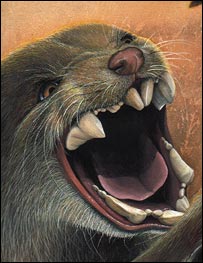
Thylacoleo carnifex
The January 25, 2007, issue of Nature announced the first analysis of a treasure trove of fossils unearthed in southern Australian underground caves in the Nullarbor plains.
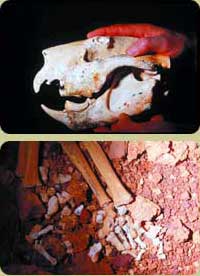
Hundreds of fossils were extremely well preserved, from the the middle Pleistocene (200,000 and 800,000 years ago).
They constitute a veritable Rosetta stone for ice age Australia. We discovered 69 species of mammals, birds and reptiles, including a remarkable eight new species of kangaroo, the most common of which sported unusually large brow ridges. – Palaeontogist Gavin Prideaux
Western Australia Museum
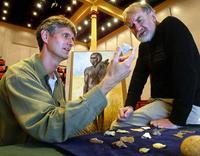
Bert Robert, on left, Mike Morwood, right.
The most impressive find was the first complete skeleton of the marsupial lion, Thylacoleo carnifex. Dr. Bert Roberts, who was involved in the analysis of Thylacoleo, was also one of the main members of the team behind the announcement of the discovery of the Flores woman, Homo floresiensis, the Hobbits.
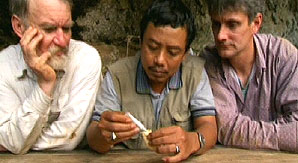
Mike Morwood, Thomas Sutikna and Bert Roberts.
We didn’t have a complete skeleton of that animal [Thylacoleo carnifex] at all until we made that discovery; now we have dozens. – Bert Roberts
University of Wollongong
Within cryptozoology, a surviving species of Thylacoleo is postulated by some Australian cryptozoologists as the candidate mostly likely to succeed in explaining the reports of the cryptid Queensland tiger.
 About Loren Coleman
Loren Coleman is one of the world’s leading cryptozoologists, some say “the” leading living cryptozoologist. Certainly, he is acknowledged as the current living American researcher and writer who has most popularized cryptozoology in the late 20th and early 21st centuries.
Starting his fieldwork and investigations in 1960, after traveling and trekking extensively in pursuit of cryptozoological mysteries, Coleman began writing to share his experiences in 1969. An honorary member of Ivan T. Sanderson’s Society for the Investigation of the Unexplained in the 1970s, Coleman has been bestowed with similar honorary memberships of the North Idaho College Cryptozoology Club in 1983, and in subsequent years, that of the British Columbia Scientific Cryptozoology Club, CryptoSafari International, and other international organizations. He was also a Life Member and Benefactor of the International Society of Cryptozoology (now-defunct).
Loren Coleman’s daily blog, as a member of the Cryptomundo Team, served as an ongoing avenue of communication for the ever-growing body of cryptozoo news from 2005 through 2013. He returned as an infrequent contributor beginning Halloween week of 2015.
Coleman is the founder in 2003, and current director of the International Cryptozoology Museum in Portland, Maine.







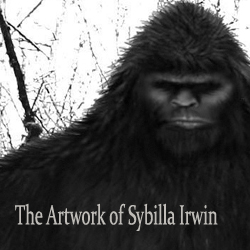



Heavy brow ridges?
Have they discovered Neanderthylacoleo?
Nice story Loren. I like the gang at thylacoleo.com – especially the forums – where they discuss possible current sightings of this animal.
By the way – that top drawing looks surprisingly similar to the famous “JAWS” photo from some years back.
Here’s the link: http://www.thylacoleo.com/desertcats/jaws/jaws01.html
Blue Steel
Neanderkangaroo actually 😀
Thylacoleo, thylacoleo, wherefore art thou thylacoleo?
Chris.
I still await the marsupial Yowie.
Note to self:
Next time I see a female Yowie:-
Ask if said Yowies has a pouch?
There, that aught to do it.
Interesting. It gives more fuel to the possibility that the big cat sightings could be due to a thought to be extinct native species. But native aborigines do not have a history of sighting this animal as far as I know so that is definately something to consider as well. If the modern Queensland tiger or big cat sightings are this Thylacoleo, then where has it been hiding for so long?
Very nice, but I still hope that finally somebody discovers a complete skeleton of Megalania.