
Happy Birthday, Jules Verne: A Visit With Your Terror Birds
Posted by: Loren Coleman on February 8th, 2011

Today, February 8th, is Jules Verne’s birthday. Let’s celebrate the kind of birds he would have loved, as have appeared in a movie adapted from one of his novels.

Even Google is acknowledging Verne’s birth, with an interactive logo for one day.
Jules Gabriel Verne (February 8, 1828 – March 24, 1905) was a French author from Brittany who pioneered the science-fiction genre. He is best known for novels such as Twenty Thousand Leagues Under the Sea (1870), A Journey to the Center of the Earth (1864), and Around the World in Eighty Days (1873).
The Mysterious Island (French: L’Île mystérieuse) is a novel by Jules Verne, published in 1874. The original edition, published by Hetzel, contains a number of illustrations by Jules Férat. The novel is a sequel to Verne’s famous Twenty Thousand Leagues Under the Sea and In Search of the Castaways, though thematically it is vastly different from those books.
The book tells the adventures of five Americans on an uncharted island in the South Pacific. The story begins in the American Civil War, during the siege of Richmond, Virginia, the capital of the Confederate States of America. As famine and death ravage the city, five northern prisoners of war decide to escape by the unusual means of hijacking a balloon.
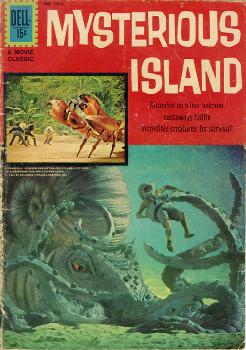
Classics Illustrated’s Mysterious Island
To some extent, the story is based on fact.
The 2003 edition of Wrecked on A Reef (in English) by F. Raynal, has additional appendices by French scholar Dr. Christiane Mortelier who presents a convincing case for the influence of Francis Raynal’s 19th century publication “Wrecked On A Reef” (originally published in French as “Les Naufrages des Iles Auckland”) on Verne’s Mysterious Island. Verne read Raynal’s account of the wreck of the Grafton (Captain Musgrave) on the subantarctic Auckland Islands and loosely based his story on this true account of shipwreck, survival, privation, and ultimate rescue. The Grafton was wrecked in the Auckland Islands on 3 January 1864. The crew of five (including Musgrave) survived for 19 months before three of them sailed to Stewart Island (New Zealand) in a boat they had made. The remaining two were rescued. Verne incorporated much of this historical material into his Mysterious Island narrative.
The later adaptions added all kinds of wonderful cryptofiction elements. For example, the film from 1961 has a mysterious volcanic island populated by a pair of shipwrecked women, giant crabs, giant bees, prehistoric terror birds and pirates. Rescuing the heroes and heroines from this plot enters none other than Captain Nemo.
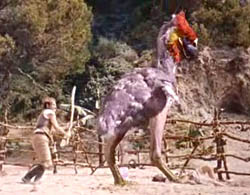
But seriously, do we all have to rethink our visions of the prehistoric world as shown in the 1961 movie, Mysterious Island, based on the Jules Verne story, which had Terror Birds and humans battling? If you haven’t seen it, you should, or better yet, read the book (especially the one translated by Sidney Kravitz – 14 years in the making – with the original 19th century art).
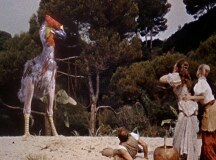
The movie Mysterious Island is a classic cryptofiction story about a group of Union soldiers escaping from their Civil War prison via balloon, and landing on a remote island filled with prehistoric survivors, including memorable giant birds that terrorize the humans. (There was a remake made in 2005, starring Kyle MacLachlan, but I’m talking about the 1961 movie.)
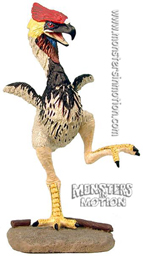
A model (above) of the Mysterious Island’s Terror Bird (using the earlier spelling Phororhacos) from MonstersInMotion.com.
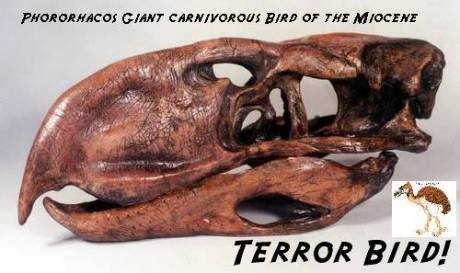
The skull (above) of the Terror Bird is one of the items on my wish list for the International Cryptozoology Museum.
{We need a $500 grant to obtain this skull. Can you donate a little, below, to the cause?}
Thank you!!
The BBC News published a news item in 2007 on another giant bird species, also one of these so-called Terror Birds. As the article mentioned: “Early humans could never have come into contact with the giant carnivorous ‘terror bird’ Titanis walleri, research suggests. It had been thought the fearsome beasts became extinct as little as 10,000 years ago – a time when humans shared their North American habitat. But a US team has now revised this date to about two million years earlier.”
Coming up with an earlier date, however, has shattered the notion that the bird walked across a land bridge from South America to North America when they became connected by the Panamanian land bridge about 3.5 million years ago, according to Professor Bruce MacFadden, a palaeontologist at the Florida Museum of Natural History and lead author of the Geology paper on the findings.
But based on the new chemical dates that we have established, that previous hypothesis is no longer correct. What we now believe, based on the age of the Titanis from Texas, is that Titanis dispersed from South America into North America about five million years ago, significantly earlier than the land bridge formed. Did it swim across? Or did it raft across on a float? There were a series of closely spaced volcanic islands, which now forms Panama, so maybe it swam from one to the other – but we really don’t know. Professor Bruce MacFadden
See the full article here.
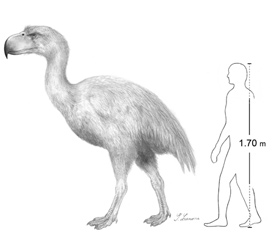
An illustration shows the size of a large terror-bird species compared to that of an average-size man. The extinct group of predatory, flightless birds dominated South America from 65 million to 2.5 million years ago. The largest known terror-bird species grew nearly 10 feet (3 meters) tall and weighed 1,100 pounds (500 kilograms).
Illustration by Gustavo Lecuona
The “Terror Bird”Phorusrhacos was a genus of giant flightless predatory birds that lived in Patagonia, containing the single species P. longissimus, living during the mid-Miocene.
So, therefore, we now know it is doubtful humans and Terror Birds ever lived at the same time. Titanis walleri, the only member of its genus, lived approximately two million years ago in North America, found thusfar from fossils in Florida and Texas.
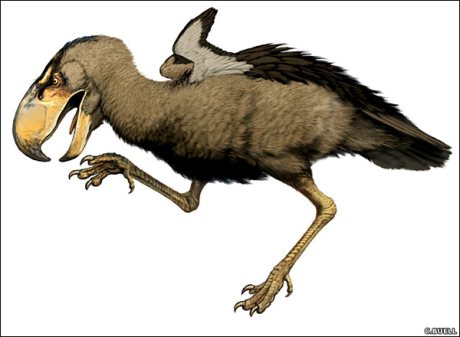
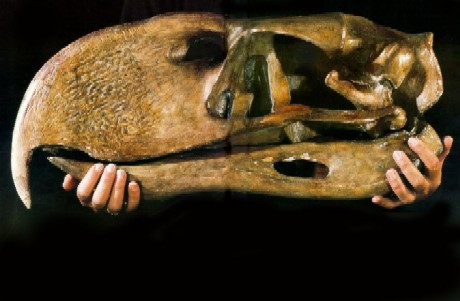
It was thought that the species did not become extinct until 15,000 years ago, but with this more precise dating by McFadden, it seems that Titanis became extinct at least 2 million years ago. Titanis was part of the group of giant flightless birds called Phorusrhacidae, which are nicknamed “terror birds,” and represents the youngest species of the lineage.
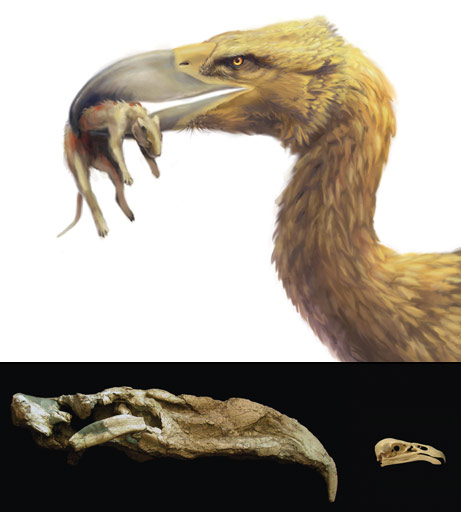
An artist’s rendering of the 2003 discovered new species of phorusrhacid, or terror bird, shows the massive creature’s sharp, curving beak. A high school student unearthed the ancient remains of the new species in the Patagonia region of Argentina. The fossil skull of the new specimen ~ the largest bird the world has ever seen ~ is viewed in the bottom photo alongside a modern California condor skull, is 2.3 feet (almost a meter) long and represents the largest bird skull ever found.
Skulls photograph by S. Bertelli, illustration by S. Abramowicz.
 About Loren Coleman
Loren Coleman is one of the world’s leading cryptozoologists, some say “the” leading living cryptozoologist. Certainly, he is acknowledged as the current living American researcher and writer who has most popularized cryptozoology in the late 20th and early 21st centuries.
Starting his fieldwork and investigations in 1960, after traveling and trekking extensively in pursuit of cryptozoological mysteries, Coleman began writing to share his experiences in 1969. An honorary member of Ivan T. Sanderson’s Society for the Investigation of the Unexplained in the 1970s, Coleman has been bestowed with similar honorary memberships of the North Idaho College Cryptozoology Club in 1983, and in subsequent years, that of the British Columbia Scientific Cryptozoology Club, CryptoSafari International, and other international organizations. He was also a Life Member and Benefactor of the International Society of Cryptozoology (now-defunct).
Loren Coleman’s daily blog, as a member of the Cryptomundo Team, served as an ongoing avenue of communication for the ever-growing body of cryptozoo news from 2005 through 2013. He returned as an infrequent contributor beginning Halloween week of 2015.
Coleman is the founder in 2003, and current director of the International Cryptozoology Museum in Portland, Maine.









The 2003 specimen may be the largest skull, but I think the largest bird ever still goes to the Aepyornis (at least for overall mass – Dinornis was taller, but most likely slimmer).