
Thylacoleo carnifex: Super-Predator
Posted by: Loren Coleman on May 6th, 2008
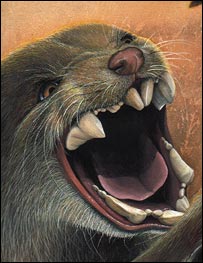
Thylacoleo carnifex
A sabre-toothed cat that sported the fearsome teeth of felines also had the body and gait of a bear, making it a “super-predator”.
So says a team led by Stephen Wroe at the University of New South Wales, Sydney, Australia, which found that the ferocious marsupial lion (Thylacoleo carnifex) shared the same super-predator body plan as Smilodon fatalis, North America’s ice age sabre-tooth cat.
Wroe and his team compared the skulls, teeth and body proportions of seven extinct mammalian predators with those of 22 living species, in a bid to better understand how the extinct animals behaved.
They found that five of the extinct species fell reasonably neatly into known predator groups. Two sabre-toothed cats sit well with modern- day felines, for instance, leading the team to conclude that they probably occupied a similar ecological niche. Smilodon and Thylacoleo didn’t fit into any group but they did have a lot in common.
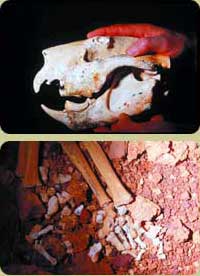
Both had hyper-carnivorous teeth, designed to eat meat and nothing else. Smilodon famously had two massive upper canines, plus vertical, slicing teeth in its cheeks. While Thylacoleo lacked the enormous canines, it did have huge slicing teeth known as carnassials that would have scissored through hide and flesh. While living cats have broadly similar teeth, their bodies are very different. “The marsupial lion and Smilodon were built much more like bears,” Wroe says (Journal of Zoology , DOI: 10.1016/j.zool.2007.07.008).
Unlike cats, both extinct animals walked on the flats of their feet, had relatively short hind limbs and were much heavier, relative to their length. They also had relatively short and robust lower backs. All these features would reduce an animal’s agility but increase its stability. As Wroe says: “If you’re built like a brick shithouse, you’re much more stable but it’s much harder to move around or change direction.”
The combination of hyper-carnivorous teeth and a sturdy, strong body evolved to kill very large, cumbersome prey, the team thinks.
Thylacoleo, which weighed around 100 kilograms, probably killed animals of up to about a tonne, such as juvenile diprotodons, a giant wombat. Smilodon would have feasted on large bison and possibly even immature mammoths.
But while these fearsome predators would have terrorised their neighbourhoods, both were highly vulnerable to environmental change. Smilodon’s extinction, about 11,000 years ago, coincided with climate change and the arrival of people. Thylacoleo vanished about 30,000 years ago, in similar circumstances.
John Long, a palaeontologist at Museum Victoria in Melbourne, Australia, has studied Thylacoleo and says: “This paper provides the first hard mathematical evidence for interpreting the lifestyles and feeding methods of the biggest extinct mammalian predators we have known.”
Source: “Bearlike superpredator terrorised early humans; A sabre-toothed cat may have had the fearsome teeth of felines but it had the body and gait of a bear,” by Emma Young, 3 May 2008, New Scientist 15, volume 198; issue 2654.
 About Loren Coleman
Loren Coleman is one of the world’s leading cryptozoologists, some say “the” leading living cryptozoologist. Certainly, he is acknowledged as the current living American researcher and writer who has most popularized cryptozoology in the late 20th and early 21st centuries.
Starting his fieldwork and investigations in 1960, after traveling and trekking extensively in pursuit of cryptozoological mysteries, Coleman began writing to share his experiences in 1969. An honorary member of Ivan T. Sanderson’s Society for the Investigation of the Unexplained in the 1970s, Coleman has been bestowed with similar honorary memberships of the North Idaho College Cryptozoology Club in 1983, and in subsequent years, that of the British Columbia Scientific Cryptozoology Club, CryptoSafari International, and other international organizations. He was also a Life Member and Benefactor of the International Society of Cryptozoology (now-defunct).
Loren Coleman’s daily blog, as a member of the Cryptomundo Team, served as an ongoing avenue of communication for the ever-growing body of cryptozoo news from 2005 through 2013. He returned as an infrequent contributor beginning Halloween week of 2015.
Coleman is the founder in 2003, and current director of the International Cryptozoology Museum in Portland, Maine.











I find the following statement interesting:
“Both had hyper-carnivorous teeth, designed to eat meat and nothing else.”
I had thought that Thylacoleo was originally thought to be an herbivore based on its teeth; only wear and use-striation patterns characteristic of carnivores changed that view.
Comments?
This was at a very early time, when some paleontologists thaugt it used its teeth to crack nuts. But already Richard Owen recogniced that it was one of the most formidable predators which ever lived. Sabertooth cats as well as Thylacoleonids had a highly reduced set of teeth, with only very few but therefore extremely big molars and premolars which were used to slice through meat. Among modern carnivores big cats like lions or tigers have the most developed carnassial teeth to slice the meat of their usually big prey, but compared to those of Thylacoleo they look small.
I’ve not heard of a vegetarian lifestyle idea. Wroe wrote a few years ago that Thylacoleo had teeth “like bolt cutters” to go with heavily muscled forelimbs like those of a jaguar.
Either way, T. carnifex seems too large to account for the yarri, or Queensland tigercat, reported by George Sharp and others. There were smaller, leopard-size relatives that would have been more adaptable as well as more suited to the descriptions of the tiger-cat (leaving out Rilla Martin’s photo, since I have no idea what that is). Sharp wrote that the skin he examiend belonged to a cat which had stood about 18 inches high in life, though there’s no way to know if that was a full-grown animal.
I agree with MattBille.
This is not like Diego from Ice Age.
Good article.
There was a huge decline in megafauna all throughout the world 11-13.5k years ago. Humans may have finished off the megafauna but they were well on their way to extinction long before humans arrived. If human hunter gatherers are responsible for wiping out the megafauna, why aren’t wild elephants and other large creatures extinct in Africa or Asia? This has always seemed to be the least supportable statement I’ve ever heard from the anti-hunting crowd. Smilodon died out because its prey died out, I suspect Carnifex died out the same way. Both modern lions and tigers are of similar size to most Smilidon species but are much less specialized hunters and survived the mass extinction which killed off megafauna and its predators.
There were very big asynchronous extinctions of megafauna over the world. In Australia nearly all big animals died out about 40.000 years ago, and not about 11-13.000 years ago. This continent was populated some thousand years earlier by humans, and it seems that they burned wide areas of the savanahs and woods which are today desert. North-and South-American megafauna became extinct just shortly after humans colonized this continents, but in South-America several megafauna-animals survived a bit longer. On the West-Indies several megafauna like the various small ground sloth became all just extinct after the population of the islands by humans, with a lot of late holocene extinctions.
The reason why Asia and Africa has remained most of its big animals is most probably because those continents were already populated by early humans and hominids from a very early time on, and the animals could develop their behavior to protect themselves.