
Sri Lanka’s Newest Shrew
Posted by: Loren Coleman on March 28th, 2008
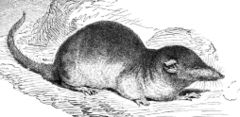
The Greater White-toothed Shrew (Crocidura russula), shown above, is a small shrew found in Europe and North Africa, and related to the species newly discovered.
A new, endemic species of shrew Crocidura hikmiya, has been described from Sri Lanka. The new shrew is presently only known from mid-montane and lowland rainforests of Sinharaja.
This shrew was previously been identified as Ceylon Long-tailed Shrew (Crocidura miya). However the latter species is now believed to be confined to the montane forests of the central hills. The researchers believe that the most frequently encountered shrew in Sinharaja is the new species.
This raises the number of shrews in Sri Lanka to ten of which six are endemic to the island.
The researchers Suyama Meegaskumbura, Madhava Meegaskumbura, Rohan Pethiyagoda, Kelum Manamendra-Arachchi and Christopher J. Schneider published their findings in Zootaxa on 19th December 2007. The paper was titled “Crocidura hikmiya, a new shrew (Mammalia: Soricomorpha: Soricidae) from Sri Lanka.” (Credit: Wildlife Extra.)
Please note, the recent news (see photo below) of the new discovery of the giant elephant-shrew or sengi (Rhynchocyon udzungwensis) issued from Tanzania, Africa.
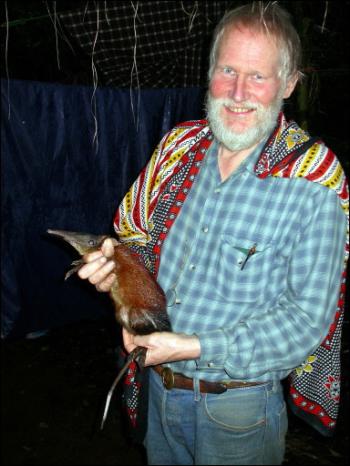
Galen Rathbun with sengi. Photo credit: David Ribble
 About Loren Coleman
Loren Coleman is one of the world’s leading cryptozoologists, some say “the” leading living cryptozoologist. Certainly, he is acknowledged as the current living American researcher and writer who has most popularized cryptozoology in the late 20th and early 21st centuries.
Starting his fieldwork and investigations in 1960, after traveling and trekking extensively in pursuit of cryptozoological mysteries, Coleman began writing to share his experiences in 1969. An honorary member of Ivan T. Sanderson’s Society for the Investigation of the Unexplained in the 1970s, Coleman has been bestowed with similar honorary memberships of the North Idaho College Cryptozoology Club in 1983, and in subsequent years, that of the British Columbia Scientific Cryptozoology Club, CryptoSafari International, and other international organizations. He was also a Life Member and Benefactor of the International Society of Cryptozoology (now-defunct).
Loren Coleman’s daily blog, as a member of the Cryptomundo Team, served as an ongoing avenue of communication for the ever-growing body of cryptozoo news from 2005 through 2013. He returned as an infrequent contributor beginning Halloween week of 2015.
Coleman is the founder in 2003, and current director of the International Cryptozoology Museum in Portland, Maine.











Quote:
“Despite prolonged terrestrial connections to the mainland during successive glacial sea-level lowstands (most recently until 10,000 ybp) the biota of Sri Lanka’s south-western “wet zone” rainforests (rainfall > 2,000 mm per yr) shows evidence of significant and prolonged isolation from both the island’s dry zone and from peninsular India…Most of the island’s endemic taxa are restricted to the wet zone, almost all of which was occupied by rainforests until large-scale clearing for coffee, cinchona and tea plantations in the 19th century.”
From:
Meegaskumbara, S., Meegaskumbara, M., Pethiyagoda, R., Manamendra-Arachchi, K. & Schneider, C.J. 2007. Crocidura kikmiya, a new shrew (Mammalia: Soricomorpha: Soricidae) from Sri Lanka. Zootaxa 1665: 19-30: http://www.mapress.com/zootaxa/
So, the high degree of shrew endemicity (6/10) is just one aspect of it…who knows what else may have been ‘lurking’ in the forests of Sri Lanka up to modern times (before the 19th century forest destruction).