
Spanish Giant Panda Discovery
Posted by: Loren Coleman on May 9th, 2012
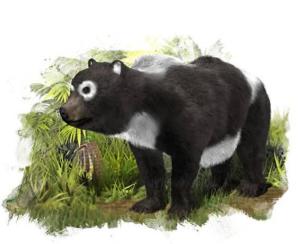
A new Spanish giant panda relative, in fossil form, has been found. See the press release from Alpha Galileo of this surprising discovery, here.
 About Loren Coleman
Loren Coleman is one of the world’s leading cryptozoologists, some say “the” leading living cryptozoologist. Certainly, he is acknowledged as the current living American researcher and writer who has most popularized cryptozoology in the late 20th and early 21st centuries.
Starting his fieldwork and investigations in 1960, after traveling and trekking extensively in pursuit of cryptozoological mysteries, Coleman began writing to share his experiences in 1969. An honorary member of Ivan T. Sanderson’s Society for the Investigation of the Unexplained in the 1970s, Coleman has been bestowed with similar honorary memberships of the North Idaho College Cryptozoology Club in 1983, and in subsequent years, that of the British Columbia Scientific Cryptozoology Club, CryptoSafari International, and other international organizations. He was also a Life Member and Benefactor of the International Society of Cryptozoology (now-defunct).
Loren Coleman’s daily blog, as a member of the Cryptomundo Team, served as an ongoing avenue of communication for the ever-growing body of cryptozoo news from 2005 through 2013. He returned as an infrequent contributor beginning Halloween week of 2015.
Coleman is the founder in 2003, and current director of the International Cryptozoology Museum in Portland, Maine.











And there it is: proof positive that if one wants to find the giant panda in the bamboo forests of Spain, one only need look.
Red pandas in Tennessee: same thing. Fossils say they’re there.
Sorry. I just like to turn one of my favorite sasquatch-denier shibboleths around and use it on them.
The take-home: If you have something alive today that can leave fossil remains, you will maybe find such remains of its ancestors someday, somewhere. No telling where.
And if there is anything in the fossil record, from anywhere, the case for the plausibility of a living descendant has been made. We may just not have found it yet.
Can’t wait to find out the rationale for the reverse coloration.
The Land of Spain: Home of The Armada, Don Quixote, Conquistadors, and Dwarf prehistoric Pandas. Who would have thought?
Question: has there ever been sightings of tiny bears or Pandas (out of place animal phenomenon) in Spain?
Actually, there are bamboo forests in Tennessee. They are called “cane breaks”.
No red pandas. Just raccoons and possums.
That is a good point brought up by Desertdweller. Yes, currently there are “bamboo forests” in Tennessee called “cane breaks.”
However, the statement “no red pandas” misses DWA’s point.
The posting above is about a panda relative being found in Spain, in fossil form.
DWA wrote: “Red pandas in Tennessee: same thing. Fossils say they’re there.”
As DWA must have recalled, I exclusively released the news in August 2010, on Cryptomundo of the discovery of the first fossil red pandas (Pristinailurus bristoli) being found in eastern North America, at the Gray Fossil Site in Tennessee, here and here. The skull was dated to the Miocene, 4.5 million years ago.
The first fossil red panda found in North America was located in 1977, based on an upper right first molar aged 3-4 millions (early Blancan of Pliocene) in Taunton Local Fauna of the Ringold Formation (Washington state).
Hapa:
Actually, Spain retains a small population of brown bears (Ursus arctos).
I found this Spanish brown bear link. Can’t totally vouch for it but it rings accurate.
DWA:
Yeah I forgot those. I meant other than Brown bears (Spanish Brown bears are not very big, but the new Spanish Panda-like bear is supposed to be smaller than the Sun Bear, the smallest in the world (largest Sun Bears get about 145 lbs, while the Spanish “Panda”, if you will, only theoretically gets up to 60 kilos, or over 130 lbs.).
Thanks for the links 🙂