
Runaway Bay’s “Chupacabra”: Dead Procyonid
Posted by: Loren Coleman on January 20th, 2010
[Updated from January 18 to January 20. See comment section below for link to confirming new verdict as to the id of this specimen.]
I find no malice in the guys that posted the video, but just honest curiosity. However, what has become of their questions is well on its way to joining the usual media “Chupa” circus.
Sorry but this is another Texas “chupacabra” that translates into, not the traditional spike-haired, bipedal Puerto Rican Chupacabras, but, instead, another American misidentified canid. Or, apparently in this case, a dead procyonid.
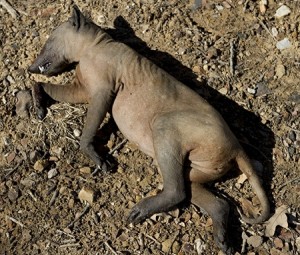
While this popped up on YouTube, it is the World Weekly News that has decided to get behind it. Please, consider the source.
 About Loren Coleman
Loren Coleman is one of the world’s leading cryptozoologists, some say “the” leading living cryptozoologist. Certainly, he is acknowledged as the current living American researcher and writer who has most popularized cryptozoology in the late 20th and early 21st centuries.
Starting his fieldwork and investigations in 1960, after traveling and trekking extensively in pursuit of cryptozoological mysteries, Coleman began writing to share his experiences in 1969. An honorary member of Ivan T. Sanderson’s Society for the Investigation of the Unexplained in the 1970s, Coleman has been bestowed with similar honorary memberships of the North Idaho College Cryptozoology Club in 1983, and in subsequent years, that of the British Columbia Scientific Cryptozoology Club, CryptoSafari International, and other international organizations. He was also a Life Member and Benefactor of the International Society of Cryptozoology (now-defunct).
Loren Coleman’s daily blog, as a member of the Cryptomundo Team, served as an ongoing avenue of communication for the ever-growing body of cryptozoo news from 2005 through 2013. He returned as an infrequent contributor beginning Halloween week of 2015.
Coleman is the founder in 2003, and current director of the International Cryptozoology Museum in Portland, Maine.










While I do not believe that these animals are chupacabras I do believe we in the Cryptozoological world should take them more seriously. Firstly, one of the versions of the chupacabra resembles a dog, which indicates that sightings of these coydogs are included in the study of this cryptid. We need to better understand this animal’s behavior and territory to better classify true chupacabra sightings. Secondly, yes, they are coydogs (not unusual), but the consistency of their unique appearance seems to suggest the possibility of these animals being a separate breed. This would indicate a new feral breed, created in the wild, unseen for perhaps decades (if certain eye-witnesses are to be believed), with a known range from southern Texas/northern Mexico to Virginia. We can use this creature’s behavior to better understand how other cryptids remain hidden in our modern world.
Maybe we should start to discriminate between the more traditional chupacabras and the “Texas Chupacabras,” which is meant to refer to a pitiful, dead, hairless dog. If the term becomes widely used, maybe it’ll stop this stupid “looks like a dog, is built like a dog, has dentition like a dog, so it must be something else,” parade we’ve had over the past few years.
Can anyone tell me when, exactly, MAD magazine took over writing the script for our reality?
Today, along a major highway in suburban Chicago, I saw a coyote running along the fence line. I was surprised enough to see that. Now, I think I should have called it a chupacabra and called in the media.
For any doubters,
I recall reading a story earlier that said these may be half coyote, half red wolf offspring. One of the scientists even went so far as to say that the loss of hair could be a genetic problem with the natural hybridization of these creatures. I am personally no expert, but this seems to be a very reasonable conclusion.
What if Chupacabras were the result of a disease all along?
Texas Parks and Wildlife biologist Jennifer Barrow has identified the beastie as a raccoon.
From the videos and photos posted on the web you can see the incisors are spatulate, unlike a dog’s conical incisors but identical to a raccoon’s. News stories mentioned the length of the back feet were “calloused,” which would be the case with a plantigrade raccoon but not a digitigrade dog.
I find it annoying that so many false cases of common animals with fairly common diseases are misidentified as cryptids and it certainly doesn’t help the credibility of cryptozoology, but I can’t say I’m really surprised by it.
Our media has a serious need of learning to get their facts straight before they run with stories. Just because it doesn’t have hair doesn’t mean its that unusual.
One of these days I’m gonna shave my dog and put it on youtube just to see what the comments would be.
First post here at Cryptomundo! Two things:
1.) I drive through Bridgeport & Runaway Bay all the time so it’s exciting to see crypto news so close to home. Heck I was out there last week and never knew this was going on!
2.) I raised a raccoon as a kid. It lived to a ripe old age (and was a wonderful pal!) so I am very familiar with them. The paws are a clear giveaway that it’s a raccoon but it would still have left me scratching my head.
3.) graybear – Nick Redfern definitely does differentiate between the ‘Texas chupacabras’ and say the “classic” Puerto Rico chupacabras. I heard him explaining that on a podcast once though I cannot recall which one off the top of my head.