
New Valley Fox: Major Discovery In California
Posted by: Loren Coleman on January 4th, 2010
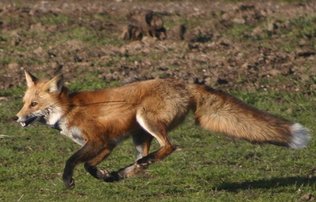
Valley Fox. Photo by Ben Sacks.
The Sacramento Bee reported Saturday, January 2, 2010, as summarized by the United Press International, that an intriguing discovery has taken place in California.
A subspecies of red fox living in California’s Sacramento Valley — long believed to be a non-native pest — is in fact native to the area, scientists say.
For almost 100 years the red foxes were thought to have escaped from fur farms and hunting parties in the 1900s, but they’re actually genetically different than non-native foxes elsewhere in California….They are also genetically distinct from gray foxes native across most of California….
Ben Sacks, a biology professor at the University of California-Davis, says genetic testing shows the subspecies, which he calls the Sacramento Valley red fox, is unique to lowland areas north of the American River and the Sacramento-San Joaquin Delta.
“We can now say that the foxes of the Sacramento Valley are native to California,” Sacks said.
“The fact that the evidence is pointing toward it as a native species — and a native species that we didn’t know about — is kind of an amazing development,” said Armand Gonzales, a wildlife program manager at the California Department of Fish and Game. “That doesn’t happen very often.”UPI
The native fox is visually indistinguishable from the nonnative variety. Both are about as big as a medium-sized dog: 18 to 20 inches tall, around 25 pounds, with a white-tipped tail as long as the body.
The Valley fox appears to thrive among small farms, keeping to themselves, especially around Woodland in Yolo County and Willows in Glenn County, California.
 About Loren Coleman
Loren Coleman is one of the world’s leading cryptozoologists, some say “the” leading living cryptozoologist. Certainly, he is acknowledged as the current living American researcher and writer who has most popularized cryptozoology in the late 20th and early 21st centuries.
Starting his fieldwork and investigations in 1960, after traveling and trekking extensively in pursuit of cryptozoological mysteries, Coleman began writing to share his experiences in 1969. An honorary member of Ivan T. Sanderson’s Society for the Investigation of the Unexplained in the 1970s, Coleman has been bestowed with similar honorary memberships of the North Idaho College Cryptozoology Club in 1983, and in subsequent years, that of the British Columbia Scientific Cryptozoology Club, CryptoSafari International, and other international organizations. He was also a Life Member and Benefactor of the International Society of Cryptozoology (now-defunct).
Loren Coleman’s daily blog, as a member of the Cryptomundo Team, served as an ongoing avenue of communication for the ever-growing body of cryptozoo news from 2005 through 2013. He returned as an infrequent contributor beginning Halloween week of 2015.
Coleman is the founder in 2003, and current director of the International Cryptozoology Museum in Portland, Maine.











Interesting news item, there. Thanks, Loren.
It simultaneously appeals to the contrarian in me while underscoring the degree to which we are uncertain in regards to our own natural history and our interpretation of it. Now if we could just carve out a nice reconstructed habitat in the Golden State big enough to support a golden bears again..
Great story. Love Foxes.
Foxes are incredible animals.
I find their great adaptability to be a fascinating aspect of these creatures. Foxes are incredibly successful animals. They are present on almost every continent on Earth, and have adapted to biomes ranging from temperate, to tropical, to the freezing Arctic. They have managed to fill avariety of niches as well. There is even a type of fox, the gray fox, as a matter of fact, that climbs trees. If I remember correctly, this particular species is the only type of canid to do so.
I also think it is interesting that wherever foxes are found in their vast range, they have become integral parts of local folklore and are intertwined with much myth and legend. In Japan, for instance, the fox is a powerful spirit, incredibly steeped in folklore. Obviously foxes have had a profound effect on the humans they have come into contact with over the course of our sharing of the land.
I wonder in this case, what the extent any hybridization might have occurred between the native and non-native species.
M_m: you recall correctly, at least unless something real recent has superseded this: the gray fox is the only tree-climbing canid.
Which brings to something really interesting about this discovery, which might otherwise chalk up as just another “chromosomal cryptid”: a long-known animal which has just now been identified genetically as a separate species.
One of the reasons English colonists introduced red foxes to North America, so one story goes, is that the native gray’s tendency to go straight up trees when pursued was deemed not very sporting.
But of course it’s long been discussed just how native/non-native the red fox is. This is the first find I’ve seen that seems to answer – if in a limited way, geographically – that question.
Dogu4: it’s indeed hopeful that the grizzly could come back to the state that features the bear prominently on its flag. I’m not so certain, however, that reconstructing habitat would be as necessary as reconstructing human attitudes. There seems to be a lot of potential habitat; the will to go against public opinion is, I think, more the rub, which will presumes public opinion to be negative. The state of California might want to risk surprising itself on that score. (Sure. Wolves too. In fact, in their very efficient role as coyote controllers, wolves are good for foxes.)
No new discovery. I forgot to lock the gate.