
Pugwis: Merbeing?
Posted by: Loren Coleman on June 22nd, 2009
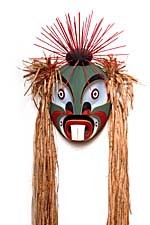
Pugwis Sea Monster Wood / Cedar bark Mask: 15 " w x 24" h Sooke Harbour House Gallery. Artist, Kwagiulth style: Allan Blyth.
John Kirk once wrote an old blog posting about the Thetis Lake Gillman. It is a creature of some interest to me and in line with recent reviews by Xtrox on Merbeings, I revisit this topic today.
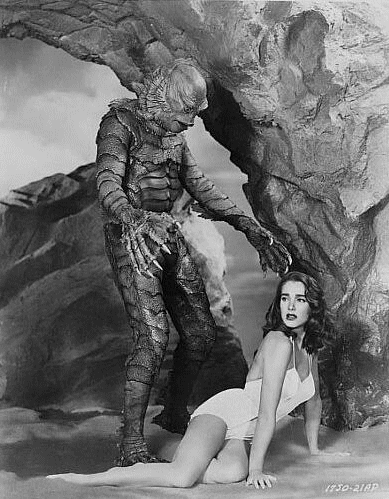
The first “monster” encountered two people at Thetis Lake, near the community of Colwood [but apparently mistakenly noted as “Cottonwood” by John Kirk], on Vancouver Island. On August 19, 1972, two young men, Robin Flewellyn and Gordon Pike, were traumatized by a creature resembling the 1954 sci-fi horror film’s “Creature from the Black Lagoon,” which emerged from the lake and attacked them. The thing was silvery gray and possessed webbed hands and feet. It used sharp protrusions on its hands to slash one of the boys who sustained a relatively nasty cut. Then again, at around 3:30 on the afternoon on August 23, 1972, two different young men, Russell van Nice and Michael Gold saw a similar creature come out of Thetis Lake. It was silvery, scaly, and monstrous, with huge ears, sharp projections on its head and an ugly face. Despite its aggressive appearance, it did not attack the two.
During my investigations at the time (I’ve included the case in several of my books), I discovered a nearby under-discussed bit of folklore that appeared to overlap with the Thetis Lake Monster’s description. I found that a similar creature has been reported in nearby Puget Sound in Washington State, as well as folkore from Vancouver Island. It appeared to me that the real sightings of these creatures had drifted, via the traditions of the Kwakwaka’wakw, into the area’s totem and mask art.
The Kwakwaka’wakw/ Kwakiutl / Kwagiulth are situated on the northern part of Vancouver Island, British Columbia, Canada. It is from here that the lore and artifacts of the Pugwis is found.
The Merman named Pugwis appeared obviously to me to be related to the Thetis Creature’s appearance. While the Pugwis seem to be a cross between Sasquatch and the Creature from the Black Lagoon, they actually have their own body of rich Merbeing lore.
The Pugwis fish-like face and paired incisors make this undersea spirit a prominent figure in First Nations’ legend. It is easily recognized in wood-carved art. Here you will find two examples of Native mask art (above and below) for sale (the artists’ names are clickable). Interestingly, these two examples show spikes on the heads, although interpreted differently by two artists.
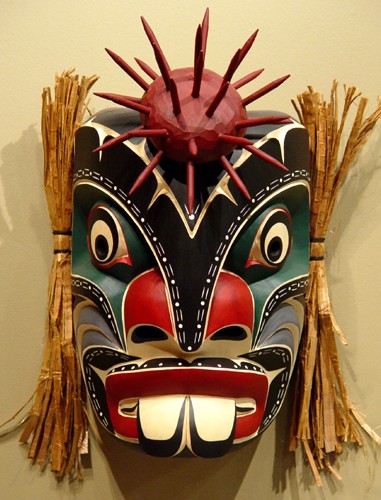
Pugwis Yellow Cedar Mask: 11" w x 17" h Black Tusk Gallery Art. Kwak waka’ wakw Artist: Bill Henderson.
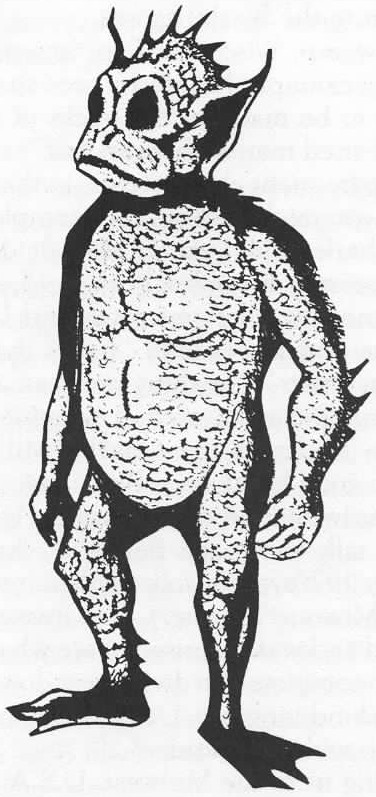
Speaking of different interpretations of these creatures, the original newspaper artist’s drawing (at the bottom) of the Thetis Creature can be compared to Harry Trumbore’s sketch. Harry made his sketch under my direction, within the context of the original description (and the original drawing in the paper at the time), plus the broader Merman-Pugwis lore, for The Field Guide of Bigfoot and Other Mystery Primates.
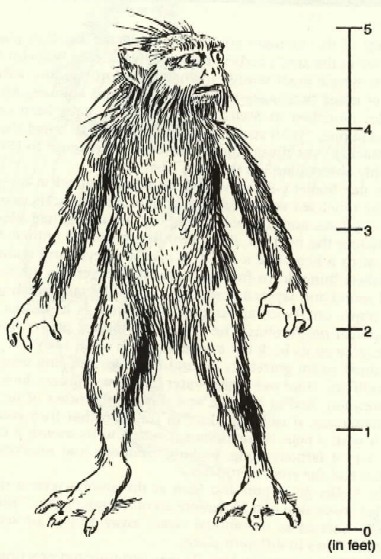
You can see from the close-up of the Pugwis head in the Native art, it has some similarities with Trumbore’s imagined Thetis Creature.
Please click to…
Thank You.
 About Loren Coleman
Loren Coleman is one of the world’s leading cryptozoologists, some say “the” leading living cryptozoologist. Certainly, he is acknowledged as the current living American researcher and writer who has most popularized cryptozoology in the late 20th and early 21st centuries.
Starting his fieldwork and investigations in 1960, after traveling and trekking extensively in pursuit of cryptozoological mysteries, Coleman began writing to share his experiences in 1969. An honorary member of Ivan T. Sanderson’s Society for the Investigation of the Unexplained in the 1970s, Coleman has been bestowed with similar honorary memberships of the North Idaho College Cryptozoology Club in 1983, and in subsequent years, that of the British Columbia Scientific Cryptozoology Club, CryptoSafari International, and other international organizations. He was also a Life Member and Benefactor of the International Society of Cryptozoology (now-defunct).
Loren Coleman’s daily blog, as a member of the Cryptomundo Team, served as an ongoing avenue of communication for the ever-growing body of cryptozoo news from 2005 through 2013. He returned as an infrequent contributor beginning Halloween week of 2015.
Coleman is the founder in 2003, and current director of the International Cryptozoology Museum in Portland, Maine.








Sounds remarkably like the “Deep Ones” (half frog/fish – humans) of Innsmouth in H.P Lovecraft’s Cthulu stories written in the 1930s. You Tube has an interesting video concerning the Cthulu mythos.
Alligator, I was thinking the exact same thing about these critters. The newspaper drawing looks pretty funny, though… like a really ugly version of E.T.
“E.T. break mirror.”
However, both the native masks and the Trumbore sketch seem to depict it as a creature that, to my eyes at least, may look almost comical in the described circumstances.
If there’s evidence for at least some sort of Native American “interaction” with the “creature,” then it is definitely worth investigating. Looking forward to more information, if any.
And I do agree:
This really does looks like a “really ugly version of ET.”
Reminds me of Rana the frogman from lost lake.
Except for their physical description, it almost sounds like the water aliens told in African folklore, they looked more like dolphins. But from traditional thinking they would have to be from out of this world. From our train of thought, a left over remnant of the dino world? Lost world right here.
Are there any books out there on mermaid lore and references to native american traditions? Since we have been in the mermaid vein here, my curiosity is up and if there is anything out there, it would be worth tracking down to read. Interesting stuff.
Springheeledjack- I was interested in reading more on these accounts after the last few mermaid posts as well, and looked into some other literature on the matter. Some decent information can be found in Creatures of the Mist, by Gary R. Varner, Mermaids and Mastodons by Richard Carrington, Magickal Mermaids and Water Creatures by D.J. Conway, Adventures in Unhistory by Avram Davidson, and Seafaring Lore and Legend by Peter D. Jears, to name a few. All of these have some interesting stuff on the mermaid phenomenon.
Hope this helps get you on your way.