
Nepal Yeti Museum
Posted by: Loren Coleman on July 17th, 2012
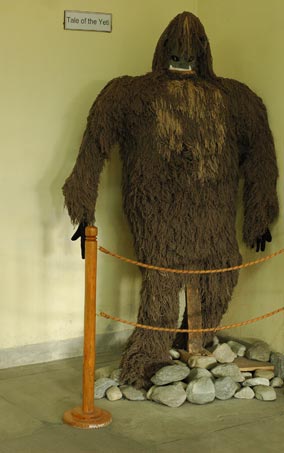
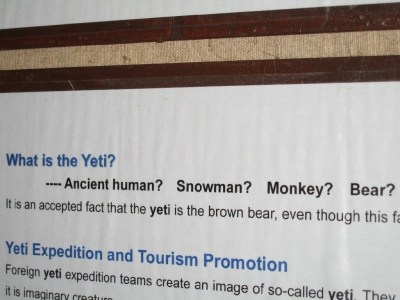
In Nepal, there is a Yeti museum. Actually, it is a mountaineering museum in Pokhara, Nepal. But do you see what they say the “Yeti” is? Humm.
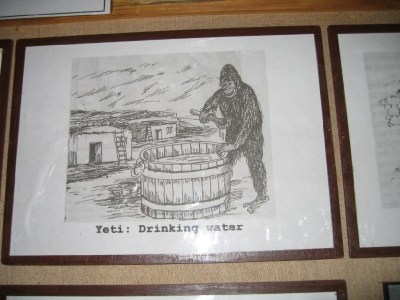
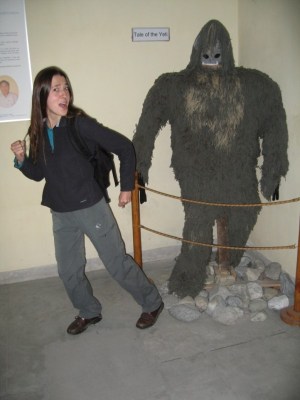
Due to the Internet, tourists are beginning to post photos of each other in front of the Yeti replica. Looks familiar, right?
 About Loren Coleman
Loren Coleman is one of the world’s leading cryptozoologists, some say “the” leading living cryptozoologist. Certainly, he is acknowledged as the current living American researcher and writer who has most popularized cryptozoology in the late 20th and early 21st centuries.
Starting his fieldwork and investigations in 1960, after traveling and trekking extensively in pursuit of cryptozoological mysteries, Coleman began writing to share his experiences in 1969. An honorary member of Ivan T. Sanderson’s Society for the Investigation of the Unexplained in the 1970s, Coleman has been bestowed with similar honorary memberships of the North Idaho College Cryptozoology Club in 1983, and in subsequent years, that of the British Columbia Scientific Cryptozoology Club, CryptoSafari International, and other international organizations. He was also a Life Member and Benefactor of the International Society of Cryptozoology (now-defunct).
Loren Coleman’s daily blog, as a member of the Cryptomundo Team, served as an ongoing avenue of communication for the ever-growing body of cryptozoo news from 2005 through 2013. He returned as an infrequent contributor beginning Halloween week of 2015.
Coleman is the founder in 2003, and current director of the International Cryptozoology Museum in Portland, Maine.









A Brown Bear ? That would be the conclusion of many but I guess it depends on who put that sign up! I know we can’t look at the world the people from outside the US as intellectual inferiors with dimished capacities for thinking on their own as our antiquated Imperialistic ideas might think. It’s one opinoin from one person or group in Nepal but I wonder ; Why put up the ” Yeti ” statue at all ? Why not a bear ? Why ? Because iit sells ! Tourist money is good money . Still , I would like to think there is more there than people conclude to be untrue . I want to believe !
Even if the Yeti really *is* just the brown bear, it’s not out of line to put up the clearly non-bear statue. That is to say, the Yeti is not the brown bear, but it may be a creature of legend inspired by the brown bear. This is sort of like the case with Robin Hood; he may have been inspired by an historical person, but by now he is a fictional literary figure. I’d say the same thing is true of the Kraken and he giant squid.
If Bigfoot ever is confirmed and studied, I wonder how similar he will turn out to be to what cryptozoologists expect?
I’d like to know how much research they had done before making that conclusion. Even cryptozoologists who spend a life time working on claims of the Yeti don’t know the answer for sure, yet these museum curators who haven’t heard the word ‘meh-teh’ yet seem to know it all right off the bat! In short, they should have at least kept it open as a possibility.
I’d like to know how much research they had done before making that conclusion. Even cryptozoologists who spend a life time working on claims of the Yeti don’t know the answer for sure, yet these museum curators who haven’t heard the word ‘meh-teh’ yet seem to know it all right off the bat! In short, they should have at least kept it open as a possibility.
Where do you get that they “haven’t yard the word ‘meh-teh'”? Nothing in Loren’s writeup suggests that this museum is operated by anyone but the Nepalese themselves. When it comes to knowing the local names and, crucially, understanding the culture that describes the Yeti, I’ll presume the locals in Nepal to know more than anyone reading this blog from America (or Canada, or the UK, etc.).
Its important to keep in mind that the Yeti of Western imagination, the Yeti of Himalayan imagination, and the animal(s) described as being Yeti are different even if related things. (Heck, the lion, the fox, and even the dog in our stories are different from the animals themselves. Also it’s a sure thing that brown bears have been mistaken for Bigfoot, since in fact stumps have been mistaken for Bigfoot.)
I was under the impression that acceptance of the Yeti’s existence was universal among residents of Nepal, Tibet, and Bhutan. Evidently, this is not so. Also ‘accepted fact’? Even if a single person denies this, it’s no longer an entirely accepted fact, because as you and I both know, scores of people around the globe support the existence of the Yeti.
Well, the museum is no doubt trying to appeal to foreign tourists; note that all the labels appear to be in English. Many of the tourists will expect a Yeti, so a Yeti is there. Others visitors will feel a sense of superiority to the “superstitious natives”, so for them there is the reassurance that “Of course, all educated people (that’s you and me, dear tourist) know that it’s really just a brown bear.”