
Pinky Expedition 2008
Posted by: Loren Coleman on March 10th, 2008
As you read these words, I’m on a mini-expedition in a rugged old boat in the St. Johns River in Florida, interviewing locals and actively looking for Pinky, the “living dinosaur” of these parts.
Ivan T. Sanderson, Mark A. Hall, Karl Shuker, George Eberhart, Patrick Huyghe, Michael Newton, to name a few, and of course, I have mentioned in various books and articles the unique river monsters seen up and down the St. Johns River in Florida, now known by the collective name most popularized in the area since the 1970s as “Pinky.”
The nickname came about when on May 10, 1975, Charles and Dorothy Abram were fishing with three friends when they saw the head and neck of a large pink animal about 20 feet away. It turned its head to look at them and then submerged after about 8 seconds.
Eyewitness Dorothy Abram said it looked like “a dinosaur with its skin pulled back so all the bones were showing…pink, sort of the color of boiled shrimp.”
Their description was concise and yet remarkable. They said it had a pink color, bones showed that through the skin, a human-sized head, small horns with knobby tips, flappy skin on the sides of the head, a three-feet-long neck, and slanted, dark eyes.
In an upcoming issue of TAPS Paramagazine, I devote an article to “Pinky.”
The long, winding, northbound course of the St. Johns River starts in the appropriately named Lake Hell ‘n’ Blazes area (which Michael Newton points out is in Skunk Ape country).
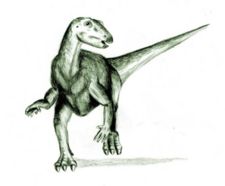
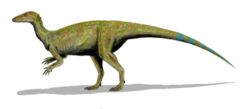
Cryptozoologist Mark A. Hall thinks that the modern Pinky could be a surviving Thescelosaurus neglectus (pictured above and throughout), a 12-foot-long ornithopod dinosaur that lived in the Late Cretaceous 65 million years ago.
Most reports of Pinky are dated to the 1950s. What if there are some earlier records, which may speak to a longer history of Florida river monsters? What if some are linked to the Pinky stories that popped up from the Jacksonville area in the disco era?
Could Pinky have been more widespread a hundred years ago? Could the neck of this creature be mistaken for a giant snake, sometimes? Or the other way around?
The Caloosahatchee River is a river on the southwest Gulf Coast of Florida in the United States, that drains the rural area on the northern edge of the Everglades. If the St. Johns River is seen as the main way north for these cryptids, the Caloosahatchee River can be viewed as the major route east.
Did the Native peoples of Florida tell the newer residents of Florida about Pinky and other related sightings of river monsters as long ago as 1888?
A Lee County Monster.
A correspondent contributes to the Fort Myers Press a story of an immense serpent lately seen crossing the Caloosahatchee river near Chokoloskee, and the Press calls upon The Herald to match the story. As we have no big snakes in this locality, The Herald gives it up and begs to repeat what it said to Col. Tom Appleyard, that it is not an authority on snakes; and as no one in the office drinks liquor, none of us have had the pleasure of seeing snakes.
But here is the narrative of the Lee county serpent as it appeared in last week’s Press:
Col. Demere and Ervin Lowe came down from Needhelp last Sunday [presumably October 4, 1908], and report having seen an immense snake swim the river about two miles from here.
They say it appeared to be a great log on the water when they first saw it, but they learned it was a snake when they got to where it was, as the tail was just leaving the water on the south side of the river, and its head stood up four or five feet high, twenty yards from the river, and looked as large as a nail keg.
Of course the reptile must have been between fifty and sixty feet long, and its body looked about the size of a flour barrel. Now this looks fishy, but there is no one in this section that would doubt the veracity of either of these gentlemen.
We have since learned that the Indians have told of such a snake twenty years ago, having been seen by them in a certain swamp, and they always kept away from that swamp. This will give a good color to the snake story.
The serpent was heading to the south-east, and will possibly take up in the first thick swamp that suits his convenience.Punta Gorda [Florida] Herald, October 15, 1908
As I look among the alligators and manatees, I am keeping my eyes peeled for a “living dinosaur.” I’ve written more in the TAPS column about the theory that all these Pinky sightings are nothing more than manatees. Or a giant salamander.
Remember, a hundred years ago was before the time of so many exotic giant snake escapees being a breeding population in Florida.
Something tells me that on this exact date of Scott Norman’s funeral, he’d understand that with a loan and a prayer, I had to keep this dinosaur trek of mine in front of me, as the quest on this day.
 About Loren Coleman
Loren Coleman is one of the world’s leading cryptozoologists, some say “the” leading living cryptozoologist. Certainly, he is acknowledged as the current living American researcher and writer who has most popularized cryptozoology in the late 20th and early 21st centuries.
Starting his fieldwork and investigations in 1960, after traveling and trekking extensively in pursuit of cryptozoological mysteries, Coleman began writing to share his experiences in 1969. An honorary member of Ivan T. Sanderson’s Society for the Investigation of the Unexplained in the 1970s, Coleman has been bestowed with similar honorary memberships of the North Idaho College Cryptozoology Club in 1983, and in subsequent years, that of the British Columbia Scientific Cryptozoology Club, CryptoSafari International, and other international organizations. He was also a Life Member and Benefactor of the International Society of Cryptozoology (now-defunct).
Loren Coleman’s daily blog, as a member of the Cryptomundo Team, served as an ongoing avenue of communication for the ever-growing body of cryptozoo news from 2005 through 2013. He returned as an infrequent contributor beginning Halloween week of 2015.
Coleman is the founder in 2003, and current director of the International Cryptozoology Museum in Portland, Maine.











Thanks Loren,
Looking forward to your return and report!
Vance
Just about 2 mi.’s east of the St. Johns river in Cocoa, Florida.
PS,
If you haven’t seen a night launch, you have to come over here and see the Endeavor tonight around 2:38am.
The description does sound like it could be a manatee. Or maybe some sort of out-of-place whale like a beluga, or a river dolphin (although I can’t come up with any way for a river dolphin to have ended up in a river in Florida, since it would have to have crossed through the ocean to get there).
It would be awesome to find living dinosaurs of any kind; however, I just do not believe that any dinos survived the K-T extinction.
Giant snakes, though – THERE is something that may very well be alive and, well, not kicking exactly, but swimming, in Florida. I’d bet that people have been turning pythons and boas loose in Florida for a century or longer. Snakes live a long time, and they grow for as long as they live. With no natural predators here, who knows how long they could potentially grow to be?
It’s a great time of year to be on an expedition in Florida!
Very interesting, Loren! I hope things go well on the expedition, and I look forward to your followup report. How about a giant salamander of some sort? I don’t know if we’ll ever know what the original inhabitants of the region might have seen. It would be great to find that out, but I doubt we ever will.
On a less serious note, I can’t help picturing a pair of animated mice hiding out in the swamps, one having constructed a very strange looking vehicle, and the other one asking, “Gosh, Brain, what are we going to do with that?” The big headed one would of course reply with, “The same thing we do every night, Pinky….”
I wasn’t even aware that there were dinosaur sightings in Florida. Though it is hard to believe that every single dinosaur species (over 400 known) went extinct at the end of the Cretaceous period I do believe that is the case. Except for birds I don’t believe there are any living dinosaur species. Still though there could be something equally interesting living in Florida and I hope your trip turns something up.
This was really cool…. as I vividly remember Dr. Meldrum saying something to the extent- “mainstream science has really dampened the spirit of exploration”… (in that recent Yeti episode on the sci-fi channel)
To me truly good science has to look into the possibility of such animals existing.
Logical explanations can sometimes be a small box that traps our reasoning.
Great read Loren, thanks!
Kittenz specualtion that it could be a river dolphin is interesting. As for its travelling across oceanic distances to get there, we might keep in mind that in the past the coasts of north and south america along the Atlantic was nearly unbroken mangrove offering a more brackish environment hop-scotching from river outlet to river outlet, and just as oceanic cetaceans can survive for some time in river water, such as the humpbacks that occasionally are reported as far inland as Sacramento, one would suspect brief excursions across coastal drainages might be possible. Sailors report that fresh water from the rivers is detectable for miles out to see in the right conditions.
I wonder if genetics can provide us with insight as to whether dolphins adapted to their native rivers just once with each population going throug similar processes or if seperate populations spread through the regions different river necessitating their passage through seawater.
Best wishes Loren. I hope that you find something (whatever it may be) to explain these sightings. I can’t wait to hear how it went when you get back!
Never heard of PINKY before. Cool!!!
COULD be a manatee like KITTENZ stated, but hey, one can hope…
Hey, one NEVER knows the truth about what REALLY happened with the mass extinctions of dinosaurs millions of years ago. Heck, we still don’t know how ENTIRE CIVILIZATIONS came to disappear almost overnight—some within a single day!!! Authors like Graham Hancock, Michael Cremo, Preston Peet, John Anthony West, Lisa A. Shiel, Robert Schoch and others have provided compelling evidence (admittedly not proof) that the TRUE history of the world is different than is the concensus now.
So again, ONE never knows. Heck, the dinosaurs may have been indeed been wiped out by a meteor millions of years ago—-but MAYBE some of them FOUND a way to escape the cataclysm. Weirder things have happened. There is SO MUCH of our past we do not know anything about.
What was once scientific FACT is now considered QUAINT. So who knows what we will discover as a species within a hundred years or so.
Anyway—
Like Maine Crypto said—hope you find an explanation for these sightings. Looking forward to your next posting!!!
Not sure how the descriptions lead to a ‘dinosaur’ conclusion, sounds more serpentine, perhaps amphibian.
Kittenz, like your thinking.
If any dino did survive it would more than likely be aquatic/semi-aquatic (Like Crocodilians). Some conditions, temp, etc are generally less variable in water. Also I reckon if something did survive it may well be greatly diverged from its fossil form. As for river dolphins, how about an ancestral or convergent evolved form?
Ecosystems such as the swamps and everglades of Florida have been altered so much recently. Historical accounts like this make me think about what creatures may have become extinct in the last 100 -200 and were never formally discovered or know by science, and as such they can’t even be forgotten.
Good hunting, Loren. I look forward to your report.
No idea what this could be. But it could be an albino phase of something else that might be more commonly seen. Were there any goanas or iguanas in that region before the exotic pet trade?
Other obvious notions have been given; including manatees, river dolphins, snakes, even an albino otter with mange.
Pink hue is also present in another Floridian animal, the flamingo, because of what it eats, but that color then shows up in the feathers, not the hide.
The thing that bothers me about the Dolphin/Manatee explanation is the neck thingy problem (explained as 3 feet long and from what I’m gathering snake-ish)…
If I said to the world that I just saw a dolphin with a 3 foot long snake type neck, people might say something like:
“Sounds like You must of seen a Dinosaur…”
Also I’m not sure if a dinosaur today would be “diverged” from the ones seen in the fossil record… For instance, the Coelacanth’s of today are the same as the ones that exist in the fossil record.
…and If it were a Python/Boa how does one explain how it held its head?
A big albino or leucistic python could also be a pinkish color, but, while I think it very likely that big pythons are living wild in Florida, I doubt that pythons are behind the tales of “Pinky”.
And just for that young person, if you are planning to see Flamingos in Florida, you better go to Busch Gardens or something. We don’t have Flamingos in Florida. Well, some Florida transplants do have either the concrete or plastic variety standing in their yards for some unknown reason lol!
Botos (Amazonian River Dolphins) are a pinkish color, and they have a long (compared to other dolphins’), flexible neck. Furthermore they don’t have a dorsal fin but instead have a low ridge running down the length of their back. Their flippers are paddle-shaped.
Here is a photo of a mother boto with her calf.
Pinky could be a Giant salamander, an undescribed species, a type of Hellbender.
Thanks for the picture of the Botos Dolphin’ Kittens.. I am unfamiliar with that species of Dolphin
For instance, the Coelacanth’s of today are the same as the ones that exist in the fossil record.
Not exactly. And in fact, iirc the genus Latimeria does not appear in the fossil record (not all that surprising, given the deep-water habitat of the living forms, L. chalumnae and L. menadoensis)…