
Two New Phrynopus Frogs Discovered
Posted by: Loren Coleman on May 13th, 2008
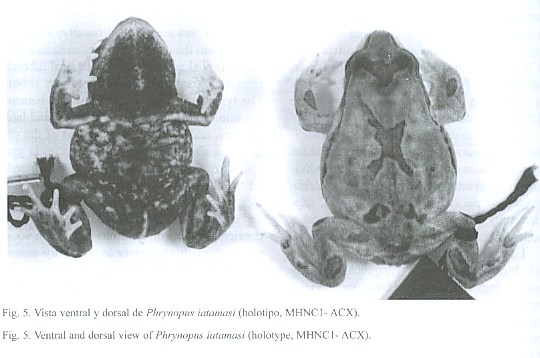
Photos above of an earlier new species (Phrynopus adenopleurus) discovered in the genus.
Frogs of the genus Phrynopus were believed to inhabit the Andes of Colombia, Ecuador, Bolivia and Peru, between 1000 and 4400 meters above sea level. However, the genus proved to be polyphyletic and recent molecular data indicate that it is restricted only to central Peru.
Currently 19 species are recognized, many of them described during the last 15 years.
The genus now appears to be one of the most speciose (e.g., rich in number of species) groups of frogs in the humid paramo and cloud forest habitats of the Andes. The actual diversity of this genus is far from being well known, and new species continue to be found as herpetological surveys are carried out in previously unexplored or poorly known areas.
Yanachaga Chemillén is a Peruvian National Park in Departamento Pasco, in which there is a remarkable amphibian diversity. Intensive fieldwork by Chaparro et al. (2008) in August and September 2007 produced several new species of frogs, among them, two new Phrynopus. With these additions, the diversity of the genus Phrynopus raises to 21 species. The new species are sympatric and described from elfin forests and puna grasslands (3363–3589 m) on the eastern slopes of the Andes.
Phrynopus miroslawae sp. nov. is a medium-sized species characterized by lacking vomerine teeth and tympanic membrane.
Phrynopus nicoleae sp. nov. is a small species characterized by lacking tympanic membrane and by having vomerine teeth.
These frogs have been described in the following paper. J, C. Chaparro, J. M. Padial, and I. De La Riva. 2008. Two sympatric new species of Phrynopus (Anura: Strabomantidae) from Yanachaga Chemillen National Park (central Peruvian Andes). Zootaxa 1761: 49-58.
 About Loren Coleman
Loren Coleman is one of the world’s leading cryptozoologists, some say “the” leading living cryptozoologist. Certainly, he is acknowledged as the current living American researcher and writer who has most popularized cryptozoology in the late 20th and early 21st centuries.
Starting his fieldwork and investigations in 1960, after traveling and trekking extensively in pursuit of cryptozoological mysteries, Coleman began writing to share his experiences in 1969. An honorary member of Ivan T. Sanderson’s Society for the Investigation of the Unexplained in the 1970s, Coleman has been bestowed with similar honorary memberships of the North Idaho College Cryptozoology Club in 1983, and in subsequent years, that of the British Columbia Scientific Cryptozoology Club, CryptoSafari International, and other international organizations. He was also a Life Member and Benefactor of the International Society of Cryptozoology (now-defunct).
Loren Coleman’s daily blog, as a member of the Cryptomundo Team, served as an ongoing avenue of communication for the ever-growing body of cryptozoo news from 2005 through 2013. He returned as an infrequent contributor beginning Halloween week of 2015.
Coleman is the founder in 2003, and current director of the International Cryptozoology Museum in Portland, Maine.











lacking tympanic membrane? Could that mean that those frogs perceive sound waves through their skin only?
No.
It’s not unusual for some species of frogs to lack tympanic membranes–or even entire middle ear structures; they do, however, have other hearing structures.
Thanks MMGood 🙂