
Otter Nonsense

Posted by: Loren Coleman on June 5th, 2007
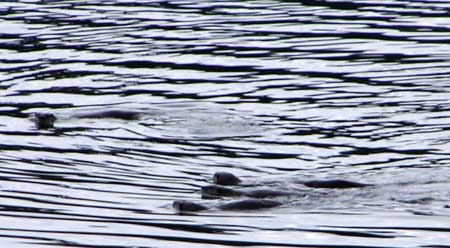
otters

Otters, of course, are responsible for a few misidentifications of Lake Monsters in bodies of water worldwide.

In my The Field Guide to Lake Monsters, Sea Serpents, and Other Mystery Denizens of the Deep (co-authored by Patrick Huyghe), the fact that people do make mistakes when viewing mundane mammals on lakes and lochs is acknowledged. Otters, nevertheless, have never been seen as the root of all Lake Monsters accounts, as seemed to be expressed on CNN’s “Paula Zahn Now” last week by the guest skeptic.

Otters are hardly in vogue any longer. Even Bernard Heuvelmans’ theory of the “super-otters,” as a type of Sea Serpent, has fallen from favor.

One of the “otter nonsense” points of the CNN interview was for Joe Nickell to, more or less, say that all Lake Monster reports could be explained as being otters.

Indeed, Nickell does use this simplistic broad brush to explain several Lake Monster reports.

In Nickell’s and Benjamin Radford’s Lake Monster Mysteries: Investigating the World’s Most Elusive Creatures, “otter” is the underlying explanation that is often used.

Various remarks from that book confirm Nickell’s theme, in which he and Ben Radford use others’ conclusions to support this all-encompassing “otter” theory:

Loch Ness, Scotland

[Quoting Ronald Binns]…With its long neck and plesiosaurlike profile, the otter is quite likely to be perceived as a monster, especially when an adult with two or more young are swimming in a line, creating the semblance of a multihumped creature, p. 13.

[Regarding the August 1933 sighting Spicer sighting, referencing a local newspaper]…the creature was almost certainly a large otter, possibly carrying one of its young, p. 13.

[Dick Raynor’s film of 1967, pointing again to Binns]…that, in my opinion, shows an otter or otters, p. 19.

Lake Crescent, Newfoundland

[Obviously, Radford writing]…Otters are very common in and around the lake, and as Joe Nickell has pointed out in earlier chapters, otters can be (and have been mistaken) for lake monsters, p. 96.

Lake Okanagan, British Columbia

[Speaking of Ogopogo, it is noted]…Lake Okanagan is in the home range of…otters, p. 113. Ogopogo and the supposedly responsible otters surface again on pages 117-120 and 168.

On pages 37-38, Nickell mentions otters as the explanation for cryptids in Lake Champlain, Vermont/New York/Quebec; a lake in Clinton County, New York; Loch Arkaig and Loch Ness, Scotland; Lake Utopia, New Brunswick; and Silver Lake, New York (the latter also on pp. 86-87).

On page 73, the Radford-Nickell book links otters to sightings of Memphre in Lake Memphremagog, Quebec and Vermont.

On pages 141-142, Nickell theorizes that at least one sighting of “Beaverton Bessie” or “Kempenfelt Kelly,” seen near Beaverton, Ontario, “could reasonably be explained by otters swimming in a line, diving, and resurfacing,” (page 141).

Reasonably? This is otterly overwhelming. Otterly ridiculous.

If so many otters around the world are “swimming in a line” to fool eyewitnesses into thinking they are the loops of Sea Serpents or Lake Monsters, where are all of the photographs of such visual demonstrations in Nickell’s book? The volume has photos throughout, but not one of these supposedly abundant otters swimming in a line. Oh yes, there is one illustration of “Northern river otters, swimming in a line” in the book. It is a line drawing by Joe Nickell, on page 118.

I was able to find a photograph (see at top) of multiple otters swimming in a lake. Their heads appear rather large and blunt, not “plesiosaurlike” (to use a Nickell descriptor) or even “long-necked.” Also, they happen to be swimming…side by side.

I invite submissions of photographs of otters “swimming in a line,” which look like the humps of a Lake Monster.

Similar Phenomena:
More Otter Nonsense »
Lake Khaiyr Hoax & More Otter Nonsense »
Real Otter Sense »
Champ Video »
Beast of Bolivia Track »
Otter Unknown Kappa »

125 Responses to “Otter Nonsense”

  1. Benjamin Radford responds:

    Lake Crescent, Newfoundland

    [Obviously, Radford writing]…”Otters are very common in and around the lake, and as Joe Nickell has pointed out in earlier chapters, otters can be (and have been mistaken) for lake monsters, p. 96.”

    Loren is a bit misleading here; while the above quote is accurate, it leaves the reader with the impression that I suggested that otters are the most likely explanation for Cressie. In fact, the sentence just before the above quote reads, “there is little doubt that the lake contains many eels, so it isn’t much of a stretch to think that Cressie, the “eel-like” lake monster, actually is an eel.” So, in context, you can see that the emphasis on otters as an explanation is Loren’s, not mine.

    It’s also important to note that in lake monster investigations, you have to include all possible explanations. One lake monster image may be a piece of driftwood (e.g. Mansi’s image of Champ), while another may be an otter, or an eel, or a beaver…

    In all the cases that Loren cited, otters were one of many possible explanations. It is true that my co-investigator Joe Nickell favors the otter theory in many cases, but I don’t think he automatically assumes that any given sighting is necessarily otters.

  2. Benjamin Radford responds:

    And as for images of otters that could be mistaken for lake monsters, that’s not hard to do:

    1) Go to www.Google.com
    2) Search for “otters swimming”
    3) You will find a dozen or so images that could be mistaken for a lake monster if taken out of context

  3. Bob Michaels responds:

    Lake Monsters in the Tropics could be rather large pythons, perhaps the one in Lake Tele Africa or the anaconda in S.A lakes. In West Africa and India types of water monitor. Surely some are mammals, otters and beavers, but I would not rule out that some day, we might wake up and find that an extinct marine reptile still lives in some form in some oceans.

  4. Loren Coleman responds:

    Yes, of course, I know all about the many explanations about lake monsters, but I was addressing Nickell’s global argument that he shared on CNN. This is a detailed listing of what lakes (and their cryptids), exactly, Nickell has linked to his otter theory.

    Ben, I didn’t ask for “otters swimming.” You are missing the boat on that one, I’m afraid, and I think you know that. Are you trying to win this point with extra “noise”?

    Photos of swimming otters are easy to find. I specifically asked for “otters swimming in a line,” which is the basis of the argument being made by Nickell.

    Don’t throw the whole circus my way when I’ve merely requested a special clown doing a specific act.

  5. mystery_man responds:

    Are you still waiting for those photos of otters swimming in a line, Loren? :) Obviously if it happens so often, there must be plenty of them to be found to submit as examples, so I’m curious to see if any will be forthcoming.

    I think that there are many mundane possibilities for lake monsters that need to be looked into, but personally do not put too much stock solely into the otter theory, indeed I do not think that all sightings can be lumped into any one explanation and I think that there could certainly be different explanations depending on the Lake, which could account for varying uniform reports within the same lake. One thing that may be good to look at is all of the wildlife (not only otters), typical water or wave conditions, any odd underwater currents, boating patterns, etc.

    Sure, I agree otters may account for some sightings or photos, that is perfectly feasible. But it might not be the most scientific approach to rely too much on that theory for dismissing all sightings, especially without photographic evidence of this apparently common behavior of otters swimming in a line. I have seen footage of other animals swimming that seem very much like they could be mistaken by the untrained observer for a lake monster. But I haven’t seen this sort of thing with otters or even convincingly with schools of fish. I am happy to see that Mr. Radford acknowledges that it could be any number of things other than otters.

  6. Rick Noll responds:

    I have seen river otters swim in a line behind one another but only from a few yards away. I don’t think many people would be able to see these animals do this kind of thing from any great distance. I don’t think there are many photographs or videos of them doing this because it is rare, usually at a distance or happens so quick that one doesn’t have time to get the camera and shoot.

    Wait a minute that sounds just like the reasons there aren’t many pictures of cryptids.

  7. Benjamin Radford responds:

    Sorry, Loren, my mistake, I wasn’t trying to throw in “noise” or anything. I guess I’m not sure what your point is.

    Do you doubt that otters swim in a line?

    or

    Do you doubt that otters swimming that way can be mistaken for monsters? I’m not sure where you’re going with this.

    Even if there are only a handful of images of otters swimming in a line, what does that prove, show, or suggest?

  8. Benjamin Radford responds:

    Don’t throw the whole circus my way when I’ve merely requested a special clown doing a specific act.

    I love that line! Seriously!

  9. mystery_man responds:

    Ben- I don’t speak for Loren here, but I think the point is if so many sightings could be attributed to otters swimming in a line, then this would point to this being a reasonably common behavior in otters and if that is the case, there should be lots of footage available of this occuring. Surely such a supposedly common behavior would be fairly well documented? If there is only just a handful of footage of this (if any), that would suggest to me that the tendency of swimming in a line isn’t so common as to be a solid culprit for Lake Monster sightings. Think of it as along the lines of when you were demanding any examples of witness ridicule, he wants examples to back up what the skeptics are claiming. I think Loren’s point is that if otters swimming in a line is such a solid hypothesis for misidentification in so many cases, where is the evidence that this is a common behavior for otters to have in the first place?

  10. Benjamin Radford responds:

    MM sez:

    “Surely such a supposedly common behavior would be fairly well documented?”

    There may be some faulty logic here, there are many perfectly common, ordinary animal behaviors that are not commonly photographed.

    I have never seen a photograph of (nor was I able to find in a Google search a photograph of) a giraffe giving birth. I’m sure that such a photo exists somewhere in some zoologist’s archive, but I’ve never seen one.

    But just because I’ve never seen an image of a giraffe giving birth does not mean that I doubt it happens. So I don’t know that a lack of images of otters swimming in a line really means anything.

  11. mystery_man responds:

    Ben- Well, a lot of people on this post would use that argument on you with Bigfoot. I don’t follow your logic here either. I don’t think giraffes giving birth is a good example because we have giraffes, they are documented and it can be ascertained that storks do not deliver their babies. The consensus would be that giraffes must give birth and that adult giraffes come from baby giraffes. What there doesn’t seem to be is any of otters swimming in a line which your colleague seems to put a lot of faith in. Why is this? Has he seen otters do this often? What is your reason for thinking that otters do this on a regular basis? Surely there must be a reason for this to be thought of as a common behavior that just hasn’t been filmed. Why do you feel that this is such a common otter behavior?

    I don’t have any personal problem with the otter theory except if new behaviors for otters are being thought up as a convenient way to explain lake monster sightings.

  12. mystery_man responds:

    After googling for really only about 20 seconds, I found footage of a giraffe giving birth.

  13. mystery_man responds:

    Ben- Your research for your argument on giraffes giving birth is a bit dodgy. It took me 20 seconds to find such footage on Google. Obviously pretty well documented too as their were many to be found. Wait until the link shows up later and check it out. So I am trying to figure your point out. Animal behaviors are documented through footage and observation. Where is proof of otters swimming in a line and even if they do, I’d like to know if this is a common enough occurrence to rely extensively on as an explanation.

  14. Benjamin Radford responds:

    “Has he seen otters do this often? What is your reason for thinking that otters do this on a regular basis?”

    No one here is (apparently) a wildlife biologist, including me. However, in Lake Monster Mysteries, Joe quotes a wildlife biologist who says that swimming in a line is a common otter behavior. Those who doubt that otters exhibit this behavior can also read Terrie M. Williams’s (of the Sea World Institute) 1989 article “Swimming by sea otters” in the “Journal of Comparative Physiology A” (available online).

    I imagine there are plenty of experts and resources that explain this. If you or Loren or anyone else believes they are wrong, and that swimming in a line is not a common otter behavior, I’m sure Joe would be happy to look at it.

    Or, maybe all the experts are wrong, and otters rarely if ever swim in a line…

  15. Loren Coleman responds:

    Ben, I am a little worried about your research skills if you can’t find any images of giraffe birthing on the internet.

    I think you’ve shown your hand here, demonstrating that skeptics may not be able to keep up-to-date on technological research techniques (using google instead of google images, for example) and instead employing old standards like “just because I’ve never seen a giraffe doesn’t mean giraffe’s don’t exist.”

    Come on, Ben, try to get out a little more. :-)

    By the way, thank you Ben for confirming that just because someone can’t immediately produce an image of a phenomena that probably exists (e.g. otters swimming in line) doesn’t mean it doesn’t exist. I think we all have been trying to tell you this with regard to cryptids for a long time.

  16. mystery_man responds:

    No one here is an otter biologist at any rate. I do work in the field of biology, but otters are not my specialty I’ll admit. Wildlife biologists can be quite specialized and are by no means experts on all types of animals. All I want are facts on the matter, not assumptions or ideas of what otters might do, so the recommended reading is appreciated. By the way, it is quite easy to find footage of giraffes giving birth on google. :)

  17. Diapause responds:

    I’ve witnessed this behavior, at a lake in South Carolina from a distance of at least 50 meters and for much longer than a few seconds. The otters I observed looked exactly like a single, long, undulating animal moving very rapidly through the water. Anyone who has ever had the pleasure of watching otters play, must know that the claim that these animals wouldn’t often travel in tandem is completely preposterous. The move in such a haphazard manner that I’d assume any configuration of otters to be fairly likely.

    To suggest the supposed rarity of these events makes some monstrous unknown creature in landlocked lakes more parsimonious is absurd. These occurrences are great examples of how a fleeting glimpse coupled with the slightest seed of suggestion (even if not at a conscious level) can result in profoundly foolish conclusions.

  18. DARHOP responds:

    What about Beaver? Do they swim in a line? Are their Beaver in Scotland?

  19. mystery_man responds:

    Ben- The link I posted earlier to a video of a giraffe birth has now opened for your perusal. 10 to 20 seconds of research.

  20. mystery_man responds:

    Now where is all the footage of otters swimming in a line? :) I can find footage of pretty much anything else swimming except that. Odd.

  21. Benjamin Radford responds:

    There you have it: Loren suggested that otters swimming in a line is rarity, whereas we already have three posters here (myself, Rick, and Diapause), who have seen it first-hand. I have also provided two resources from experts who note this behavior.

    Therefore the otter explanation is one of several perfectly valid explanations for lake monster sightings. Just as I said.

  22. Richard888 responds:

    Are there even otters in Scotland? This Wiki article, although possibly not the most reliable field guide to Scotland’s mammalian fauna, makes no mention of otters. If Scotland has no otters then this wouldn’t be the first time that a conventional explanation approaches the cryptozoological one in unlikelihood. I prefer a science dominated by crackpots than one arrested by the “it can’t be” concept.

  23. mystery_man responds:

    To be fair though, I suppose if we can accept the idea of the existence of cryptids without solid video footage, then we should be prepared to accept that otters will swim in a line from time to time without footage as well. I can see the skeptic take that this is perhaps more plausible than an actual lake monster considering that otters do exist and I suppose it is highly likely they might swim in a line, but considering otters are known animals, I would think that there would be some sort of footage of this behavior. Probably there is, and I’d be glad to see it. This discussion is amusing to me in that the skeptic side often demands footage or images from cryptid proponents, yet feel they do not have to do so to back up their own arguments. I am not even a proponent of lake monsters, I just think there happen to be plausible explanations other than otters swimming in a line.

  24. Loren Coleman responds:

    Ben says: “Loren suggested that otters swimming in a line is a rarity.”

    Show me the photos of “otters swimming in a line” was my request.

    First of all, I don’t think you can quote that I said anything like that. I merely asked for photos of such a behavior, as I was surprised this was a theory so core to Joe Nickell’s explanation for lake monsters that he would proclaim it as thus on CNN, yet there were no photos of it in his (and your book).

    Show me the photos.

    Secondly, I find it amusing that Ben is using three reported sightings of otters doing this in support of the reality of this behavior existing. Does that mean that Ben has turned a corner on using eyewitness accounts to support lake cryptids’ reality?

    Show me the images of otters swimming in a line that look like a lake monster.

    Don’t change my request into a statement I did not make.

  25. Benjamin Radford responds:

    Loren sez: “Show me the photos.”

    To what end? For what purpose? What is your point?

    Do you really doubt that otters exhibit this behavior? If not, then just say so.

    Do you think it does happen, but is so rare that there are only a few photos of it? Then just say so.

    Are you suggesting that there is a direct correlation between how common something is and how many photos exist of it? If so, what is the logical basis for this assumption?

    Come on, Loren be clear about your point!

  26. PhotoExpert responds:

    This is a very interesting discussion. I have seen and photographed otters in the wild and in captivity. I have seen giant river otters of the Amazon Jungle first hand. For those unfamiliar with them, these giant otters are about 6 feet long and with tail, sometimes longer. So I have some limited experience with them.

    There seems to be several points of discussion here and although related to each other, are separate entities.

    The first point of discussion is: Do otters swim in a line and if so is it common? Yes, otters do swim in a line. It does not happen with great frequency but it does happen. However, when I have witnessed them first hand swimming in a line, it usually is only two of them. And in these not so common occurrences, they were unmistakably otters from my frame of reference. To someone else, they may be monsters or beavers. Many photos you will see of otters have their heads sticking out of the water. This is common behavior and why we see so many photos like these and less with otters swimming in a line.

    That brings us to the second point of discussion and that is: Could otters swimming in a line, even if it is a rare occurrence, be mistaken for something else? When swimming at slow speeds, their heads are usually popping up and visible. Sometimes the otter in trail will have it’s head down and the otter in the lead position will have it’s head up. This might explain some sightings of lake monsters. But that depends on the observer’s experience with otters. I might look at that activity and say, otters! Someone less experienced may say, what is that? Nessie?

    I looked through a couple of photographs I had taken and could not find one of them swimming in a line that could explain the lake monster theory. So I looked through the internet to see if I could find a photograph that might explain some of the lake monster sightings. I found this, which also happens to show the giant Amazonian otters I saw while in the Amazon Jungle. This photo was not taken by me. Here is the link.

    It is a photo of the lead otter with head out of the water and the trailing otter with head in the water. This gives the appearance of a single creature.

    If I saw this, even at a distance. I would say, otters! If someone with less familiarity with otters saw this, they might say, monster! So the third discussion taking place here is: What is the frame of reference of the observer?

    A marine biologist would have an excellent frame of reference. But a marine biologist with an astigmatism, would not be a good witness. I would find someone’s eyewitness account who was less credentialed but had good eyesight. So the witness’s frame of reference is important.

    Then we go into another area of discussion, and that is, what is the evidence we are currently evaluating. In this case, it is video. Is it good quality video? Well, it’s better than a lot of videos that are submitted for evaluation. And even though it does not have the camera shake of some submissions, it is a bit shaky since it is obviously hand held video and it is taken a fairly great distance.

    I agree with the one poster who said, I did not see any fins, etc. So what we are looking at is something. Something in the water that is moving at a pretty good clip and not sulking along.

    Do otters do that? Yes, they do move at fast pace sometimes. Most of the time they are playing and basking and head popping to look around. They are curious creatures.

    So we get into the entire discussion, bringing up all these separate issues. I think both sides have made some very valid points. Both sides have made some credible arguments in trying to prove their points.

    But the fact remains, if you look at the separate issues or you look at them as a whole, the video itself proves nothing more than something is moving in the water. What it is can not be defined. And since it is ambiguous at best, it could be anything.

    I say, seal! LOL And my argument would be just as valid as the otter argument based on the facts at hand and the limitations of the evidence. I could say, otter! I could say, Nessie! And based on the evidence or lack there of, under the parameters of the discussion and limitations of the evidence, be correct using those answers.

    The reason I like the video is that it gives us all here at Cryptomundo something interesting to look at and discuss and interact. We can use our imaginations and exercise our creativity and thought processes. And there is no right or wrong schools of thought on that. It is open for discussion. And that is what makes it both interesting and fun!

    Have a great day everyone!

  27. Bob K. responds:

    I think I’ll introduce a new “line” of thought here. There have been a number of reports of various lake monsters being sighted ON LAND. If I were a serious researcher, I think that I would abandon-at least for a time-all efforts to capture video of these creatures while they are swimming, when much of their bulk is hidden under water and can’t be seen in any detail, and focus on trying to capture video of these cryptids while they are out of the water, when there would be no doubt about their identification. Blurry shots of mostly submerged animals isn’t getting us very far as to identifying what is actually in the Loch, or the lake.

  28. DWA responds:

    Look, I’m just grateful for confirmation that Bigfoot is a pretty common animal that just isn’t filmed very often.

    “There you have it: Loren suggested that otters swimming in a line is rarity, whereas we already have three posters here (myself, Rick, and Diapause), who have seen it first-hand.”

    Compared to how many thousands of eyewitness accounts of the sasquatch…? So thanks, too, for the confirmation that eyewitnesses constitute pretty durn strong evidence. Finally we got there.

    I’ve seen one otter in my life, coming right at me in the water from a few feet away, in Corkscrew Swamp, FL. He was a big ‘un. “Lake monster” is the last thing anyone could have thought.

    I’d prefer a simple effort being made to confirm what people are seeing, rather than a whole bunch of armchair theories about why they couldn’t possibly be seeing that.

    You know, armchair perceptions have no validity. They are, literally, people seeing things.

  29. DWA responds:

    “By the way, thank you Ben for confirming that just because someone can’t immediately produce an image of a phenomena that probably exists (e.g. otters swimming in line) doesn’t mean it doesn’t exist. I think we all have been trying to tell you this with regard to cryptids for a long time.”

    Actually, Loren, I could Google a film, pretty clear one, of a sasquatch walking along a river bar in a few seconds here. It’s clear enough for you to see that it has a humanlike nose and is female. Stand by one…

  30. DWA responds:

    BTW, I doubt Ben saw otters swimming in a line.

    I mean, he says he did, but he’s only one eyewitness. I’d kinda doubt it. Three? That’s evidence? A hundred wouldn’t be evidence to me. A thousand wouldn’t, a hundred thousand wouldn’t, not to me and especially not to Ben Radumahnevermind…

    One should be careful of one’s petards on this site. Hoisting comes unexpectedly. ;-)

  31. Notsobigfoot responds:

    Ben,

    You keep saying “whats your point? make your point clearer” etc. Why is it that nobody else is having a hard time understanding what Loren is saying? I’m not trying to be rude, I’m just saying that all Loren asked for is pictures of otters swimming in a line, not arguments, not theories or probabilities, just one picture that you have yet to produce despite claims that there are a dozen or so on google. I personally did not see a single one when I looked, just lots of swim clubs athough to be fair I only spent about 5 mins looking.

    Again, not trying to be rude, just hoping we can all get past this childish argument and back to the good stuff :)

  32. fuzzy responds:

    “Does that mean that Ben has turned a corner on using eyewitness accounts to support lake cryptids’ reality?”

    Nope - it’s just one of his debunking techniques, as usual.

  33. Benjamin Radford responds:

    Good post, PhotoExpert!

    I, also, have seen giant river otters in the Amazon. Big bastards, but kinda cute. And if you didn’t know what they were, you could easily mistake them for a lake monster!

  34. AtomicMrEMonster responds:

    Here’s what I found in 20 seconds:

    http://tinyurl.com/2ps8ro - If seen from a distance, I can easily imagine someone unfamiliar with otters thinking “lake monster.”

    http://tinyurl.com/2vaqlo - Again, this could look “monsterish” if seen from a distance. Especially if one had gone to a body of water thinking about and looking for a “lake monster,” which could make practically anything in the water appear to be an unknown creature.

    http://tinyurl.com/3xhosa - Otters have been known to travel in (rough) lines on land, too!

    http://tinyurl.com/2myedu - Not a line of otters, but I think this looks rather “lake monsterish.” Just think of it as a special bonus picture.

    And for what it’s worth, I suspect that these were taken by photographers assigned to take good, clear pictures of otters. After all, I doubt they thought that people visiting their respective websites would be satisfied with blurry pictures.

  35. elsanto responds:

    PhotoExpert… fantastic post, but let’s not play any games… I had a look at that link… no question:

    it’s a bunyip!

    I have seen otters swimming on more than one occasion, and while it’s possible a group of otters could be mistaken for a multi-humped lake monster, a while it’s possible that a group of otters swimming in a line could be mistaken for the same, they do not swim in the way that the subject in the Holmes footage appears to move… not that I’m suggesting that the Holmes footage is genuine, my buttocks are planted firmly on the fence on that one.

    Just my two cents.

  36. BugMO responds:

    I have a question for everyone, especially those who believe that a sighting of a lake monster can be explained as someone simply misidentifying a lake monster for an overly large eel. My question is if all the sightings of Lake Monster throughout history and from all over the world are misidentified giant eels. Where are all of these giant eels? Does anyone check to see if there are even eels in the waters where lake monsters are supposed it reside in? What types of FRESH WATER eels can grow to a size that could be considered OR misidentified as a lake monster? I know that salt water eels can grow to be giants, but I’m asking about fresh water eels. Because if lake monsters can be explained as giant eels, then giant eels and regular size eels in general should be living in the lakes where lake monsters are supposed to live in.

  37. joppa responds:

    Hey DARHOP. I’m with you. I’ve seen beavers swim in a line and was freaked out until I got close. Alas, no beavers in Scotland, so they only get blamed for being cryptids here in North America.

  38. DWA responds:

    BugMO: let me help you with that one.

    The intent of the eel hypothesis is simply to introduce another favorite fish of scoftics: the red herring.

    The intent is to debunk while remaining in one’s armchair. Why, everyone knows what an eel is! I’ll simply say it’s an eel, and the hoi polloi will buy it! The intent has nothing to do with serious thought as to what this phenomenon might be; it has to do with dismissing it without having to go to the hard work of engaging in serious thought.

    IMHO.

  39. PhotoExpert responds:

    Benjamin–Yes, unless you have seen an Amazonian River Otter first hand, you would not believe the size of these things. Even then, they are a bit shocking. Thank you! It was nice to have my post acknowledged in a positive way. Sometimes it is easy for your post to be lost in a sea of opinions.

    I try to remain objective both when posting and reading. Many times, there is common ground on different schools of thought no matter how polar opposite the objective and subjective opinions may be. The reality is that posters are sometimes saying the same thing, but from different perspectives, but they don’t always realize they are using similar arguments to prove different points.

    I read everday here at Cryptomundo, but post infrequently, unless I see a need for mediation or that some common sense needs to be mixed into a recipe that is headed for disaster or is starting to flame into an argument based on one’s beliefs. Let’s face it, emotions run strong when anyone has passion and embraces his or her beliefs. So even though one tries to remain objective, emotions run high.

    I look for commonalities or common ground. The common ground here is an interest in cryptozoology. And whether one is interested as a skeptic or they are interested as a believer, it makes no difference. They are interested in the same subject.

    In this thread, we are figuring out what it is while we are figuring out what it is not. And therein lies the possibility of solving the mystery, unless a body turns up or an irrefutable video or photograph is produced.

    However, we can use common ground between differing thoughts for points of clarification. This clarity should eventually lead to an objective agreement, or at least to an objective agreement on what it is or what it is not.

    That was the point of my post. And I did supply a link to a photo, although I pointed out, the photo in question can be just as strongly debated by both sides, if one takes into account the separate areas of discussion I mentioned in my first post.

    Kudos to you! Kudos to Loren! You have both made this a very interesting discussion and may I add, a very active thread! There was a lot of participation in this and isn’t that why the Cryptomundo site is here–so people can actually voice their opinions and become involved in their interest. The great thing I noticed is that we had many members from BF enthusiasts to those that were skeptical, participating in this thread. If you get a BF thread, usually just the proBF people participate in it. If you get a big cat thread, usually just the feline fanatics participate in it. But in this thread, we had many members participating in it from the frame of reference that they were all cryptozoology lovers!

    Ain’t life great!

  40. PhotoExpert responds:

    elsanto–Thank you too for noticing! I appreciate the comments and sentiments. I missed your post because I was posting at the same time you were.

    And LOL! Thanks for the laugh!

  41. BugMO responds:

    DWA that’s exactly my point. What’s the point in getting one’s hands dirty? When it’s easier to just explain something away with an even less believable explanation.

  42. Benjamin Radford responds:

    BugMo sez: “My question is if all the sightings of Lake Monster throughout history and from all over the world are misidentified giant eels.”

    No one has ever claimed that.

  43. Benjamin Radford responds:

    Somewhere I actually have a photo of giant river otters I saw in Brazil. Maybe I’ll post it if I can find it…

  44. BugMO responds:

    Boy, it must be nice to be able to explain some of the world’s most bizarre phenomenon with the simplest answers. Being quoted in newspapers and magazines, going on TV shows to explain to the viewing audience how simple it is to debunk some of the most puzzling mysteries the world has ever seen, with the simplest answers. Then, ask all of the believers of said strange phenomenon to give the world more credible proof of the phenomenon they believe is true. Then, when more credible proof is given you simple have to either give another simple answer or you could just ignore the so called proof. Either way you won’t have to do much work.

  45. BugMO responds:

    No one has ever claimed that. Really?

    In fact, the sentence just before the above quote reads, “there is little doubt that the lake contains many eels, so it isn’t much of a stretch to think that Cressie, the “eel-like” lake monster, actually is an eel.”

  46. Benjamin Radford responds:

    BugMo sez: “Boy, it must be nice to be able to explain some of the world’s most bizarre phenomenon with the simplest answers… how simple it is to debunk some of the most puzzling mysteries the world has ever seen, with the simplest answers.”

    What a remarkably stupid and uninformed posting! It always amazes me that people who know little or nothing about the topic will write whatever comes into their heads, blissfully unaware of the facts.

    I don’t know of any “simplest answers.” I spent months of my life meticulously researching and investigating Champ and the Mansi photo alone. I spent years working on my lake monster book.

    The answers I come to are hardly “simple.” Often they are very complex

    “Either way you won’t have to do much work.”

    I’ve done more work on trying to understand these mysteries than almost anyone else alive. How many eyewitnesses have you spoken to? How many hours have you logged at lakes in North America and in Scotland? How many weeks and months have you spent researching reports?

  47. BugMO responds:

    Benjamin: I’m sorry if you’re feeling that I’m directing my posts at you. Which I’m not. I merely directing my posts to the whole Cryptomundo community. I have nothing but the highest respect for anyone who’s willing to spend hours researching a subject and then is willing to present their claims for the whole world to see.

    I haven’t spoken to any eyewitnesses or made any special trips to any location of strange phenomenon in the intent of studying the phenomenon. But, I’m a middle class college student trying to make my way through college and going on a trip across America or to Scotland doesn’t quite fit into budget. But, that’s no excuse. I have spent months researching strange phenomenon.

  48. kamoeba responds:

    I liked PhotoExpert’s picture of two otters that kinda sorta looked like a serpent in the water. But remember that that photo represents one tiny fraction of a second in time. Don’t you think that at some time the lead otter’s head went below water and the submerged otter’s head raised above the water? I think it would take some incredible synchronizing for two otters to hold up the illusion of an aquatic “monster” for more than a second or two.

  49. jerrywayne responds:

    I wonder why, at crypto-zoo school, the dunce cap is given to the folks that posit the mundane and plausable, such as otters accounting for many lake monster reports. And gold star stickers are awarded to those with the most sensational, least explicable notions: lake phenomena are prehistoric whales, plesiosaurs, Great Orms, gigantic eels, super otters, monster slugs, etc

  50. Ceroill responds:

    Interesting discussion all round, guys. I was at Loch Ness briefly back in the summer of ‘76. Didn’t see anything though, although I’d wanted to. Not even a stick or an odd wave. Oh well. Not everyone can be a witness to potential strangeness.

  51. mfs responds:

    Mr. Radford and Mr. Nickell are “probably” right in their assumptions that the creature in the Holmes video may be an otter or another known creature that inhabits the Loch. But they really don’t know.

    I can’t form an opinion on what the video is actually showing since it is too indiscernible which seems to be the case these days for any kind of cryptid video footage which is unfortunate. I don’t know what it is. It can be anything.

    Even with a detailed analysis of the video it still may prove difficult to ascertain the identity of the creature. Put this under the “Unknown” category for now. The debate goes on and the speculation continues.

    An “otter” great blog folks!

  52. BugMO responds:

    mfs: I fully agree.

  53. mystery_man responds:

    Ok, so it seems that otters can and do swim in a line from time to time, I will agree to that. As I said before, I have no problem with the idea that otters could be misidentified. I do not get the impression from any of these posts, however, that otters swimming in a line is an incredibly common occurrence.

    Way up above, Mr. Radford said that there is often no photographic evidence of common or mundane animal behavior, but let’s look at that statement from the perspective of otters. I have searched and found many, many pieces of footage of otters swimming, which I think everyone will agree is pretty perfectly normal behavior for an otter to engage in. So there is a lot of footage of otters merely swimming, not even anything so interesting as them swimming in a line. What I find odd is the conspicuous absence of any footage of any swimming in a line, which has been claimed is such a common occurrence. This is strange in that I would think that during all of this filming of otters swimming, some would have been captured of the “perfectly common, ordinary” behavior of otters swimming in a line. The fact that all of the footage is of otters not swimming in a line, that would stand to reason that NOT swimming in a line is more common and perhaps swimming in a line is not the norm.

    I can see how some large otters by themselves could be misidentified, and I’m sure it is sometimes a cause for a lake monster sighting. I am willing to admit that otters will swim in a line occasionally. What I don’t see is otters swimming in a line being a common enough occurrence for it to adequately explain the majority of sightings. To build otters swimming in a line into a cornerstone argument, I would have expected more to back it up than one expert’s opinion and some eyewitness accounts. There is plenty of footage of otters swimming. Where is the footage of the “common occurrence” of them swimming in a line? I really am curious.

  54. PhotoExpert responds:

    kamoeba–Thank you for your kind comments! But I can only take credit for linking to the photograph in my post and not the actual photograph. Credit needs to go where credit is due. I linked to that photograph. That was someone else’s photo. Although I have taken many an otter photo, that was not mine.

    You are correct kamoeba, a photograph is only a split second of time.

    Everyone seems so friendly here. I should start posting more often instead of just reading.

  55. springheeledjack responds:

    I am willing to concede that once in a while someone who has no experience with the water may see a line of otters and if they do not look to closely or for too long, might interpret it as a lake critter, especially in a place like Ness or Champlain.

    BUT, if you live in the area (and I am not sure that otters are a mainstay at NEss or Champlain–in all the investigations of Loch Ness otters is not one of the creatures that gets popularly mentioned as one of the local wildlife, and I am not saying there aren’t any, but I do not believe there are large populations of them creeping around)…and you are used to seeing what is out on the waters on a daily, weekly and monthly basis, you are going to become familiar with what is around you. You are going to see otters swimming and begin to be able to discern that from other phenomena.

    My other problem is the giant eel theory. Eels swim side to side and while they may come to the surface and do whatever it is they do, some time spent in scrutiny is going to give you an idea of what you are looking at. Eels have never properly explained the head and neck accounts…especially the accounts where the head and neck is several feet out of the water for several seconds or minutes.

    My problem with the debunking crowd, is that they latch onto a possibility to explain one situation (and sometimes the stuff the debunkers come up with is even more outlandish than an as yet unidentified water critter), and then extrapolate that to fit all accounts.

    That is poor logical thought on any front.

    I have problems with sticks in the water too, but I think Ben and I have already been over that ground…

  56. asrai responds:

    I also wonder where all the footage of otters swimming in a line is? And for that matter, since it was the Holmes footage of the “loch ness monster” that brought this up, wouldn’t we be talking about European otters? So where is all the footage of European otters (which are SOLITARY animals) swimming in a line? I don’t even know how many videos I watched of otters swimming and not in one were they swimming in a line. Now I’m not saying that they don’t ever do this, but I don’t think it is as common as some are making it out to be.

    As for fresh water eels most are smaller than 2m. So I’m not sure they could be mistaken for a lake monster either. Anyways I loved reading all the comments on this post, made for a very interesting discussion.

  57. DWA responds:

    SHJ: exactly.

    One thing that crypto has a big problem with is its own outlandish - OK, currently unverifiable by science - explanations of phenomena. (Most of which, granted, aren’t taken seriously by real cryptos.) This problem causes cryptos to creep around the dim edges of zoology, constantly saying pardon, pardon, excuse me excuse me, and not calling “skeptics” (still having problems with gross misapplications of that word) on explanations my six-year-old wouldn’t get away with.

    Nobody who keeps offering stuff like that - instead of doing the simple, easy, intelligent thing, and calling for a real look into the matter - is doing research that crypto has any obligation to respect.

    Anybody who doesn’t think it’s waaaaaay past time to find out what, precisely, is in Loch Ness is summarily convicted of mental lassitude and sentenced to life on Bigfoot stakeout. In Schenectady, NY. Sez here.

    And I’m not somebody who even particularly believes there IS something radically unknown in Loch Ness.

    And this to Ronald “With its long neck and plesiosaurlike profile, the otter is quite likely to be perceived as a monster” Binns:

    Anybody who thinks otters and plesiosaurs have any similarities worth talking about would confuse me with a gorilla at a dinner party. (AFTER I shaved.)

  58. Sergio responds:

    Benjamin Radford wrote:

    “What a remarkably stupid and uninformed posting! It always amazes me that people who know little or nothing about the topic will write whatever comes into their heads, blissfully unaware of the facts.”

    Benjamin, this is definitely one of the most the most antagonizing, patronizing posts I’ve seen here at Cryptomundo. One thing is certain; you have a serious complex. As a psychologist, you of all people should appreciate the implications of one who seemingly is in constant need of inflating oneself at the expense of others.

    Where I’m from, if you try that kind of talk at the library, the bar, the bleachers at the ballgame, or at the lyseum, well, you’ll end up with a few missing teeth.

    Which is why, I suspect, that you constantly belittle and berate others in this manner, because you’re safely tucked away behind your keyboard.

    Hubris.

  59. mystery_man responds:

    PhotoExpert- Your excellent posts didn’t go unnoticed by me either. You should post more often, as it seems you could really contribute some good stuff.

    SHJ- That was a point I meant to bring up earlier, and I agree. As an ex-debunker myself, I can personally attest to the urge to latch onto any mundane explanation, no matter how implausible, and fashion it into a major debunking argument. In these cases, I would look at any other remotely possible hypothesis EXCEPT that it may just be something unknown to science. It is hard to show these types of debunking skeptics other alternatives because they will twist logic around, put words in your mouth, and change the parameters of their arguments in order to avoid facing theories other than the ones they favor. They will absolutely not even consider that there may be something new to science there. I know because that’s what I did and it wasn’t an unbiased scientific approach. This is despite the fact that some of the so called mundane explanations may be too rare to have been seen by so many or in some cases may be going so far as to be attributing cryptic behavior to known animals. Some proponents do the same thing and I don’t agree with it.

    I am still a skeptic. I still embrace good, plausible theories that do not involve Lake Monsters. I still think there may be common explanations for sightings, but what I want is something that seems likely and can be shown to be plausibly what people have reported through visual aids of images, footage and what not. If the skeptical argument is that it is wave patterns, I want to know about how those would be perceived and see how that could be misidentified. I want to know the conditions they appear in compared to when sightings were made. The excellent links posted here to images of known animals that could be mistaken for cryptids are good examples of what I personally want to see when weighing skeptical theories. If an idea has merit, then I will absolutely recognize it as such.

    That being said, one thing that I feel is important is to keep open is the possibility that some of the sightings may not be easily explainable, and like trying to push a square peg into a round hole, may not be fit into any pet theory smoothly. To me, that is not where true skepticism lies, but rather with trying to find real answers without the shackles of true belief. I think skepticism can be a good path to real answers if one does not become so biased and impassioned with their own ideas and cause as to discard conflicting notions no matter how possible they might be. I have even seen skeptics squabbling amongst themselves about different hypothesis, so caught up with trying to be clever or right that the real answers may elude them. Again, I think believers are guilty of this too.

    So while I entertain mundane causes for Lake Monster phenomena, I also think there should be the consideration that perhaps maybe it is something unknown causing these witness accounts in some cases. It would be nice to see at least some acknowledgment from time to time that the answer may not be so clear in some cases. I personally want both possibilities to be pursued in a scientific manner, with as little bias as possible. Otters always swim in a line all of the time? Ok. If that is true, so be it, as long as I can see how this is a strong argument. A large undiscovered animal lurks beneath the waves? Ok, again, I want to see how it is possible. If I am wrong, fine, show me I’m wrong. I want to see all angles and love to learn more. Being right is not my purpose for being here, discovering the truth is.

  60. Ceroill responds:

    Well said, Mystery Man.

  61. AtomicMrEMonster responds:

    asrai responds: June 6th, 2007 at 1:43 am
    I also wonder where all the footage of otters swimming in a line is?

    Mr. Coleman only requested photographs of otters swimming in lines that could be mistaken for lake monsters, but since I’m in a good mood, I’ll throw some videos your way:

    Two otters swim in a rough line about a minute into the video.

    Here we have a mother otter and her child swimming in a line. I will grant you that European otters tend to be solitary animals, but please note that according to this, European otter pups are dependent on their mother for a year and that a mother can have up to four pups. With that in mind, it’s not hard to imagine that a mother could swim with four pups following her. That, combined with the loch’s murky waters making bumplike waves, could easily be mistaken for an unknown animal. Look at how the otter in this video has a wake that makes it seem like a bigger animal.

    I’d also imagine that otter mates would be seen together as well.

    I should also note that Scotland’s wildlife population does include otters.

    Maybe it’s just me, but this video seems to start with three otters swimming in a line? And this obviously isn’t footage of otters in the ocean, so they aren’t sea otters (I’m anticipating someone trying to say that some of the stuff I linked to aren’t valid because they show sea otters). This shows that this behavior isn’t limited to sea otters.

    Speaking of sea otters, why is the idea of sea otters making their way into places like Loch Ness considered less likely than the “Sonar scans can’t find Nessie/Morag/etc. because it comes to and from the loch from connections to the sea or over land”? Sea otters are a lot smaller and easier to ignore than the large creatures that Nessie and its ilk are supposed to be. So why is this possibility overlooked? Is it because people don’t like the idea that some sightings could have explanations that aren’t as appealing as crediting them to an unknown animal?

    If a toad being found deep in the loch can be touted as proof that one can find “…most common things in the strangest of places,” that the loch hasn’t been fully explored and so an unknown animal could be there, etc., why not apply it to otters as well?

    This video shows a beaver chasing an otter in a line. If that beaver was a little faster (or the otter was a little slower…or if otter pups were involved), this would be dead-on perfect “lake monster” footage.

    I hope that this footage is to your liking and that this post doesn’t get ignored like my other post containing pictures of otters traveling in lines in the water and on dry land.

    Special bonus stuff:

    And look at this otter sticking its head and neck out of the water. Or look at this picture. It’s not entirely unlike for a few lake monster sightings to be misidentified otters.

    Are all lake monster sightings otters? Of course not, the sheer variety and type of sightings (like seeing something on land) can’t all be credited to otters. However, this also doesn’t mean that no sightings can be credited to otters or other misidentifications. Personally, I honestly don’t care if they do ever find anything in Loch Ness. It’d be great if they found a new species in there, but I’m not “married” to proving or disproving Nessie’s existence. The only reason I posted this stuff was because so many people were implying that such evidence of this behavior in otters doesn’t exist or that otters in a lake was somehow less likely than an unknown animal. In a good scientific investigation, all possible (common) explanations/factors should be examined before declaring it to be something unknown to science.

    And on a final (unrelated) note, how is Mr. Radford’s “patronizing” post different from a typical DWA post or some of Mr. Coleman’s posts in this thread (without an emoticon attached)? Let’s not play favorite here.

  62. DARHOP responds:

    This is better than Friday night fights. I love it.

  63. PhotoExpert responds:

    mystery-man–Thank you for the kind and generous comments! With encouragement like that, I am going to do just that. I will post more often as you suggested.

    By the way, I always enjoyed reading your posts too. You make threads that would get a few reads very interesting and they become popular. Your contributions have not gone unnoticed by readers either.

    I especially like the one a while back where you came out and your name was no longer a mystery. LOL That was really cool and surprising. It was fun too! You revealed the mystery and made for some excitement in that thread because no one expected it. Thanks for all you do here in making Cryptomundo the place it is. Now I have to take you up on your encouragement and find a something to post to!!!

    Enjoy this beautiful day!

  64. Daniel Loxton responds:

    I’m not completely clear about the “swimming in a line” thing myself. I’m assured this happens, but I’ve never attempted to really lock down how common it is. I’ll note in passing, though, that any group of animals moving together at the surface of a body of water are made into “a line” by perspective if they are even a little way out.

    It seems to me that this very specific question (while interesting) misses the general point of the frequent otter appearances in Lake Monster Mysteries: if a large enough number of people look at a monster-haunted body of water long enough under a broad enough range of viewing conditions, false positive monster sightings caused by misinterpretation of common lake phenomena will start to accumulate. Under the right circumstances, ducks, otters, boats, logs, boat wakes, mirages, and so on can (and, we know, do) generate false lake monster reports. Given that fact of life, it’s just a numbers game: enough lake visitors, and you’ll generate an impressive lake monster database. (Note that this holds true regardless of the existence of an actual monster in the lake.)

    Of course, solving specific cases is a tougher proposition. We know there are false positives in the mix — a lot of them, whether we like it or not — but we don’t generally know which sightings were generated by what. Commentators on all sides often argue for educated “best guess” explanations for given cases, but these necessarily involve speculation.

    Misinterpretation is of course much less likely to be a factor in the spectacular rock star cases. In those most spectacular cases, hoaxing is always an uncomfortable possibility — but that’s a topic for another thread…

  65. DWA responds:

    Daniel:

    As somebody who has seen, in his mind’s eye, too many things morph into too many things on big bodies of water, I’ll drink to that. (One of the seminal moments of my life: realizing those were whitecaps out there, not whales. It made my childhood a lot less frustrating when I realized why they didn’t show themselves.)

    My thing about water monsters of any stripe is this: unless we break the surface and go down to where they are, forget it. We’ll never know.

    And now you have to narrow down to the very few where this seems like a real Thing To Do. And I’d argue Nessie is one - however many the false positives; whatever the likelihood of it being something unknown to science.

    (Yeah, we can dredge one up, by accident or design, as well. It just doesn’t seem the most likely way.)

  66. Daniel Loxton responds:

    What a remarkably stupid and uninformed posting! It always amazes me that people who know little or nothing about the topic will write whatever comes into their heads, blissfully unaware of the facts.

    C’mon, Ben, you can do better than that. BugMo’s characterization of skeptics was not at all accurate, but we can’t expect everyone to have an accurate ready-made assessment of what we do. If it’s wrong, just correct it — while taking care not to reinforce anyone’s prejudices.

    (If I might make a personal aside, this chore of correcting mistaken assumptions about my activities was no different when I was a shepherd. I must have heard it asserted dozens of times a year, “Wow, must be peaceful. Get a lot of art done, huh?” No farm kid would ever say that! We actually worked 100 hours a week under isolated, difficult, stressful, exhausting, and dangerous circumstances, so this idyllic assumption was really pretty insulting. Of course spending the summer in the Northern Canadian wilderness working with 1500 sheep is no picnic. But how is a non-expert to know that unless someone explains it?)

  67. DWA responds:

    AtMEM says: “And on a final (unrelated) note, how is Mr. Radford’s “patronizing” post different from a typical DWA post or some of Mr. Coleman’s posts in this thread (without an emoticon attached)? Let’s not play favorite here.”

    Exactly. Let’s not. STOP DEFENDING RADFORD WHEN HE CALLS PEOPLE STUPID, FOR DOING THINGS HE DOES REGULARLY.

    Now that I have your attention: if you think that Ben post that you’re [use appropriate substitute word for “defending”] is anything like a “typical” post of mine, you don’t come here often enough. (And you probably don’t, judging by how often I see that handle.) In fact, I should point out that Ben is just about the only person on this site that prompts what you call a “typical” post from me. So let’s call it “a typical response of the type Ben should expect when he comes on like he does in his, yes, typical post.”

    Great. Now we’re straight. That out of the way: back on topic.

    You say:

    Speaking of sea otters, why is the idea of sea otters making their way into places like Loch Ness considered less likely than the “Sonar scans can’t find Nessie/Morag/etc. because it comes to and from the loch from connections to the sea or over land”? Sea otters are a lot smaller and easier to ignore than the large creatures that Nessie and its ilk are supposed to be. So why is this possibility overlooked? Is it because people don’t like the idea that some sightings could have explanations that aren’t as appealing as crediting them to an unknown animal?

    Nope. That possibility is overlooked because a line of sea otters heading for fresh water to do a lake monster imitation for tourists is about as likely as a giant squid’s doing it. As is the similar claim about Nessie puttin’ on a wee miner’s lamp an’ hiddin’ to the sea. It’s a frequent skeptic tack, in fact, to justify not-too-damn-likely debunking explanations by comparing them with the most-way-out-there proponent schemes. Definitely not according to Hoyle, that. Let’s stick to Occam’s Razor, K?

    You also say:

    ….so many people were implying that such evidence of this behavior in otters doesn’t exist or that otters in a lake was somehow less likely than an unknown animal.

    Um, no they weren’t, in so many words. This may be more evidence that you don’t show up here a lot. What they were doing was taking Ben to task the way he so often does them: by saying that visual evidence counts for nothing, and that if you can’t produce conclusive evidence, then the thing you’re talking about doesn’t exist. And no, he doesn’t say that. Not in so many words. What he does is not-saying it, which, if you get the difference and I know you do, is just as bad, really. What folks were doing was simply yanking Ben’s chain the way he likes to yank theirs.

    And I know you have noted that I haven’t used words like “remarkably stupid and uninformed” or “know little or nothing” yet. Ben’s our resident expert there, and I like to leave the expertise to the experts. :-)

    And BTW, it’s flat wrong that “all possible (common) explanations/factors should be examined before declaring it to be something unknown to science.” First of all, you never declare something unknown to science. A second’s thought will reveal that logically impossible to do. If you don’t know what it is you don’t - can’t - declare anything. You speculate, intelligently thank you, as to what the evidence indicates it might be, then you take steps to CONFIRM ITS EXISTENCE. And I think it’s way past time to do this with Nessie, the yeti and the sasquatch - at least - and not continue to waste good bandwidth claiming that it’s a bear with three otters swimming in a line behind it, which appeared bipedal because of the two giant eels on its shoulders.

    Or whatever.

    It’s not that proponents are dedicated to out-debunking the debunkers. It’s that they’re pretty damn tired of the simple, logical, quite plausible possibility that we have a new animal here getting, well, laughed at by people offering even more laughable reasons it ain’t so.

    Putting it nicely. ;-)

  68. ygor427 responds:

    Here’s an otter related cryptid story for you…

    At my high school the drama teacher had worked for Unsolved Mysteries. She was a director. She was still working for them when they did the Ogopogo episode. For this episode, they actually purchased footage (which they rarely did) of an elleged Pogo encounter. According to her, they were viewing this costly footage when one of the other crew members noticed that when you zoomed in you could clearly see little otter feet. Because they’d already paid for it they aired it. Needless to say, Robert Stack did not mention the feet nor the fact they’d paid a few grand for video of an otter. And this otter wasn’t even having a jug band christmas!!!

  69. asrai responds:

    AtMEM: thank you for posting all the footage of otters. although it does show otters sort of swimming in lines, i still don’t see how any of this footage could be misinterpreted as a lake monster. and also let me remind you that i didn’t say that they didn’t swim in lines, just that it might not be that common. and I’m also not saying that every piece of footage that is possibly a lake monster is in fact a lake monster. because it probably isn’t. and i don’t think i was asking for anything more than what skeptics ask for. anyways thank you again for the otter footage.

  70. DWA responds:

    jerrywayne says:

    “I wonder why, at crypto-zoo school, the dunce cap is given to the folks that posit the mundane and plausable [sic] as otters accounting for many lake monster reports.”

    My response above probably covers this too. But why not be sure. We don’t hand out any dunce caps here; we just get tired of loopy scenarios involving existing critters being used to put dunce caps on cryptos without the postulators getting off their butts to do, or encourage, real research. It’s like my saying that, no, mountains are really just clouds, and hoping you don’t walk or drive over to them to check me out.

    “And gold star stickers are awarded to those with the most sensational, least explicable notions: lake phenomena are prehistoric whales, plesiosaurs, Great Orms, gigantic eels, super otters, monster slugs, etc [sic]”

    Actually, “super otters” sound like a skeptical creation to me, from perusing this thread. ;-)

    Trust me, Nessie itself would be much more explicable than some of the “arguments” I’ve heard kissing it off.

  71. aastra responds:

    A few years ago (~10 years, max) the city newspaper in Victoria, BC printed a rather remarkable photo of otters swimming in a line. The resemblance to the hypothetical undulating sea serpent was very good, and (I recall) this point was emphasized in the photo’s caption.

    The newspaper in question is called the Times-Colonist. I remember the picture as being on the front page, but it might have been on the front page of one of the sections.

    Maybe I’ll head on over to the library’s microfilm collection one of these days and try to dig it up.

  72. Daniel Loxton responds:

    DWA writes,

    You speculate, intelligently thank you, as to what the evidence indicates it might be, then you take steps to CONFIRM ITS EXISTENCE. And I think it’s way past time to do this with Nessie…

    What would you suggest? Of all cryptids, every organized, dedicated effort has been made — for many years, and at tremendous expense — to confirm the existence of Nessie: from the practical (massive, systematic observation campaigns; large scale sonar dragnets), to the fanciful (submarines; simply walking the entire length of the floor of the lake in a diving suit), to the outrageous (spells and incantations)…

    What’s the next step — and what are the odds that this step will finally pay off?

  73. Daniel Loxton responds:

    aastra:

    Try this shot in the dark first, as it’s a front-of-section caption that includes the word “Cadborosaurus.”
    Source: Times Colonist
    Page: B1 / FRONT, Edition: Final
    Sat, Mar 1, 2003

    (PS: Take old quarters; the microfilm printer machines at the Greater Victoria Public Library reject new quarters for copies.)

  74. DWA responds:

    Dainiel:

    I might be mistaken on this but I don’t think a top-down, end-to-end drag of the loch has been done, with current technology. If we long ago were able to track Russian submarines in the vastness of the oceans, then we have what it takes to do this. I think that Matt Bille also suggested this in a recent post (forget the thread). I’m also not sure what the massive observation campaigns consisted of (although one might argue that Ness is under pretty constant surveillance as is).

    Now of course I can understand why some people (particularly Inverness Chamber of Commerce types) might not want to have their bubble popped. Cost might be another obstacle. Availability of equipment (and willingness to loan) might be yet another.

    There is one photo taken in the loch, about 30 years or so ago, that I can’t get over. It seems to show what looks like a plesiosaur fin (and I’m no more likely to see shapes in clouds than the next guy). That one’s had me scratching my head.

    But I would say, that unless such an effort as I’m talking about is mounted, well, good luck Rock Ness. And if it has been already, well, another incantation wouldn’t hurt, I guess. :-D

  75. mystery_man responds:

    Thank you for the kind words PhotoExpert. They are much appreciated.

    AtomicMrEmonster- Thanks for the images you posted. I am always happy to see any sort of visual evidence for any theories. Nice images.

    A few more thoughts on Lake Monsters here even though it seems the debate has died down. Being a skeptic myself, especially of Lake Monsters, there are a few nagging things that bother me about some of the mainstream skeptical theories and things that I don’t think can conveniently be explained away. Here it goes.

    First of all, I fully entertain the notion that common animals are seen by visitors and can be misidentified. I can appreciate how various swimming animals such as elk, beavers, otters, and so on can create the illusion of something strange to the untrained eye or under the right conditions, and I think a lot of images have been put forward that support that. What bothers me about this hypothesis is that lakes that are said to harbor monsters are not the only lakes that represent this sort of wildlife. There are many, many lakes that have otters, beavers, moose, and so on, yet do not have any reports of lake monsters. How to explain this? If these creatures really are causing all the reports of lake monsters, then why don’t all lakes that have these very same creatures and just as many tourists have these sorts of reports? It seems strange that one lake with tourists and otters could be said to have a Lake Monster based on false identifications of common animals, yet another Lake with the same wildlife and conditions does not any reports or alleged monster at all. Conversely, why are there sometimes reports of lake monsters where these otters and other wildlife are not present?

    Second. When I read any witness reports of lake monsters, a common description through all of them is that of the alleged creature’s size. There just are not many reports of anything within the size range of an otter, not even especially large species of them. Even in a line, otters are not especially massive creatures, and the animals reported outsize moose too. I can see witness misjudgment of size to an extent, but not when a lot of the reports are describing quite huge animals. I cannot see how the posted footage above of a mother otter and baby could be misidentified for something as massive as what is often reported. If the size is the illusion, what are the plausible reasons how a fairly small beaver, water bird, or otter could become so large in the witnesses eyes?

    Third. Another thing that I find hard to explain is that lake monsters within the same lake will show similar appearances in the reports. These reports of a lake monster in one lake will differ from the appearance reported in other lakes, with often uniform features reported within the same lake. Now if both lakes have the same sort of wildlife that could potentially be misidentified, then why is there a uniform difference between what is reported within one lake and what is seen in another? Otters swimming in a line, for instance, will look similar in any lake, yet lake monsters from lake to lake can vary wildly in appearance.

    As I said, I am skeptic and I appreciate skeptical inquiry, but I don’t think these questions can be readily written off. These are all things that make me think. I must add that if anyone wants to respond to this post, I hope you will do so in a civil, engaging manner. I do not wish anyone to offer snide dismissals to anything I’ve said here or try to pull an expert card, or try to start an argument. I’m here for answers. I’ve put forth some rational questions, I’d appreciate rational responses. Thanks.

  76. Daniel Loxton responds:

    DWA writes,

    I might be mistaken on this but I don’t think a top-down, end-to-end drag of the loch has been done, with current technology.

    Unfortunately, complete end-to-end sonar drags of the loch have been done — several times. Most recently, the BBC-sponsored sonar survey in 2003 swept the entire lake using the most up-to-date technology. But this survey only confirmed the results of many previous top-to-bottom, end-to-end sonar sweeps. In 1962, a team from Cambridge created a sonar dragnet using a small fleet of boats, allowing them to scan the entire lake six times. The largest effort was undertaken by Adrian Shine’s people in 1987: “Operation Deepscan” swept the entire lake with a sonar curtain using a fleet of 20 boats, which were followed by an additional fleet whose job it was to probe and document any sonar contacts detected by the dragnet.

    So far, no dice.

    I’m also not sure what the massive observation campaigns consisted of (although one might argue that Ness is under pretty constant surveillance as is).

    Your point about the informal surveillance is a good one. In addition, there have been several organized observation campaigns, starting with the 1934 Edward Mountain expedition (in which 20 men were stationed around the loch with cameras). The largest such effort was run by the Loch Ness Investigation Bureau in the 1960s and 70s, which used giant telephoto movie cameras mounted on viewing platforms and camera trucks. It ran for several years, unfortunately with no luck whatsoever.

    For a fairly complete and concise survey of the history of Loch Ness investigation, see my 10-page article in Skeptic Vol 11, #1.

  77. Daniel Loxton responds:

    mystery_man writes:

    Being a skeptic myself, especially of Lake Monsters, there are a few nagging things that bother me about some of the mainstream skeptical theories and things that I don’t think can conveniently be explained away. Here it goes.

    These are really good questions, mystery_man! I think I can help with one or two of them.

    First of all, I fully entertain the notion that common animals are seen by visitors and can be misidentified. … What bothers me about this hypothesis is that lakes that are said to harbor monsters are not the only lakes that represent this sort of wildlife. There are many, many lakes that have otters, beavers, moose, and so on, yet do not have any reports of lake monsters. How to explain this?

    I think the main difference must be expectation. Any splash, object, or creature on Loch Ness will suggest a monster, at least to some viewers or under some conditions. The same phenomenon seen in your local trout lake might not carry the same thrill of possibility.

    Despite this, it’s my impression that these same sorts of everyday phenomenon — otters, waves, and so on — actually are sometimes interpreted as monsters, wherever they’re spotted. It’s a bit of a problem for the “undiscovered species” hypothesis that lakes all over the world are now said to have their own monsters. Big lakes, small lakes, lakes in many countries and many climates — according to Loren Coleman, “more than a thousand lakes around the world harbor large, unknown animals unrecognized by conventional zoology.”

    I regard this as an issue of multiplying improbabilities…

    Second. When I read any witness reports of lake monsters, a common description through all of them is that of the alleged creature’s size. There just are not many reports of anything within the size range of an otter, not even especially large species of them.

    I’m not too bothered by this, as people are absolutely terrible at judging the size of objects out on the water. We know for a fact that small animals such as cormorants have been mistaken for large monsters. In those cases in which it is possible to test eyewitness descriptions of the size of lake monsters (see, for example, Nickell and Radford’s work on the Mansi photo in Lake Monster Mysteries, in which it is established that the object is less than half the size of previous estimates), it almost inevitably proves to be the case that the size of the monster was exaggerated by the witness. (This reminds me of my own experience as a shepherd: it was rarely the case that anyone out there encountered a small, juvenile grizzly bear; by and large, they were all Shardik.)

    I’d add a couple more points regarding the size of reported monsters. First, relatively small monsters quite often are reported. Second, many of the sources of misinterpretation are in themselves very large phenomena, such as logs or boat wakes.

    Third. Another thing that I find hard to explain is that lake monsters within the same lake will show similar appearances in the reports. … Otters swimming in a line, for instance, will look similar in any lake, yet lake monsters from lake to lake can vary wildly in appearance.

    It’s important to realize that monster reports are not, in fact, consistent within a single lake. At Loch Ness, for example, it is common for Nessie to be described as variously plesiosaur-like, or a single large hump, or many humps, or writhing coils. Nessie is described as having a head like a sheep, horse, snake, or indistinct blob; of having horns or not; of being almost any size, color, or sheen; and so on. (This has led to some amusing attempts to reconcile the various conflicting reports, in which a plesiosaur has pasted onto it several humps like a camel. For more on eyewitness differences at Loch Ness, see for example)

    Furthermore, this is the case at other monster lakes as well (as covered recently in the Nickell / Radford book).

    It seems to be the case that it is less the witnesses that are consistent than the public persona of the monster. (This has annoyed cryptozoologists, by the way: the idea that Nessie is a plesiosaur is both so pervasive and — sadly — silly, that it makes it difficult to open room for other explanations.)

  78. mystery_man responds:

    Daniel Loxton- Thank you for your thorough, rational insights into my questions. It is much appreciated and I enjoy this sort of exchange of ideas. Some thoughts.

    I can see what you mean about witness expectation. That is a very good point. If someone were to see a swimming otter in a lake that is not said to harbor any monster, their first reaction would perhaps not be to think it is a mystery animal, whereas in Loch Ness, Lake Champlain, etc, there would be more of the inclination to think “hey it must be the monster!”. This leaves the question of why the lake is said to harbor a monster in the first place, though. I think it is possible that the whole thing could start with a hoax and then snowball from there. All it takes is one, well publicized bogus monster report to start making everybody think they are seeing monsters. I think an example of this happening can be found in lakes where the monster sightings have begun rather recently, with nothing on record before that.

    Concerning size, I suppose that could be linked to expectation as well combined with poor size judgement of a waterborne object. If the witness is convinced what they are seeing is the monster, I suppose that in their mind’s eye, they could remember it being much larger than it actually was. The thing that still bothers me is how much can we really count on this always being the case? There are people who are quite experienced with being on the water or live on the lake, yet still report great sizes. I am hesitant to say they all must be making mistakes of size perception. Boat wakes and such could be behind these, but not where the description obviously points to a living creature, i.e. it has a head.

    I guess I may be wrong with the uniform descriptions of lake monsters, but I was under the impression that monsters such as Champ were fairly regularly reported as having a similar appearance. Of course not all reports, but a good enough number that one could imagine these witnesses were seeing the same thing. I could be wrong about that as lake monsters are not my forte, but is it not true that a good deal of reports have shared characteristics? I suppose even if there were uniform reports, this could still be explained. Perhaps in one particular lake, there is more odd wave activity than otters, etc, and so since the monster reports are based on wave patterns, they share similar descriptions whereas in another lake where otters are the culprit, those reports would include different descriptions. If there is a lot of otter activity in one lake and a lot of moose or wave activity in another lake, or bird activity in another, then just by numbers, the reports are going to lean towards an appearance of what is most common. Hmmm. Interesting speculation.

    Thank you Daniel Loxton, for your informative insight and discussing these things with me. I look forward to any other ideas you might have or any thoughts on what I’ve said here. I find you to be a very rational, open minded, and willing to listen to other’s ideas. I feel more rational, plausible skeptical input such as yours is a welcome addition to this site. Thanks again.

  79. DWA responds:

    Daniel:

    You might have a better time with springheeledjack, who as a bigger lake monster fan than me would have, I’d think, much more grasp on what, exactly, has been done in the way of searches of this type.

    Part of my problem with Nessie is that whatever’s been done, the loch ain’t that big, compared to, say, the possible range of the sasquatch or the yeti. It’s got walls, ferpetesake. And I’m not buying that the big guy leaves the lake through an underwater passageway - until somebody shows there is one.

    And a size range between, as I understand it, 10 and 187 feet isn’t doing it for me neither. Not ruling it out; but maybe I need to be more conversant with the data.

    OK, SHJ, I’ve set the table. So show up already…! :-D

  80. AtomicMrEMonster responds:

    AtMEM says: “And on a final (unrelated) note, how is Mr. Radford’s
    “patronizing” post different from a typical DWA post or some of Mr.
    Coleman’s posts in this thread (without an emoticon attached)? Let’s
    not play favorite here.”

    Exactly. Let’s not. STOP DEFENDING RADFORD WHEN HE CALLS PEOPLE STUPID,
    FOR DOING THINGS HE DOES REGULARLY.

    The thing is that what he’s doing and what others are doing aren’t the same.

    From what I can tell (and I could be mistaken), Mr. Radford is getting annoyed that people are poo-pooing the idea of a documented behavior attributed to scientifically recognized animals that has been documented in (presumably, seeing as how it’s a journal) peer-reviewed materials whereas others support the idea of reports of, films of, etc. “unknown animals” being good enough to justify their existence. Eyewitness reports of, films, pictures, etc. of otters carry more weight than those of cryptids is because people know otters are real because they have been studied and proven to exist. Otter corpses have been examined, some types of otters were hunted into near-extinction for their very real fur (And I’m not talking little clumps of it either, I’m talking complete pelts), scientists know how to recognize otter DNA, you can see them for yourselves at your local zoo/aquarium/Sea World-style park (or you can see stuffed ones at musuems if you prefer dead ones), etc.

    Could pictures or films of otters swimming in lines be faked? Sure. But unlike pictures of Bigfoot, Nessie, etc. there’s no reason to fake something like that. Why fake something that’s said to be common? Cryptid hoax pictures bring attention, the high possibility of money, etc.; pictures of otters swimming in a line will probably get you a “Um