
Rash of OOP Animal Sightings
Posted by: Loren Coleman on March 5th, 2010
There has been a rash of out-of-place animal species sightings in New England and New York, as well as in “New England South.”
The following is a rapid roundup:
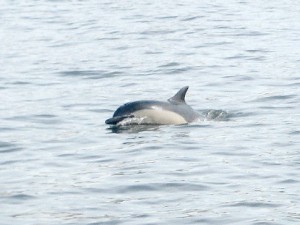
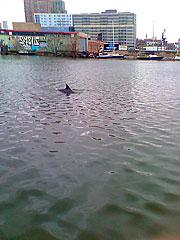
Confirmed observations (on Wednesday, March 3) of a dolphin or two (photos above) in Newtown Creek and near Brooklyn’s Navy Yard, New York, are noted here and here.
A large harp seal stranded itself in a Weymouth, Massachusetts marsh on Thursday afternoon, March 4, according to this report, which also has video.
The alleged dubious nature of recent cougar sightings in Connecticut are discussed in the Courant.
Plus the drama of that escaped monkey in Florida continues, according to a March 3rd news item.
 About Loren Coleman
Loren Coleman is one of the world’s leading cryptozoologists, some say “the” leading living cryptozoologist. Certainly, he is acknowledged as the current living American researcher and writer who has most popularized cryptozoology in the late 20th and early 21st centuries.
Starting his fieldwork and investigations in 1960, after traveling and trekking extensively in pursuit of cryptozoological mysteries, Coleman began writing to share his experiences in 1969. An honorary member of Ivan T. Sanderson’s Society for the Investigation of the Unexplained in the 1970s, Coleman has been bestowed with similar honorary memberships of the North Idaho College Cryptozoology Club in 1983, and in subsequent years, that of the British Columbia Scientific Cryptozoology Club, CryptoSafari International, and other international organizations. He was also a Life Member and Benefactor of the International Society of Cryptozoology (now-defunct).
Loren Coleman’s daily blog, as a member of the Cryptomundo Team, served as an ongoing avenue of communication for the ever-growing body of cryptozoo news from 2005 through 2013. He returned as an infrequent contributor beginning Halloween week of 2015.
Coleman is the founder in 2003, and current director of the International Cryptozoology Museum in Portland, Maine.











What could be causing Flipper there to go to New England, I wager???
Could it be changing weather patterns??? Loss of habitat???
Maybe Dolphins now have the Travel Bug??? 🙂
Whatever the reason—cool beans. Thanks, Loren…
It’s probably for the better acronym-wise that it’s no longer “particularly-out-of-place” animals.
earthquakes? I wonder if a big one is looming…
Cryptidsrus- Well, OOP animals that are escaped exotics are easy enough to explain but in the case of animals that are just clearly out of their range, there could be all kinds of reasons.
It could be global warming, loss of habitat, diminished food resources which in turn cause the animals to travel farther and farther to find food, and others. It might even be something that we don’t even fully understand or are not aware of, such as fluctuations in magnetic fields or some other inhibition to an animal’s natural navigation sense. So for instance, perhaps things like artificial signals, waves, sonar, and whatnot are interfering with the animals’ directional sense, or some other process we don’t fully comprehend.
Likely it is some combination of several factors.
I also think that it is hard to put strict boundaries on the range of certain species. Historical ranges of various animals are malleable and subject to change for a wide variety of reasons from natural to human imposed. Organisms are constantly adapting and pushing at the boundaries of their supposed ranges. In fact, this branching out to different habitats is one of the driving forces of speciation. It should not seem too surprising to occasionally find wayward animals where they are not supposed to be.
Even in cases where there are strict geographical boundaries such as mountains, deserts, or with islands and other environments surrounded by completely unlike environments, the modern world has drastically changed the dynamics of the distribution of species. Humans are increasingly able to, and do, transport species with ease across boundaries that would have isolated these species before.
This can be either intentionally as with animals that we desire or perceive as beneficial to us in one way or another, or unintentionally. For instance ship ballast tanks are notorious for transporting an array of stowaway marine species. The rate of introduced and/or invasive organisms on foreign habitats has seen a dramatic increase as these geographic boundaries become a thing of the past.
My point is that humans and their technology have created a world where the boundaries of species no longer really exist in a natural state, where species are spreading out across divides at a far greater rate than would naturally occur under normal circumstances. We are looking at a situation where it is really no longer so odd to find species where they are not supposed to be. I can think of very few places that are completely free of foreign plant and animal species.
Add in climate change and other, often human imposed factors, and we are likely to see some significant changes in the distribution of species into the future, well within our lifetimes. In my opinion, it is going to come to a point where “Out of place” is not going to be so OUT of place at all.
I find myself less and less surprised by these OPP reports.