
An Old Chestnut
Posted by: Loren Coleman on March 25th, 2008
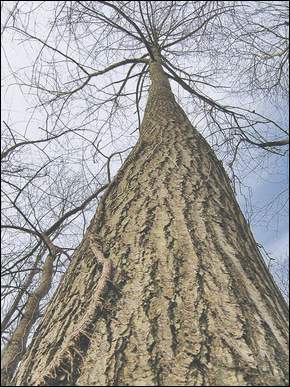
Ohio has a secret, which has been revealed a bit. A secret tree, that is. The state has kept their secret for seven years. They retain part of the hidden knowledge about the above pictured tree, because they aren’t telling anyone where it is located.
This Ohio treasure’s existence was closely guarded until last week when the director of the Ohio Department of Natural Resources revealed that a full-sized American Chestnut tree still stands in a marsh near Lake Erie.
For tree experts, it’s a big deal.
American chestnuts that grew up to 120 feet once accounted for about 25 percent of the forests in the eastern half of North America until a fungus wiped out all but a few.
“They are often referred to as the redwood of the east because of their tremendous size,” Gary Obermiller, a regional manager for the Division of Natural Areas and Preserves.
The fungus was first detected in 1904 in trees in New York City, and by 1950 some 3.5 billion trees – about 90 percent of the species – were dead.
Only a few trees had resistance to the fungus and survived.
In Ohio, most American chestnut trees were found in the eastern half of the state.
The state’s largest existing chestnut tree – known only to a few until last week – is in Sheldon Marsh, a 465-acre state nature preserve about midway between Toledo and Cleveland.
The tree stands 89 feet tall and has a 5-foot circumference. “To our knowledge, we don’t have any that come close to this size,” Obermiller said.
Most surviving chestnut trees are small, sprouting from the roots of trees killed by the fungus.
Steve Maurer, the new chief of Natural Areas and Preserves, decided the public should be told about the tree, Obermiller said. “He realized this was a very special tree,” Obermiller said.
Maurer has asked the American Chestnut Foundation if it wants samples of the tree to determine if the tree is resistant to the chestnut blight, Obermiller said.
The tree produces fruit, but the seeds aren’t viable because there isn’t another tree to pollinate it, he said.
Natural resources director Sean Logan let it slip last week that the tree exists. He said during a meeting of the Ohio Lake Erie Commission that he was going to visit it later that day.
But the exact site is still protected.
State officials want to make sure the tree remains, and there is an eagle’s nest in it.
Someplace out there in Sheldon Marsh may be a cryptid black panther staring at this large Chestnut tree, and wondering what all the fuss is about.
 About Loren Coleman
Loren Coleman is one of the world’s leading cryptozoologists, some say “the” leading living cryptozoologist. Certainly, he is acknowledged as the current living American researcher and writer who has most popularized cryptozoology in the late 20th and early 21st centuries.
Starting his fieldwork and investigations in 1960, after traveling and trekking extensively in pursuit of cryptozoological mysteries, Coleman began writing to share his experiences in 1969. An honorary member of Ivan T. Sanderson’s Society for the Investigation of the Unexplained in the 1970s, Coleman has been bestowed with similar honorary memberships of the North Idaho College Cryptozoology Club in 1983, and in subsequent years, that of the British Columbia Scientific Cryptozoology Club, CryptoSafari International, and other international organizations. He was also a Life Member and Benefactor of the International Society of Cryptozoology (now-defunct).
Loren Coleman’s daily blog, as a member of the Cryptomundo Team, served as an ongoing avenue of communication for the ever-growing body of cryptozoo news from 2005 through 2013. He returned as an infrequent contributor beginning Halloween week of 2015.
Coleman is the founder in 2003, and current director of the International Cryptozoology Museum in Portland, Maine.











Wow thats great news . Are there any other trees available in other areas to pollonate it with?
Wow! It really boggles the mind when one tries to imagine the changes that the landscape in North America has undergone since the end of the ice age, let alone the arrival of humans, and Europeans in particular. This entire history fascninates the stuffing out of me.
I would highly recommend anyone who is interested in finding out what recent reseach is revealing about the transformation that’s taken place in the Americas forests just since 1491 to check out author Charles C. Mann’s book “1491: recent revelation on pre-columbian americas”. Dry history it is not and you will be astonished at the story of the Pilgrims that’s not in every child’s 5th grade American History book.