
Ogopogo 1934
Posted by: Loren Coleman on February 24th, 2010
In the spirit of the 2010 Winter Olympics, perhaps we should visit another Canadian cryptid? As it happens, I did in 1975, in B.C., at least.
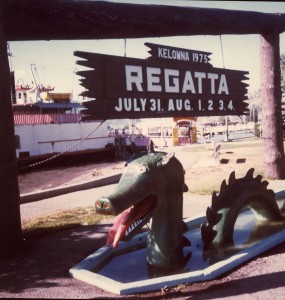
(Photo: Loren Coleman © 1975)
Billings, Montana
Billings Gazette
July 1, 1934
Sea Serpent Is Objective Of Mounties
Edmonton, Alta., June 30. – (UP) – Royal Canadian mounted police are on the spot.
Extolled for their ability “to get their man,” the mounties have been assigned the task of catching an Ogopogo – Sea Serpent to you. Since nobody, since the days of ancient mariners, has succeeded in hog-tieing an Ogopogo, it appears the mounties are in for a lot of work, if their reputation is to remain unblemished.
The latest source of annoyance for the world’s most famous policemen first poked its ugly head above the waters of Battle river near Rosalind, 77 miles southeast of Edmonton.
Described as “about the diameter of a stovepipe, 25 to 30 feet long, grey in color, with a slimy, tapering head,” the monster has been seen at points eight miles apart, at four different times by four different witnesses, all reputable folk.
The witnesses, three coal mine operators and a farmer, say the monster swims at a speed of about 15 miles an hour, lashing the water into foam as it moves.
The Ogopogo was reported to Royal Canadian Mounted police and crowds of more than 100 have gathered from time to time on the river bank in hope of catching the Ogopogo.
William Shurrett, farmer, apparently had the best view of the critter. He said, “I was crossing a bridge and I saw waves like those made by a stream launch approaching.
“Then I saw a sea serpent coming through the shallow water. There was no mistake about it. It had an ugly head with a tapering neck and was about 30 feet long. There was a bulge in its middle, as if it had just eaten a big meal.”
Thanks to Jerome Clark for sharing this archival news item.
 About Loren Coleman
Loren Coleman is one of the world’s leading cryptozoologists, some say “the” leading living cryptozoologist. Certainly, he is acknowledged as the current living American researcher and writer who has most popularized cryptozoology in the late 20th and early 21st centuries.
Starting his fieldwork and investigations in 1960, after traveling and trekking extensively in pursuit of cryptozoological mysteries, Coleman began writing to share his experiences in 1969. An honorary member of Ivan T. Sanderson’s Society for the Investigation of the Unexplained in the 1970s, Coleman has been bestowed with similar honorary memberships of the North Idaho College Cryptozoology Club in 1983, and in subsequent years, that of the British Columbia Scientific Cryptozoology Club, CryptoSafari International, and other international organizations. He was also a Life Member and Benefactor of the International Society of Cryptozoology (now-defunct).
Loren Coleman’s daily blog, as a member of the Cryptomundo Team, served as an ongoing avenue of communication for the ever-growing body of cryptozoo news from 2005 through 2013. He returned as an infrequent contributor beginning Halloween week of 2015.
Coleman is the founder in 2003, and current director of the International Cryptozoology Museum in Portland, Maine.









Greetings All!
I have a question of nomenclature. I have thought that “Ogopogo” was only used for animals sighted in Lake Okanagan. Last I checked, that lake was not 77 miles southeast of Edmonton. Has the term “Ogopogo” had a historically larger area of use? Or is this just some journalist, not worth his/her salt (in the original sense), not fact checking?
While it could certainly be a journalistic mistake, I tend to find that terms like “Ogopogo” were used loosely, applying to any Canadian Lake Monster, if the news reporter so wished to employ it thusly. The story from Alberta seems to be talking about something seen in an Alberta lake.
Furthermore, the “pogo” part of the word Ogopogo caught on and was transposed to be used for other Canadian aquatic cryptids, e.g. Igopogo (Lake Simcoe, Ontario, from 1952?) and Manipogo (Lake Manitoba, Manitoba, named in 1957).
Of course, since the term “Sea Serpent” is used with Ogopogo in this 1934 article, considering that Ogopogo is a Lake, not a Sea Monster, one must assume that the media played fast and loose with cryptid terminology back then. 🙂
Actually, I was led to think the term “Ogopogo” was coined by an English vaudevillian touring the area in the early twentieth-century. He supposedly included it in a song. Guess I was wrong.
I guess he merely popularized an existing term.
My “Bad.” Whenever the “moniker” came from, it is unforgettable.
Ogopogo was used as a term for lake monsters in Alberta at the time.
If you check my catalogue of Alberta lake monster articles, Ogopogo is used from 1927-1949