
New Ray Discovered
Posted by: Loren Coleman on March 22nd, 2009
Scientists have discovered a new species of sting ray.
The spotted eagle ray was thought to be one species of fish found all over the world in tropical shallow waters including the Indian Ocean, the Pacific west coast and Gulf of Mexico.
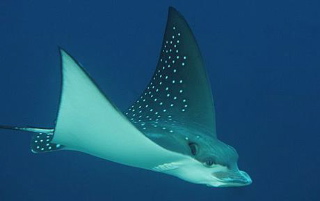
The ray has a venomous tail but is not aggressive and feeds on molluscs. It is named after the numerous white ringed spots on its body and a distinctive head that resembles a bill. It can weigh up to 500 pounds and measure 10ft across the wingspan.
However using new DNA techniques scientists have discovered that in fact the sting ray is made up of a number of at least two and possibly more species and sub species. This means the ray is under more threat from over fishing as each newly discovered species or subspecies has a smaller distribution and population size compared to a single, globally distributed species, making them more vulnerable to pressures from fisheries. Ultimately fishing out one small population could mean the extinction of that species.
This discovery was made by a team of marine scientists from the Save Our Seas Foundation Shark Center and National Coral Reef Institute at Nova Southeastern University in Florida, USA. In the past the spotted eagle ray was categorised on its physical appearance. But using new DNA techniques, it was found the ray is actually made up of at least two and possibly more subspecies. The different species look similar but have a different genetic make up which has evolved as the ray spread to different parts of the world.
Work will now begin to officially identify and name the new species.
The findings published in the Journal of Heredity has significant conservation implications for the survival of all the new species.
At the moment the spotted eagle ray is already listed as a vulnerable and near threatened species because of its low reproductive rates.
However Mahmood Shivji from the Save Our Seas Foundation Shark Center said the different species will be even more vulnerable.
“These listings are based on the designation of the ray as a single global species; in light of what we have discovered each of the more regionally distributed species may be far more threatened than previously thought. Clarifying uncertainties surrounding the number of species, and their exact distributions and population size is imperative for guiding conservation and management efforts,” Mahmood Shivji said to the London Telegraph.
🙂 Thank You.
 About Loren Coleman
Loren Coleman is one of the world’s leading cryptozoologists, some say “the” leading living cryptozoologist. Certainly, he is acknowledged as the current living American researcher and writer who has most popularized cryptozoology in the late 20th and early 21st centuries.
Starting his fieldwork and investigations in 1960, after traveling and trekking extensively in pursuit of cryptozoological mysteries, Coleman began writing to share his experiences in 1969. An honorary member of Ivan T. Sanderson’s Society for the Investigation of the Unexplained in the 1970s, Coleman has been bestowed with similar honorary memberships of the North Idaho College Cryptozoology Club in 1983, and in subsequent years, that of the British Columbia Scientific Cryptozoology Club, CryptoSafari International, and other international organizations. He was also a Life Member and Benefactor of the International Society of Cryptozoology (now-defunct).
Loren Coleman’s daily blog, as a member of the Cryptomundo Team, served as an ongoing avenue of communication for the ever-growing body of cryptozoo news from 2005 through 2013. He returned as an infrequent contributor beginning Halloween week of 2015.
Coleman is the founder in 2003, and current director of the International Cryptozoology Museum in Portland, Maine.











A new species, really? Or a new sub-species. Although I am happy to have the facts on this ray this is a mixed bag of emotions for me. The whole tenor of the article turned to protecting this creature and its habitat. That can only mean a plethora of restrictions on recreational fishing, commercial fishing, diving, sight seeing, or splashing where this animal is said to live.
The Endangered Species Act is a valuable tool for protecting the welfare of at risk populations, but, it can also be a bludgeon in the wrong hands. As we find more and more populations of sub-species and unique variants of a common breed stock I fear abuse of private property owner rights.
Yikes, as science improves it’s techniques of identifying the DNA of populations of all manner of creatures there will be some difficult choices that need to be made. Do we have the where-with-all to protect every new sub-species we find? My first impulse is to say no. But that is the pragmatist in me. I do not doubt we will shortly hear that global warming is threatening the breeding grounds of this new ray we can’t get along without.