
Do Bigfoot Show Steatopygia?
Posted by: Loren Coleman on August 28th, 2012
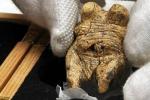
The Venus of Hohle Fels, discovered in a cave in southern Germany, may be the oldest-known example of figurative art. The mammoth-ivory carving (allegedly) of a woman with grotesquely exaggerated sexual features is at least 35,000 years old, and may be 5,000 years older than the next-oldest example of so-called Venus figurines. Does it remind you of other hominology profiles?
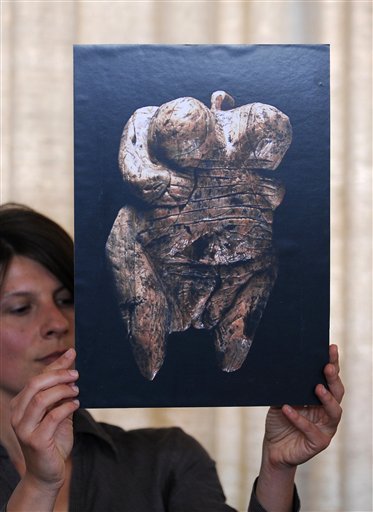
Maria Malina, scientific employee, presents the photo of a carved ivory female figurine during its presentation in Tuebingen, southern Germany, Wednesday, May 13, 2009. The figurine, found in 2008 in a cave in Schelklingen, southern Germany is allegedly the world’s oldest reproduction of a human with an estimated age of at least 35,000 years.
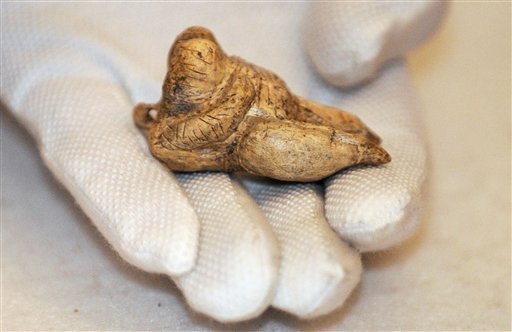
A carved ivory female figurine is presented in Tuebingen, southern Germany, Wednesday, May 13, 2009. The figurine, found in 2008 in a cave in Schelklingen, southern Germany is allegedly the world’s oldest reproduction of a human with an estimated age of at least 35,000 years.
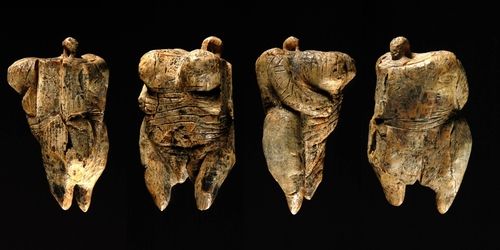
The 35,000 year old Venus of Hohle Fels is seen here from all sides. She’s holding up rather well for a woman of that age, I’d say.
What does the figurine have in common with other images we have come to know?
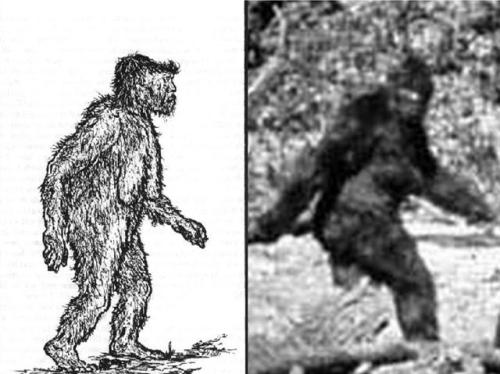
Maybe big-breasted women and Bigfoot – remember those Venuses found in cave art were big in a few areas of their bodies – stored fat reserves for the hard times. Perhaps men are still working with Neandertal and Cro-Magnon genes that still shout out some hard to ignore signals about selecting the best breeders with the best fat reserves?
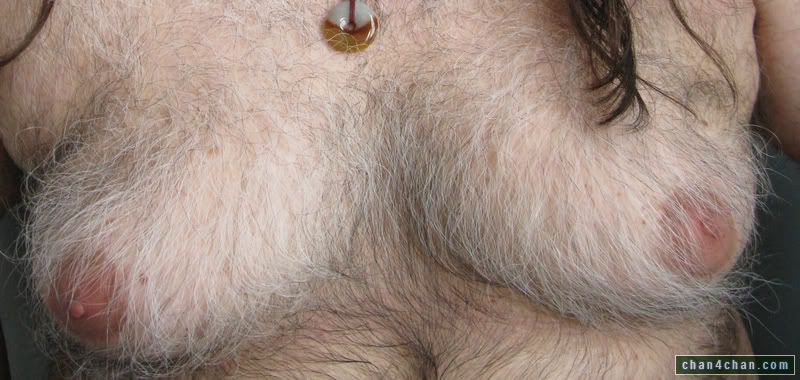
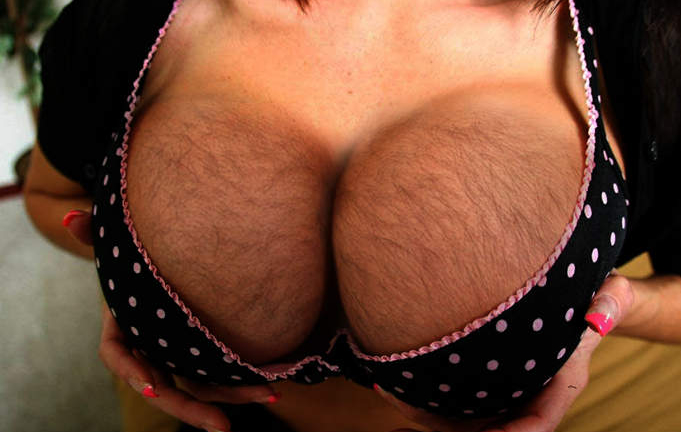

Ms. Sheyla Hershey. Of course, the storage of the fat has to be real.
Everyone talks about Bigfoot breasts, of course, but aren’t we ignoring another rather significance part of the apparent Bigfoot body?
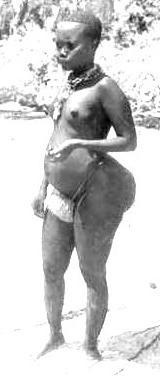
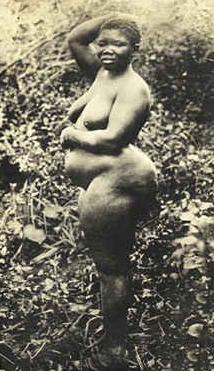
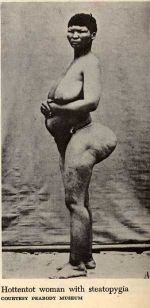
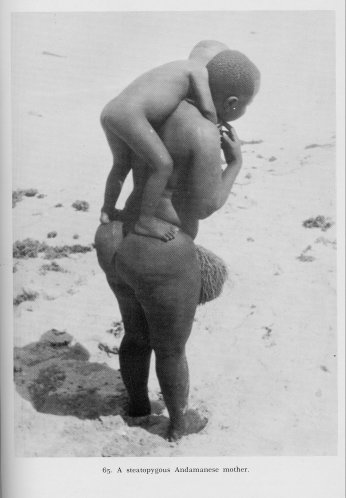
In 2007, I examined the never-before-discussed theory that the female “Patterson Bigfoot” shows steatopygia. By definition steatopygia is the extreme accumulation of fat on the buttocks.
“Steatopygia is believed to be an adaptive physiological feature for female humans living in hot environments, as it maximizes their bodies’ surface-area/volume ratio but keeps enough fat to produce hormones needed for menstruation….Women possessing these fat deposits can keep on reproducing through the unproductive seasons, thereby increasing their fitness. Others say that the steatopygia developed as a response to sexual selection.”
Below are some visuals supporting these thoughts about the October 20, 1967 filmed Bigfoot at Bluff Creek, California. These are archival anthropological photographs that demonstrate examples of steatopygia in Homo sapiens – contemporarily and through archaeologically discovered art. These also can be compared with the new find of the Venus of Hohle Fels.
Shown in ancient cave art:
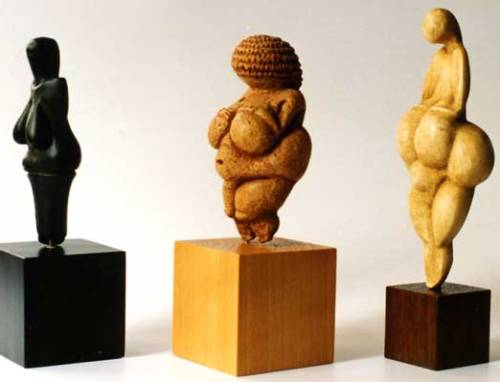
For modern females among the Onge/Bushman, Hottentot, and Andamanese Negrito:
And with a Bushman male:
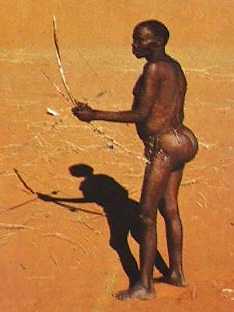
What do you think? Bigfoot breasts and steatopygia don’t seem to be that abnormal, after all, do they?
Perhaps hominology would do well to study more closely other angles of the Venus of Hohle Fels and Venus figurine research.
 About Loren Coleman
Loren Coleman is one of the world’s leading cryptozoologists, some say “the” leading living cryptozoologist. Certainly, he is acknowledged as the current living American researcher and writer who has most popularized cryptozoology in the late 20th and early 21st centuries.
Starting his fieldwork and investigations in 1960, after traveling and trekking extensively in pursuit of cryptozoological mysteries, Coleman began writing to share his experiences in 1969. An honorary member of Ivan T. Sanderson’s Society for the Investigation of the Unexplained in the 1970s, Coleman has been bestowed with similar honorary memberships of the North Idaho College Cryptozoology Club in 1983, and in subsequent years, that of the British Columbia Scientific Cryptozoology Club, CryptoSafari International, and other international organizations. He was also a Life Member and Benefactor of the International Society of Cryptozoology (now-defunct).
Loren Coleman’s daily blog, as a member of the Cryptomundo Team, served as an ongoing avenue of communication for the ever-growing body of cryptozoo news from 2005 through 2013. He returned as an infrequent contributor beginning Halloween week of 2015.
Coleman is the founder in 2003, and current director of the International Cryptozoology Museum in Portland, Maine.







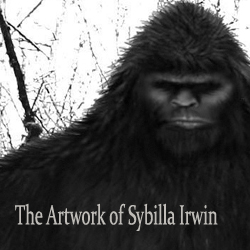



So….now when we’re asked, “Does this dress make me look fat?” we can safely reply that it merely demonstrates her “ample reserves”? How fast can you duck?
Apparently, in the modern world, the best breeders are those females who display ample reserves of silicone… 😉
A careful lingering look at patty’s rump does suggest steatopygia but maybe its extra muscle. My impression is that she has quite wide hips as well, as in this homo erectus pelvis see.
I get the impression that the homo erectus pelvis would fit her quite well.
R. Crumb thinks so:
From the side that piece looks like a woman lying on her back with a smaller figure (man)? on top of her. Anyone else notice that?
Excuse me.
Does this highly controversial film, still hotly debated after 45 years, and oh by the way shot by a man falling off a horse, make me look fat?
“From the side that piece looks like a woman lying on her back with a smaller figure (man)? on top of her. Anyone else notice that?”
William I was go’n’o be facetious and say lying on her back she looks like Jabba the Hutt lying atop Han Solo. Had you noticed that?
But you have a point.
But it isn’t one smaller figure lying atop her it’s two (when you factor in she’s got two breasts) and the motif of divine twins’s as cofounders of civilization’s extremely ancient.
* * *
Loren I actually used to know a brunette who was covered from head to toe in thick wiry white fur and she was oddly quite popular even though she tended to have a a thicker beard and moustache than yours when she couldn’t be bothered to shave. Fancy a date?
But that steato- arseous thing is a good point (or two) and I find myself wondering in a non-facetious way whether anyone’s ever bothered to play the Patty film to a gang of black rappers.
Those guys’re really big on booties and booty calls etc and if ever there were any group who could be said to be world experts on arses it’s them.
Seriously if Patty’s arse’s real (therefore implying she’s real too) then those guys will nail her (so to speak) before they even have a chance to blink.
Seriously.
Your reaching here. The human female images that accompany the article provide all the answers needed without calling in Bigfoot. Surely you don’t expect primitive humans to sculpt with the talent of Rodin or Michelangelo…just the fact that the ancient figures even resemble females is impressive for primitive artists working with hard substances and almost no tools. Sculpting is difficult – try it sometime and see how you do. Those ancient artists were creating images of what was improtant to them…their women, not bigfoot. As to the question – does Bigfoot display steatopygia? – humans and apes do and if Bigfoot does exist, It’s certainly possible.