
Yeti Crab And Beyond: New Marine Species 2006
Posted by: Loren Coleman on December 11th, 2006
The media attention is high today for the Sloan Foundation’s year six census of marine life, so I’ll keep this short. You can read one of the stories here, from CNN, and another here in The Hindu. At last count, I found over 200 versions of this story appearing in newspapers and online sites around the world.
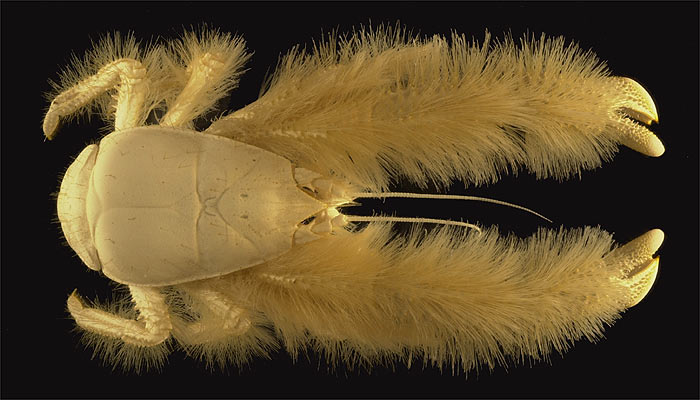
Courtesy © Ifremer / A. Fifis Press Release; click on image for larger view.
The Yeti crab photo is getting recycled. (Click on the hyperlink for more about it.)
Here’s a summary of the findings from the 2006 research:
Shrimp, clams and mussels living near the super-hot thermal vent in the Atlantic, where they face pulses of water that is near-boiling despite shooting into the frigid sea.
In the sea surrounding the Antarctic, a community of marine life shrouded in darkness beneath more than 1,600 feet of ice. Sampling of this remote ocean yielded more new species than familiar ones.
Off the coast of New Jersey, 20 million fish swarming in a school the size of Manhattan.
Finding alive and well, in the Coral Sea, the type of shrimp called Neoglyphea neocaledonica, thought to have disappeared millions of years ago. Researchers nicknamed it the Jurassic shrimp.
Satellite tracking of tagged sooty shearwaters, small birds, that mapped the birds’ 43,500-mile search for food in a giant figure eight over the Pacific Ocean, from New Zealand via Polynesia to foraging grounds in Japan, Alaska and California and then back. The birds averaged a surprising 217 miles daily. In some cases, a breeding pair made the entire journey together.
A new find: a 4-pound rock lobster discovered off Madagascar.
A single-cell creature big enough to see, in the Nazare Canyon off Portugal. The fragile new species was found 14,000 feet deep. It is enclosed within a plate-like shell, four-tenths of an inch in diameter, composed of mineral grains.
A new type of crab with a furry appearance, near Easter Island. It was so unusual it warranted a whole new family designation, Kiwaidae, named for Kiwa, the Polynesian goddess of shellfish. Its furry appearance justified its species name, hirsuta, meaning hairy.
 About Loren Coleman
Loren Coleman is one of the world’s leading cryptozoologists, some say “the” leading living cryptozoologist. Certainly, he is acknowledged as the current living American researcher and writer who has most popularized cryptozoology in the late 20th and early 21st centuries.
Starting his fieldwork and investigations in 1960, after traveling and trekking extensively in pursuit of cryptozoological mysteries, Coleman began writing to share his experiences in 1969. An honorary member of Ivan T. Sanderson’s Society for the Investigation of the Unexplained in the 1970s, Coleman has been bestowed with similar honorary memberships of the North Idaho College Cryptozoology Club in 1983, and in subsequent years, that of the British Columbia Scientific Cryptozoology Club, CryptoSafari International, and other international organizations. He was also a Life Member and Benefactor of the International Society of Cryptozoology (now-defunct).
Loren Coleman’s daily blog, as a member of the Cryptomundo Team, served as an ongoing avenue of communication for the ever-growing body of cryptozoo news from 2005 through 2013. He returned as an infrequent contributor beginning Halloween week of 2015.
Coleman is the founder in 2003, and current director of the International Cryptozoology Museum in Portland, Maine.











I just find it fascinating to think that human knowledge of the universe outweighs the knowledge we have of the oceans here on earth! It’s exciting to think of all the different species we’ve still to encounter as technology allows us to explore deeper.
Wowza! That crab is freaky lookin!
Wikipedia says:
“True crabs have five pairs of legs, the first of which is modified into a pair of claws…”
I’m only seeing three pairs, with maybe a fourth hidden in the fur of the clawed pair. So is this really a crab?
Answered my own question. Again, according to Wikipedia, the Yeti crab is more closely related to the Hermit Crab, which is not a true crab, and the Squat Lobster, which is not a true lobster. The Squat Lobster has four pairs of legs, including the claws.
I guess the fur-bearing trout isn’t so ridiculous now that we have a fur-bearing crab.
Intersting, the world still holds some secrets for us to find.
Speaking of bigfoot lobsters – it seems a new 4 pound marine variety has been discovered of the coast of Madagascar.
But let’s not forget – the Australian freshwater crayfish from Tasmanian rivers grows at least half the length (and twice the weight) again.
Chris.
You sure that’s not a werecrab ???
At the other end of the spectrum, ABC Science reports that a “Jurassic Shrimp” – thought extinct for 50 million years – has been discovered alive off the West Australian coast.