
New Limbless Lizard Discovered
Posted by: Loren Coleman on May 29th, 2007
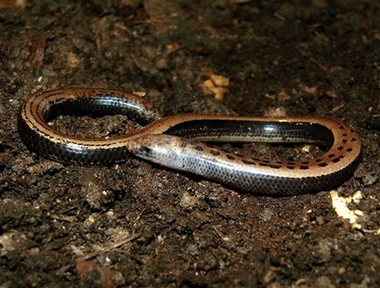
The discovery of a new species of limbless lizard (pictured above), belonging to the genus Sepsophis, was announced on May 28, 2007.
The seven-inch-long lizard was found 10 days before during a field study in the forested region of Khandadhar near Raurkela in Orissa state, India, about 625 miles southeast of New Delhi.
It prefers to live in a cool retreat, soft soil and below stones. The lizard is new to science and is an important discovery. It is not found anywhere else in the world. The new species will be scientifically described at a later stage after accumulation of more data. Dr. Sushil Kumar Dutta of Vasundhra and Head of Zoology, North Orissa University, Baripada, India, as told to the Associated Press.
The closest relatives of the new species are found in Sri Lanka and South Africa.
Another species of the same genus, Sepsohis punctatus, was found in 1870 from the Golconda hills in Andhra Pradesh, said Varadi Giri, a scientist at the Bombay Natural History Society, who was not part of the team that found the lizard. Giri said Dutta is a reputed zoologist and his claim appears legitimate.
“But for an independent confirmation, one has to wait for the publication of the finding in a reputed science magazine,” Giri noted.
 About Loren Coleman
Loren Coleman is one of the world’s leading cryptozoologists, some say “the” leading living cryptozoologist. Certainly, he is acknowledged as the current living American researcher and writer who has most popularized cryptozoology in the late 20th and early 21st centuries.
Starting his fieldwork and investigations in 1960, after traveling and trekking extensively in pursuit of cryptozoological mysteries, Coleman began writing to share his experiences in 1969. An honorary member of Ivan T. Sanderson’s Society for the Investigation of the Unexplained in the 1970s, Coleman has been bestowed with similar honorary memberships of the North Idaho College Cryptozoology Club in 1983, and in subsequent years, that of the British Columbia Scientific Cryptozoology Club, CryptoSafari International, and other international organizations. He was also a Life Member and Benefactor of the International Society of Cryptozoology (now-defunct).
Loren Coleman’s daily blog, as a member of the Cryptomundo Team, served as an ongoing avenue of communication for the ever-growing body of cryptozoo news from 2005 through 2013. He returned as an infrequent contributor beginning Halloween week of 2015.
Coleman is the founder in 2003, and current director of the International Cryptozoology Museum in Portland, Maine.











well since there are no post so far i think i’ll add this,
What features does it have make it a lizard instead of a snake, because thats what i thought it was when i first saw it, and wondering why its known as a lizard.
Duffguy, lizards have eyelids and external ear openings, which snakes do not. Also, I think lizards can’t separate their jawbones to swallow large food like snakes. But, lizards and snakes are closely related.
If they never knew this one existed before, how can they say that it is found nowhere else in the world?
Duffguy- Snakes and lizards are both part of the order of reptiles known as Squamata. However lizards are part a sub order Lacertilia, (AKA Sauria), while snakes are part of the suborder Ophidia. How are they different?
Usually, a big difference between snakes and lizards is obviously the fact that most lizards have legs but even when these are absent, there are differences. There are, for example quite a few internal differences. In lizards, there is at least a vestige of skeletal support for the front limbs, which is called a pectoral girdle. Lizards also have a sternum and the ribs are not forked, where in snakes at least one or two sets of ribs are. Lizards also do not have a brain that is encased in as much bone as snakes, with a region being covered by a membrane. In lizards, the two halves of the jaw are united where in snakes they are attached by a pliable ligament.
There are external differences too. Lizards have external ear openings flush with the skin, allowing them to hear airborne sounds, snakes do not. Lizards also have flat, fleshy tongues rather than forked tongues like snakes. If you look at a lizard’s eyes, you will find that they have moveable eyelids, which are absent in snakes. Lizards, even when limbless tend to be shorter than a snake.
Even with legless lizards, it is fairly easy to classify them into the proper suborder. I hope this is useful information for you!
Reptiles are still evolving, they are not merely a product or leftovers from the age of Dinosaurs.
For a lizard to lose its legs in this particular species there had to be some advantage to aid in its survival. I know of a Marble faced Worm lizard and a Burtons snake lizard both from the family (Pypogodidae) and a Skink, Boulenger’s legless skink.
There is a legless lizard common to the Smokey Mountains; I caught several over the years, I can’t remember its common name, but they are distinct from snakes and they don’t move as fast as snakes.
Joppa, this would have been the misnamed “glass snake”, so called from the brittle tail. It was also called “joint snake” from the folk belief that the animal could rejoin with its separated tail later.
The so-called “slow worm” or “blindworm” of the British Isles and maybe continental Europe is also a legless lizard.
Bob Michaels- Indeed, there would be some sort of advantage in order for an organism to undergo such drastic evolutionary change. These features do not happen in a vacuum, for no reason, but rather they persist and are passed on because they are of some use to the creature. In the case of this species, since it seems to prefer soft soil, the benefit could be the aid that leglessness gives to burrowing. Evolving leglessness presents advantages to burrowing into the ground and therefore exploiting resources that other legged, non burrowing animals were unable to get at.
You guys know your reptiles! Cool…I will turn to you for information when I need to know my reptiles!
That’s not too far from the Gobi Desert… Maybe a limbless lizard is to blame for the Mongolian Death Worm reports – it’s a possibility anyway.
czs, I’ve always thought that der totenvurm sounded like a legless lizard like the above. I suspect that is what will be found.
Cryptozoology shop, yes indeed it could be an Amphisbaenians, but they are known from Africa and South America, could be a form in the Gobi desert.
Mystery man, I agree with your analysis. What came first the limbless lizard or the snake?
Bob Michaels- The answer to your question is actually pretty complicated and kind of a trick question. The evolution of snakes is not very well understood and is the subject of some debate especially considering that the fossil record for snakes is full of holes and is quite incomplete. Snake fossils are delicate and do not fossilize easily, which leaves the record patchy. I won’t go into too much detail, but the main theory is that snakes evolved from a family of lizards during the time of the dinosaurs. It is thought these lizards adapted to a burrowing way of life in order to open up new food sources and afford protection from predators. It wasn’t until later on that many snakes abandoned the burrowing lifestyle and proceeded to fill the myriad niches they inhabit today. In modern times, there are arboreal snakes, desert snakes, ground dwelling snakes, marine snakes, snakes living in a wide variety of habitats and niches, yet they are thought to have all evolved from lizards that originally adapted to burrow. If you want to look at this strictly speaking, then since they evolved essentially from legless lizards, the legless lizards came first.
But another way to look at it would be that modern legless lizards as we know them came second because they represent species of legged lizards that evolved later on to utilize the rescources and burrowing lifestyle that was being abandoned by the snakes. As these burrowing niches opened up, some lizards adapted to exploit them and so from this perspective, snakes came first. So in a way, you could say that snakes came first.
There has actually been some debate as to how exactly snakes evolved and some have challenged the commonly held theory that I just told you. There are those who think that snakes represent the evolution of lizards adapting to a marine lifestyle rather than a burrowing one, and other theories are floating around as well. It is not known for certain and it is difficult since as I said, the fossil record for snakes is poor, so the debate will probably continue although improved DNA and molecular analysis will perhaps clear up some questions. It’s very interesting to speculate about although I personally think that snakes evolved from lizards that evolved to burrow.
Thanks for the informative responses Jayman, I really appreciated reading them.
I just wanted to mention that this lizard looks a lot like an Aligator LIzard we have out here on the west coast (US), but a legless variety. At least a superficial similiarity perhaps due to their shared prefered habitation. That being under cool rocks etc.
Dear Friends,
It seems our small lizard has raised many questions in your mind. As I am a part of the team which discovered it. I would like to clarify your doubts on this aspect. It is no doubt a lizard rather than a mistaken snake. Please post any question you would like to me on the lizard. And some people say how can we say that no other lizards are found in the whole world. Well we have been misquoted. It is an evolutionary significant discovery.