
New Bird Discovered in Brazil
Posted by: Loren Coleman on October 11th, 2007
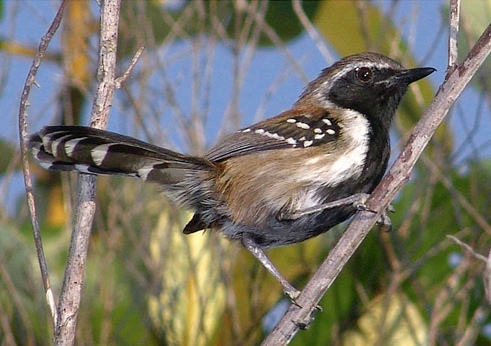
A beautiful new species, Formicivora antwren from Brazil, has just been discovered. Intriguingly, this bird’s status as a new species was argued based on its distinct vocalizations.
A new species of antwren from Bahia, Brazil has recently been described in the journal Zootaxa. Sincorá Antwren Formicivora grantsaui is found only in the campo rupestre vegetation of the Serra do Sincorá between 850 m and 1,100 m in the Chapada Diamantina region. This is an important area that holds other restricted range species such as Grey-backed Tachuri Polystictus superciliaris and Pale-throated Pampa-finch Embernagra longicauda. First observed in 1997, it is closely related to Rusty-backed Antwren Formicivora rufa, with which it sometimes occurs sympatrically. It differs slightly in some plumage characters but more importantly it has quite distinctive vocalisations and each species utilises different habitats. Formicivora grantsaui occurs on rocky outcrops in the campo rupestre and F. rufa in the adjacent savannas. If confirmed, this discovery highlights the importance of researchers using vocalisations and habitat preference in identifying distinct species.International Birdlife
 About Loren Coleman
Loren Coleman is one of the world’s leading cryptozoologists, some say “the” leading living cryptozoologist. Certainly, he is acknowledged as the current living American researcher and writer who has most popularized cryptozoology in the late 20th and early 21st centuries.
Starting his fieldwork and investigations in 1960, after traveling and trekking extensively in pursuit of cryptozoological mysteries, Coleman began writing to share his experiences in 1969. An honorary member of Ivan T. Sanderson’s Society for the Investigation of the Unexplained in the 1970s, Coleman has been bestowed with similar honorary memberships of the North Idaho College Cryptozoology Club in 1983, and in subsequent years, that of the British Columbia Scientific Cryptozoology Club, CryptoSafari International, and other international organizations. He was also a Life Member and Benefactor of the International Society of Cryptozoology (now-defunct).
Loren Coleman’s daily blog, as a member of the Cryptomundo Team, served as an ongoing avenue of communication for the ever-growing body of cryptozoo news from 2005 through 2013. He returned as an infrequent contributor beginning Halloween week of 2015.
Coleman is the founder in 2003, and current director of the International Cryptozoology Museum in Portland, Maine.











Thats one good looking bird!
Hmm. An ant eating wren. Interesting, and beautiful indeed.
Thanks Loren.
PS. I can swear I’ve seen this bird somewhere in Toronto.
Great insight illuminating the concept of species as a population where seperation, rather than simply a variation in morphology or geography, is due to instinctual behaviours as intricately matched and as specific as any lock and key.
A lovely looking thing.
“perdy” birdy 😀
Based on vocalizations. Wow, do the splitters have no limits? Are Russians a different species than Poles?
Sschaper: if the Russians and Poles used instinctive language, instead of the learned forms that we use to communicate vervbally (a not-insignificant component in the socialization that is critical to attracting and keeping mates) and that language was needed in order to get an keep a mate…then yes, Russians and Poles would be different species from the perspective of the biologist who studies populations…but not necessarily from the perspective of someone studying fossils since those features and the barriers they create are not necessarily detectable in fossils but would be apparent and effective when the individual animals were alive. It’s important to keep in mind that the definition of words and concepts will have special significance to groups of specialitst. It’s a mistake to confuse the layman’s understanding with the specialist’s.
Looks like I could find it in my backyard. I don’t live in Brazil.
Mauka; you’re right and depending on where you live, you might be surprised as to just where the dull little birds you associate with your prosaic back-yard spend the other half of the year.