Giant Species Found in Antarctic
Posted by: Loren Coleman on March 21st, 2008
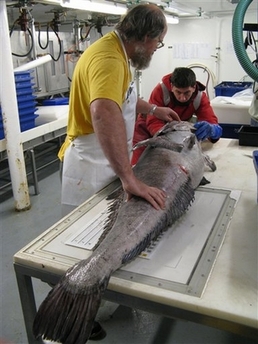
National Institute of Water and Atmospheric Research scientists Brent Wood (NIWA fisheries scientist, left) and Stefano Schiaparelli (Italian National Antarctic Museum taxonomist, right) examine an Antarctic toothfish (1.81 m long, 57 kg) in Tangaroa’s wet lab in Antarctic waters.
Found: giant jellyfish with 12-foot tentacles, large sea spiders, huge sea snails, and 2-foot-wide starfish.
Breaking news is that incredibly large new species have been found in New Zealand’s Antarctic waters. Of the 30,000 specimens collected, hundreds might turn out to be new species.
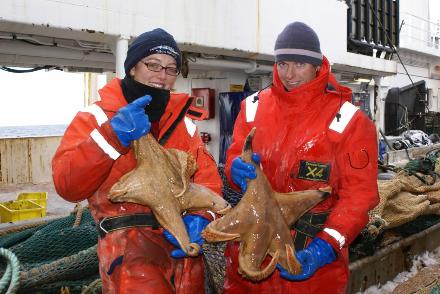
National Institute of Water and Atmospheric Research team members Sadie Mills (NIWA curatorial technician, left) and Niki Davey (NIWA marine ecologist, right) hold giant Macroptychaster sea star (starfish) recently found in Antarctic waters.
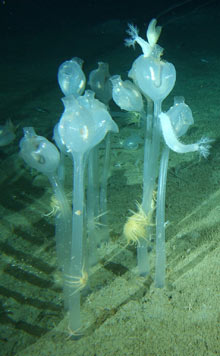
Tunicates, animals that resemble glass tulips, were photographed in Antarctic waters by Australian scientists taking part in a census of marine life in January 2008. (Martin Riddle, Australian Antarctic division/Associated Press)
And you only thought that it was the entryway to the Hollow Earth that would be found!?
 About Loren Coleman
Loren Coleman is one of the world’s leading cryptozoologists, some say “the” leading living cryptozoologist. Certainly, he is acknowledged as the current living American researcher and writer who has most popularized cryptozoology in the late 20th and early 21st centuries.
Starting his fieldwork and investigations in 1960, after traveling and trekking extensively in pursuit of cryptozoological mysteries, Coleman began writing to share his experiences in 1969. An honorary member of Ivan T. Sanderson’s Society for the Investigation of the Unexplained in the 1970s, Coleman has been bestowed with similar honorary memberships of the North Idaho College Cryptozoology Club in 1983, and in subsequent years, that of the British Columbia Scientific Cryptozoology Club, CryptoSafari International, and other international organizations. He was also a Life Member and Benefactor of the International Society of Cryptozoology (now-defunct).
Loren Coleman’s daily blog, as a member of the Cryptomundo Team, served as an ongoing avenue of communication for the ever-growing body of cryptozoo news from 2005 through 2013. He returned as an infrequent contributor beginning Halloween week of 2015.
Coleman is the founder in 2003, and current director of the International Cryptozoology Museum in Portland, Maine.









Thousands, hundreds, a dozen. Depends on the article you read. Or if you read the headline, or the quote here.
The opinion seems to be that they were rather over-zealous in claiming new species. Splitters seem to want to call every breed, race and phase as a new species, rather than the old criterion of ‘can they produce offspring?’
With the almost constant discovery of new creatures, it makes me wonder why there are so many that refuse to even consider the possibility of the existence of some of the more fantastic cryptids. I understand the need for guarded skepticism, but ignoring possibilities for discovery seems counter to the spirit of scientific exploration.
Fascinating story with interesting implications ranging from the question of “what constitutes a species” to “the impact of cold deep and isolated waters”.
I was fortunate to have spend a number of seasons down on “the Ice” and the underwater aspects were among the most fascinating examples of the science being conducted there. Antarctica truly is labratory the likes of which modern science had never had before and the wealth that is eagerly eyed as our technology becomes more capable of exploiting it, I hope will not overshadow the treasure of knowledge that it holds. As hungry as the world is for resources, nothing is as satisfying to the human spirit as the knowledge and sense of wonder at what the planet has in store for us there.
I’m looking forward to more dazzling discovery and deeper understanding as Lake Vostok and other unexamined features are revealed through international cooperation in science.
I think it is fascinating how Antarctic waters have gone from a place once thought to be mostly barren and inhospitable for life, to a perfectly functional ecosystem with a myriad of uniquely adapted organisms. We are finding new types of animals thriving in places previously never dreamt possible for supporting them, from the cold depths of Antarctica, to the sulphophilic deep sea vent ecosystems and whale falls that rely on chemosynthesis rather than photosynthesis to survive. The natural world consistently has shown us that it is more varied and adaptable than we can imagine. Just when we think we have a handle on things and think we know something, nature can still surprise us. I think the cold depths of the world’s oceans and deep lakes, or the precarious balance between hot and cold found at undersea vent systems, are going to produce some amazing discoveries in the future.
Wow! What remarkable pictures. The tunicates are facinating. They do look like glass tulips.
Beautiful!