Myakka, Masks, and Apemania

Posted by: Loren Coleman on June 16th, 2008
Myakka Debate

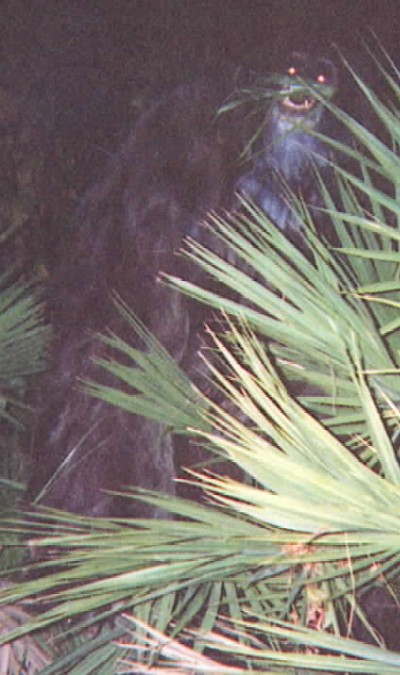
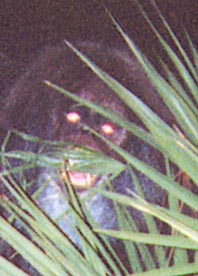
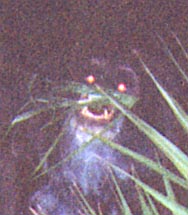
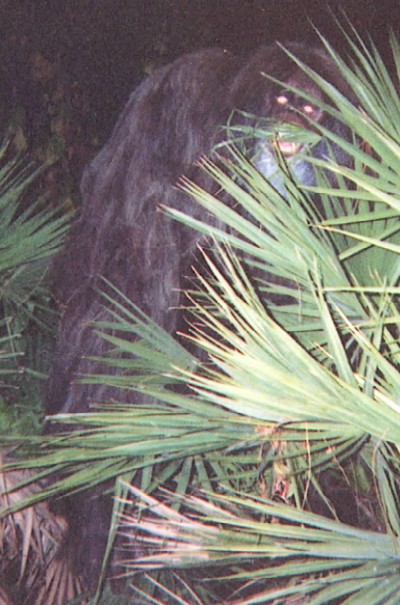
It all began with a December 22, 2000, letter signed “God Bless. I prefer to remain anonymous,” mailed to the Sarasota (Florida) Sheriff’s Department. Two photographs were enclosed.

Did you ever think you would hear that the motion picture Planet of the Apes (the 1968 version) would be used by skeptics of the photos to explain them? Well, stay tuned.

I’ve written about these Myakka photos extensively, including in Bigfoot! The True Story of Apes in America (NY: Simon and Schuster, 2003). You may consult the quick details by merely clicking here.

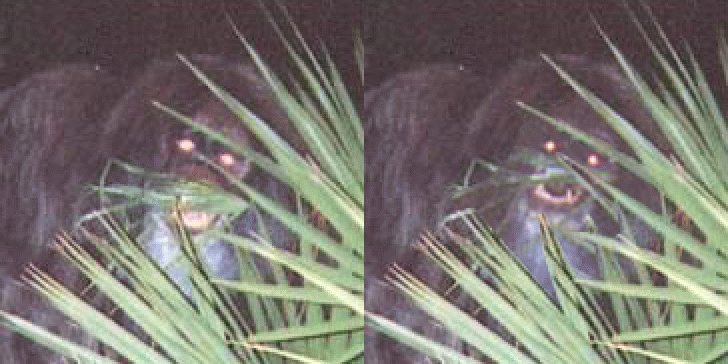
In recent years, new discussions, a new moving gif (up top, above) and a new debate took place about whether or not these photos were of an unknown hominoid, hoaxes, too good to be hoaxes, a masked man, or an escaped known ape. The debate originally occurred at the Bigfoot Forums, but has died off; besides, here are all the photos borrowed from there, with the permission of Bill Appleton, in one place, for your perusal.

Cryptomundo was recently contacted in June 2008 to inform us that all the photos of the masks and makeup that were used first apparently at Bigfoot Forums and then borrowed by us, unfortunately, did not have tied to them their ultimate proper origin credits from Apemania.com, a division of Make-up & Monsters Studios in Chatsworth, California. At the time, Morgoth (Bill Appleton) gave us permission to reproduce here what he had posted, and wrote, on March 21, 2006:

“I relinquish any rights I might have to these pictures, and/or my email, to the public domain. Some of the other attached pictures were gathered from costume companies on the Internet under fair use for research.”

We were unaware that Apemania photos were in the mix. Coincidentially, the John Chambers’ obituary photograph was properly obtained and credited when originally published in 2001, on my personal website to Apemania.com. But the transfer of that credit was also left off, in error, when the image was added to this original older Cryptomundo blog. We apologize for these oversights.

Therefore, this updated posting is being brought forward in time to acknowledge and thank Apemania.com for these images, which they have now granted us full permission to use here.

Back to whatever is shown within the Myakka images: Critiques about there being no movement in the piece of vegetation on the mouth, the creature itself not moving, the mouth not closing, the body being too static and/or more have all fallen by the wayside.

But several questions seem to remain. Why the eyeshine? Is this a noctural creature? If a hoax, how was it pulled off? Are there Apemania.com masks that match? Was John Chambers involved? What? Wait a minute. Let’s get back to that last one later. John Chambers?

Myakka Ape

Logically, of course, the elderly woman taking the photo with an old-style instamatic was able to get a quick flash and scared this cryptid or whatever. If not, why the movement, the obvious fright expressions? Why is she hiding her identity? Why not? Would you come forward? The letter and photos were sent without fanfare to the sheriff’s department. Only by chance did they come to my attention. If a hoax, it was not handled very well to get immediate media attention.
Myakka Ape

Myakka Ape

Myakka Ape

Myakka Ape

Myakka Ape

Myakka Ape

Click on image, immediately above, for full size version.

Getting back to John Chambers, isn’t that just one side trip?

Some critics have said that the object photographed in Florida was really a reddish Bigfoot Ripley’s Believe It or Not model in Wisconsin. But we now know that photo was flipped to “look” like the Myakka photo by the skeptics and in color, surrounding, and appearance, the Ripley’s object is not like the Myakka cryptid. It is hairy and bent over, but then lots of hirsute, sloping “Bigfoot” photos exist. I would say the “classic” posture for any Bigfoot-like statue created (such as the one in Wisconsin) is going to poorly imitate the Patterson-Gimlin footage. Besides, several items between the two don’t match, but here it is for your examination:
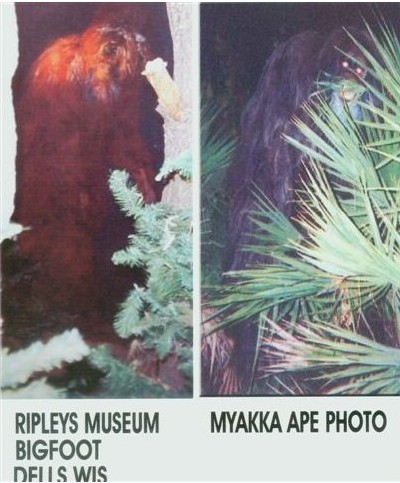
Myakka Ape

Others have said the Myakka thing is a person in a dark straight-legged costume from an Oriental source, but here too, definite reference points don’t align. Show me the suit? Overall appearance do not mean they definitely match.

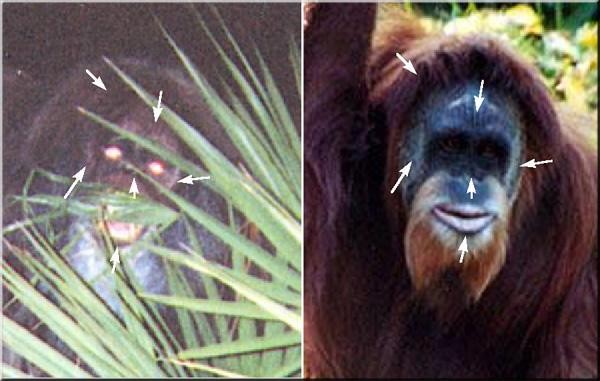
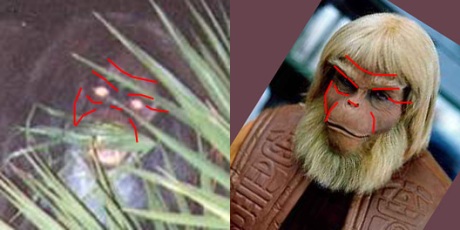
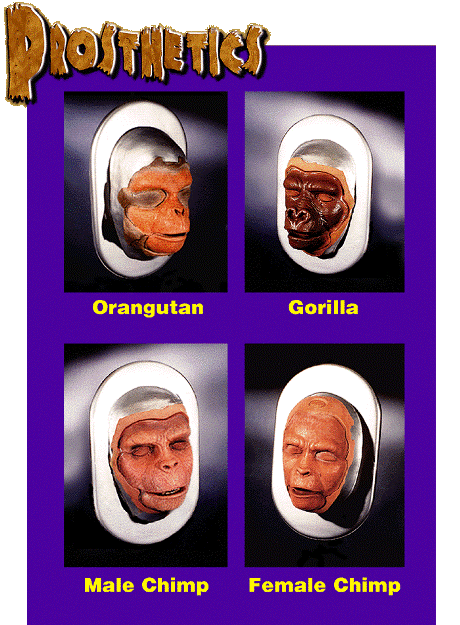
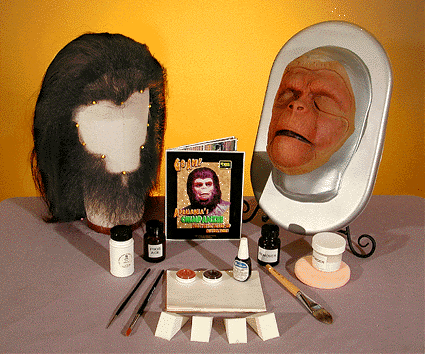
Now, as noted by Bill Appleton, there is a new round of analyses being made to “match” the Myakka face to masks allegedly created by John Chambers. Yes, John Chambers. Remember him? Bobbie Short did a great job demonstrating Chambers was merely a red herring in attempts to overthrow the P-G footage. The masks, of course, were made for the Planet of the Apes film. You can look yourself. But in mild rebuttal, aren’t we just seeing that Chambers was modeling the masks’ faces on the contours and structure of orang and chimp faces, which naturally match the seemingly “ape-like” (mostly orangutan-like) face here in these Myakka photos?
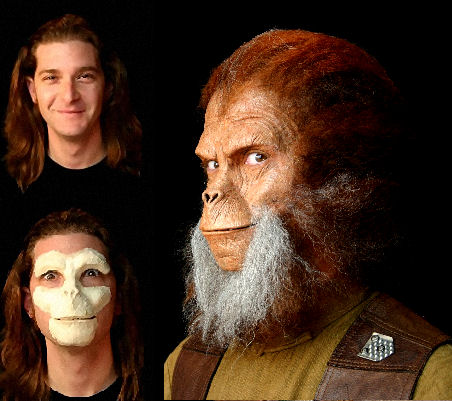
Myakka Debate
Mask image from the fan-based ScreamTeam.

I am not saying the Myakka photos show a Skunk Ape, a hoax, homemade mask, a Chambers creation, an Apemania.com mask, or anything known. All I am saying is that it is an unknown, a hominoid cryptid, and I have not seen anything skeptically presented to undermine the “unidentifed” nature that is shown in these photos with anything known that definitely mirror all that is seen here.
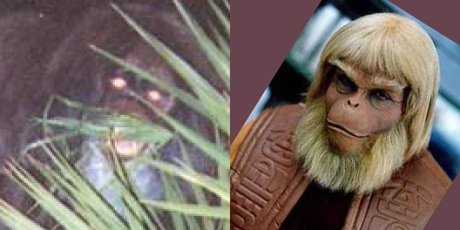
Myakka Debate
Mask image courtesy of Apemania.com.

Myakka Debate
Mask image courtesy of Apemania.com

Myakka Debate
Mask image courtesy of Apemania.com.

Myakka Debate
Mask image courtesy of Apemania.com.

John Chambers

John Chambers signs an autograph for a costumed Planet of the Apes character. Courtesy of Apemania.com.

Academy Awarding winning make-up artist John Chambers died of diabetes at the age of 78, on August 25, 2001, at the Motion Picture and Television Fund retirement home in Woodland Hills, California. But his work on the movie Planet of the Apes remarkably lives on in the debunking attempts to explain everything from the Patterson-Gimlin footage to the Myakka photographs.

All photographs of masks above and of John Chambers copyrighted by Apemania.com.

Myakka Debate

All photographic enhancements of the Myakka Photographs on this page are © David Barkasy and Loren Coleman 2001.

Thanks to Bill Appleton for stimulating more discussions on these photos.

Similar Phenomena:
Myakka Finally Solved »
Cold Case Investigation For 2007: The Myakka Photos »
New Myakka “Ape” Video »
Yeti Skoda Yeti »
Charlton Heston Has Died »
New Cryptid Ape Reports in Florida »

54 Responses to “Myakka, Masks, and Apemania”

  1. calash responds:

    It looks like an orangutan. It would be helpful if a zoologist familiar with Orangutan could examine the photos and comment on similarities or differences.

    Does any one know if there eyes will reflect like this when exposed to a camera flash?

    Regards

  2. monkeyz responds:

    The mouth really kills any credibility for me.

  3. inspector71 responds:

    i live in fla. and i remember when these pictures first came out and scrutinized them hard. arm length to body build the way the head sits on the shoulders, even the r
    reflected light from the eyes, even the fingers and nails, this looks like a dark phase orangatan. the pictures i have seen earlier were not as grainy as these. as far as the mouth yes it looks odd, but i have seen chimps in documentaries rock thier heads mouth open hanging on to something with thier upper lip, even orang hair is sort of coarse looking and not much sheen. if this is a hoax it is one of the best i’ve seen.

  4. DWA responds:

    This is precisely what I’m talking about when I say that it’s long past time for cryptos to hold skeptics’ feet to the fire on their illogical flights of fancy.

    I cannot conceive of any logical person making any logical attempt to tie the Myakka photos to John Chambers. The dude made ape MASKS (which look, if you only ask me, nothing like the animal in the Myakka photos, although good point, Loren, the masks themselves were modeled after actual animals).

    monkeyz: you’d have to explain your comment to me. If it’s an unkown animal, what would we know about its mouth? If it’s a known animal, you can’t see enough about the mouth from these photos to draw any conclusions. It could be an orangutan, from all the orang photos I’ve seen; but the photo is nowhere near good enough for me to conclude anything.

    So, I’m left with two questions.

    1. Why would an intelligent hoaxer - we’re not still talking about these photos if the hoaxer wasn’t smart - try just about the LEAST likely avenue for the hoax to become public? If I wanted something like this to become instantly buried, local law enforcement would be my first pick for a place to send it. If I wanted to spur public interest, I’d want more than one little old lady, at night, to see me.

    2. Do known apes have eyeshine when illuminated at night? I know humans don’t.

  5. DWA responds:

    Ah. A third question, while we’re on illogical flights of fancy.

    3. What’s the logical explanation for these excellent fakes going all this time (Patty, 40 years; this one going on two decades) with no one owning up to them? It might be barely conceivable for one person to be in the population with the means and the motivation to do this and stay anonymous. But two? Three? More? The same guy, doing all of them?

    Hey, it’s conceivable that sas bury their dead. But the above? Now you’re really testing my credulity.

  6. Morgoth responds:

    DWA, there are makeup kits available on the Internet used for halloween costumes or theatrical productions inspired by the ‘Planet of the Apes’ movies. You should carefully study the side by side comparison with Dr. Zaius, above. The color is different, and the wig is different, but the shape of the foam rubber appliances and the construction of the face is compelling:

    Compare the crow’s feet on the right-hand eye, and the circles underneath the eye

    Compare the little nose hidden under the leaf

    Compare the angle where the snout joins the nose

    Look at the contour of the left-hand cheek, it’s a little hard to see in the dark

    The wrinkles under the brow are the same shape, and in the same location

    The ape snout has the same shape

    The overall proportions of the two faces are very similar

    The leaf is there to hide the characteristic shape of the foam. The eye shine is from real eyes, or maybe contacts, and it changes in the second picture. Think about it…

  7. DWA responds:

    Morgoth:

    There may be a lot of similarities.

    But then the mask is based on a real animal, and remember this is just the mask. Not the rest of it, how it all got put together, how that person got there…and why anybody would want to do this; watch it get mulled over for almost 20 years…and say nothing.

    THAT’s what has me wondering about the hoax theory.

    Similar I’d expect. But that doesn’t look similar enough to me to say, yep, that’s a mask.

  8. tirademan responds:

    Well, the Ripley photo has been flopped in an attempt to match the Myakka photo, as I’ve found the original.

    Also as stated, why send it in to get buried in a police round file?

    The letter is absolutely top notch if fake IMHO…just like the suit that no one can buy. Remember, along with the head you’d need the hand, the rest of the body and teeth too. And it has to fit into the scale of real palmettos (although that would be an estimate).

    As for the eyeshine, I’d say it is from real eyes…sasquatch eyes! :)

  9. DWA responds:

    Oh. Morgoth: I should have mentioned as well that the eyeshine doesn’t appear to change at all, really, in my view of the two shots. It’s the same basic color, both shots. Intensity of shine differences can be explained by relative positions of the camera and the subject in the two shots. Color’s the same, though.

  10. Beachdaddy03 responds:

    DWA, I have taken pictures of a male orangutan at the San Diego zoo. The most I got was a little red eye in my pics. I took some shots during the day and some at dusk when I went back to see him later. My flash did go off because of little light outside.

  11. bill green responds:

    hey loren wow this is a very interesting new update about the myakka skunk ape photos very informative as well. thanks bill green

  12. Rillo777 responds:

    Speaking as a photographer and also one who works in a photographic lab (no I mean a real one, not Walmart!) I can tell you that most definitely a human’s will appear red when caught by a flash. The wider the pupil the worse the redeye is. But what bothers me a bit about this photo is that the ferns are brightly illuminated yet cast no shadows on the creature behind.

    I just stopped to look at it again and it appears the creature is in the midst of the ferns (or whatever they are) judging by the leaves on the left of the picture. I can’t think of any natural way this would occur. There should be some deeper shadows where none appear to be. I would love to be able to take out some density in this photo and lighten it up a bit to see what would come out clearer.

    Quite honestly, I’m thinking it’s been touched up considerably in photoshop.

  13. Beachdaddy03 responds:

    I don’t know of any animal or being, who eats palm leaves. Especially the spiney one that is in it’s mouth. Notice that these palms are all around this thing. Hmm…

  14. Rillo777 responds:

    I took the image into microsoft digital and played with it some. In my opinion it’s at least one person (maybe two) in some fake fur with a light in the mask to make the eyes and mouth glow. First, the eyes should glow red if it’s a primate (they’re gold) which suggests a light source inside the eyes. Second, the mouth is far too well lit as is the area directly beneath. When I sharpened the image and adjusted the contrast and compared the tonal value to the fronds in front illuminated by the flash they were very similar, suggesting a light source behind the fronds. It is also possible that some parts of the hair on the back of creature may have been added in photoshop. The tonal values show an awful lot of regularity for a picture taken with a flash at close range. Hair should show more diverse highlights than what I saw.

    Granted, what I have on my laptop isn’t nearly as sophisticated as what we have at the lab, but I feel pretty certain we’re looking at a half-way decent, but not excellent, fake.

    I’m not trying to be an expert here, but I have spent a few years doing professional work on photos and this is my opinion.

  15. joppa responds:

    I am still of the opinion that this is an old orang; probably shot at some zoo.

  16. mystery_man responds:

    I’ve always thought these photos are very compelling. The creature is obviously very large and its body shape does not lend itself readily to a guy in a suit. It is not only the face that is interesting, it’s the whole body of the thing. The detail of the fingers and the way they seem to exert pressure on the leaves below are also remarkable, in my opinion. As for what some have said about the face, I think that the similarities between it and masks or what not are not necessarily a sure sign that this is a hoax. To me, the differences are enough to keep me curious about these pics. It seems easy to try and debunk these photos, but as some have said, where is the suit? And not only that, but how do you use it to give it the same effect as these photos give? Those are not human proportions by a long shot. If such a suit is readily available, then someone can produce it and show everybody so as to put the whole thing to rest. The fact that the only thing that skeptics can come up with are “similarities” is very telling here. I won’t jump in and say this is real, but I haven’t seen anything to convince me it is not. To me, these are still some of the most amazing cryptid photos out there.

  17. DWA responds:

    mystery_man: don’t know if I can say “compelling,” but I’d sure like these explained.

    The proportions look wrong for an orangutan - the only possible culprit among known primates (other than, sigh, a guy in a suit fine fine). But how’s Suit Man getting that mouth to move?

    And that eyeshine? Weird.

    It could be a cryptid - and it is NOT a sasquatch. So if it’s a real animal - and again I doubt it’s an orang - we have more than one hairy hominoid here, eh?

  18. mystery_man responds:

    That’s what I’m saying, DWA. There are a lot of things about these photos that lead me to believe they are not faked. I don’t think these are photos of Bigfoot per say, but I feel they are most likely of some sort of large ape. Considering the skunk ape is thought to be an entirely different type of animal than the good ole sasquatch, I don’t find the different appearance to be suprising. It sure doesn’t look like a normal orangutan nor a Bigfoot either, but like I said, this is a different type of creature we are talking about. I find these pics to be very interesting and they have always had me scratching my head. If these are a hoax, which I don’t feel they are, then they are a very well done hoax.

  19. DWA responds:

    I believe I’ve read that the skunk ape is postulated to be a pongid, and not indeterminate pongid/hominid/? as is the sasquatch.

    Hey, everybody in the country seems to think there are monkeys in FL. (And yes there are; don’t know what happened to the rhesus troop I saw running around through the trees when I was on the Silver River in 1989. But they were there then.)

    So why not?

  20. kittenz responds:

    To me the animal in that photo looks like a monkey rather than an ape.

  21. DWA responds:

    Kittenz: don’t know. If I had to call that face anything, I’d say pongid.

    But I’d be interested in hearing why you say that looks like a monkey.

    If the plants in front of it are saw palmetto, that’s a BIG monkey.

  22. sschaper responds:

    I don’t think the flash is the only source of light. I think that there must be a porch light or similar to the upper left. The palm leaf shadows fall then where you wouldn’t see them. If I’m seeing this thing right.

    I favor the old orang theory, too.

  23. Beachdaddy03 responds:

    This can’t be an orangutan. Look at the position of it’s toes. The big toe should be positioned off to the side of the foot. Not next to the others. Hmmmm. Dr. Meldrum would probably agree. He is a expert on primate bipedal locomotion. Look again at the foot of this thing. Would any of you agree???

  24. mystery_man responds:

    Beachdaddy- I agree. The foot is definately an interesting aspect of this creature to me and adds to the realism and feel that I am looking at a living creature. I just don’t think toes in a costume would have the substance and weight distribution that these seem to have.
    DWA- I have heard that the skunk ape is supposed to be a pongid too.
    Kittenz- Yeah, i think if this is a monkey, it is a really big monkey. I am leaning towards an ape on this one. And although I admit it looks similar to an orangutan, it just doesn’t match up entirely to me.

  25. Rillo777 responds:

    I’ve downloaded the photo and gave it to someone who’s been in the photography/restorations business a long time. I didn’t tell him anything about it so as to not influence his opinion. He’s got some pretty impressive systems to break the photograph down so I’m curious to see what he says. I’ll let you know when I find out.

  26. Beachdaddy03 responds:

    Thanks you guys for your comments. They just add to the mystery of this creature.

  27. things-in-the-woods responds:

    Its weird. As many have said, this is not an obvious hoax. There are plenty of aspects that are very realistic seeming. The mouth to me, doesn’t look like a mask. And the fingers of the hand are definately not human hands, and would have to be very good prosthetics. And just in general it has something of the look of a real living creature.
    But, the shining eyes do look a little like they are backlit. And the foliage and setting just look odd. Especially the bit that is apparently ‘in’ the creatures mouth. It doesn’t look that way to me. It looks more like it is stuck across the middle of its face, and that is both unlikely and suspicious (such an unusually clear photo, and yet we still fail to get the all important full facial shot- a variant of the video camera shake/go-out-of-focus-just-at-the-crucial-moment phenomenon?). Could be photoshopped, but we mustn’t forget what can be achieved witha bit of sticky-backed plastic.

    if this is a real beastie then i think it is clearly related to the orangutan (if not an actual orangutan- although as mystery_man says the proportions seem all wrong- the head to small, the limbs too long- even for an orang). So if this is real, and is a ’skunk ape’, then the skunk ape has got to be either a feral orang (possible, i’d say), or a previously ‘unknown’ orang relative- Now, how likely is it that Giganto made it over to florida….

  28. Greg(Not that Greg) responds:

    ( tirademan responds:) ” The letter is absolutely top notch if fake IMHO…”

    It seems a little strange that someone who is concerned for the safety of themself, their grandchildren, as well as other concerns about local traffic safety & etc would wait ( How long? ) to have film developed and then send an anomynous letter to the authorities ..

  29. Rillo777 responds:

    Just got word back on the photo from my colleague. He says in his opinion it’s a fake. The flash would have caused shadows that just aren’t evident in the photo and he thinks there are inconsistencies in the background which indicate a doctored photo as well.

    He believes there might also be a human figure back and to the left of the “creature”, as well, that showed up when he ran it through some of his programs although it is indistinct. Just thought I’d pass this along.

  30. Alistair responds:

    Isn’t this an obvious fake?

    If someone did take those photos in the wilderness, you wouldnt stand there, you would run for your life in shock that maybe you would be torn limb from limb.

    What happened to the “Ape” after he took the photos? Did it slowly descend back into the wilderness or what?

  31. john5 responds:

    I had the good fortune of looking after the Orang troop at Metro Toronto Zoo for 6 months and can say that these pictures show something similar to a large male Orangutan. However the canine dentition of the Myakka subject is not similar to an Orang at all. Orangutan canines aim outwards away from the mouth and are not sharply pointed, whereas the canines of the alleged Myakka aim inwards towards the tongue and are very pointed.

    Male Sumatran Orang skull:
    http://www.skullsunlimited.com/graphics/bc-02-lg.jpg

    Male Borneo Orang Skull:
    http://www.skullsunlimited.com/graphics/bc-25-lg.jpg

    Male Orang baring teeth:
    http://www.fotosearch.com/DGT084/42-16422784/

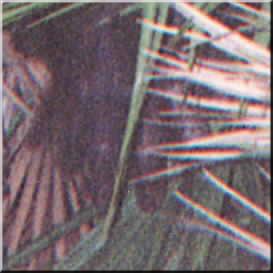
    The zoom in of the hand is also interesting. I am not sure if I am seeing 4 fingers with a thumb on the right or if the smaller finger on the left is a shadow. If this is indeed a thumb on the right then it is located closer to the fingers then a thumb on an Orang. See pic of male orang baring teeth for hand comparison.

    These pictures have always intruiged me since they first appeared. In fact the eyeshine gave me the willies when I first saw them! Initially I thought the photos could not be authentic but on closer inspection I am not convinced they are faked.

  32. elsanto responds:

    I’m not certain that I agree with Beachdaddy03 about the toes.

    If we look at the enhancement, what we can see CLEARLY are 3 toes, and what could be the knuckle of a fourth toe, which could be construed to be not a knuckle, but a toe like a homo sapien’s “big toe”.

    There is also a suggestion of a fifth “baby” toe. I say “a suggestion” because it could just as well be a shadow.

    If we’re going to speculate a bit (since speculation’s been the trend in the last couple months that I’ve had my hiatus), we could construe that there is an opposable toe in the “right” place for a pongid. One can see a suggestion of it under the horizontal fronds in the right of the enhancement. (Look between the second and third blades of the yellowed frond). If we go with the idea that the shadow is a pinky toe, then we’re looking at something that does not have feet that would be typical of any living pongid (can’t speak for Gianganto- or Sivapithecene feet). I tend to go with the obscured big toe behind the palmetto blades, myself.

    I can neither dismiss this as a fake, nor definitively say that it is real. This is not of the calibre that the Patterson-Gimlin film is, despite the greater proximity to, and better focus on, the subject.

    Were I to take the tack that this is not a fake, then i would have to suggest that what we are looking at is not a sasquatch, but a pongid of some sort.

    What surprises me is that no one has commented on the subject’s ponytail, nor on the stick that it is clearly holding.

    Just my two cents

  33. elsanto responds:

    Just to clarify my point further… my explanation was a touch lacking. If we assume that the three toes we clearly see are the 5th, 4th, and 3rd toes, and that the partially obscured one is not a “big toe” but a second toe, then the suggested toe between the blades of the palmetto fond is in the right place for a pongid’s opposable toe (discounting the small digit-like shadow as a shadow, which it increasingly appears to be, to my eyes).

    Now, it’s two cents’ worth.

  34. cryptidsrus responds:

    Kittenz:

    Once again you make sense.

    I’m sorry but this does not look like an (obvious) hoax. The lady made no attempt to profit or otherwise put herself out there in the media because of this. Would you blame her?

    I also agree with Mystery_Man. These are not human proportions by any means.

    My opinion—escaped monkey and/or descendant of escaped monkey which has adapted to life in the wild.

  35. mantis responds:

    this is an obvious fake
    the eyes shine ’cause they’re made of plastic

  36. alanborky responds:

    To me, I’m strongly struck by how brightly the foreground fronds are illuminated, yet the creature has moved to precisely this area.

    This is only serves to strengthen my suspicion the light in the eyes is precisely that - little electronic lights placed behind the eyes of a model, and the strong plant illumination is intended to prevent these light sources from giving themselves away by shining out onto the plant surfaces in front of them.

    Notice how the light in the eyes, if it’s coming from an external source, doesn’t adjust in relation to that light source by shifting down onto a lower point on the surface of the eyes but instead pulls back with the eyes.

    In other words, first the lights in the eyes points directly at us; then, when the head is pulled back and tilted upwards, the lights correspondingly point upward.

  37. dmpelley responds:

    For what its worth, here’s my two cents:
    Not to toot my horn (it simply is what it is), but I have my degree in biology, spent hours in the field researching wildlife, interned at zoos, and avidly pursued cryptozoology for over 20 years.
    I live in Central Florida and have actually had a couple of experiences with what I believe to be the primate known as “the skunk ape”.
    All of that being said, I have not given the Myakka photos much thought from the very first time I saw them when they hit the web, and here’s why:
    Primates lack the layer on the back of the eye which causes “eyeshine”. This layer is known as the tapetum lucidum and is found in many mammal species; but it is not an anatomical feature found within any apes or monkeys.
    Furthermore, with all the vegetation that grows in Myakka State Park (and the surrounding area); why on earth would any animal attempt to consume palmetto fronds? The fronds are inedible (although its fruit and buds while bitter are occasionally eaten by deer and raccoons)!
    Of course, one could argue that this specimen would represent an entirely new species with physiological adaptations that are completely unique and unrepresented in the 625 known species of primates alive today.
    The other option is that we could stop trying to make the facts fit a scenario which doesn’t work in the natural world and accept these photos for what they are-a hoax.

  38. Bill Munns responds:

    Just a thought from a makeup artist:

    One photo shows a pinkish tone immediately behind the teeth, while the other photo doesn’t, suggesting a retractable tongue (forward in the pinkish shot, retracted in the darker mouth shot.

    Nobody makes masks with retractable tongues like that, and the Planet of the Apes appliances definitely had nothing even remotely like that.

    The photos are likely real, maybe an orang, maybe a gelada baboon, maybe a (?), but it’s not a mask.

    Bill

  39. dmpelley responds:

    Bill, I like your attention to detail (more so as it seems we might be in the same business-I’m a filmmaker).
    However, once again I must say that orangs and baboons are wholly incapable of exhibiting eyeshine. There are no species of primates that exhibit this trait.

  40. Bake Neko responds:

    But if it is indeed a hoax then why did the hoaxer anonymously send it to the police? The most likely place for it to get buried and not gain any recognition. None of this adds up at all. I do have some things to say in regards of the subject in the photographs. With all of its orangutan characteristics it makes me think of gigantopithecus whose closest living relatives today are the orangutans. If the subject is real then that may explain why the body proportions, fur and skin color are different from an orang yet has practically the same facial features. And yes nearly all of the known living great ape and monkey species are diurnal. Except for lemurs, aye-ayes, and the douroucouli, probably better known as the night monkey. Though night monkeys lack tapetum lucidum (they have evolved huge owl-like eyes) lemurs and aye-ayes are primates that actually do have them. This proves that nocturnal primates can develop during natural selection. But all of these examples are simian or prosimian. A nocturnal ape is a bit of a stretch. Gigantopithecus was most likely diurnal but there is a slight chance that it could have been nocturnal and it may have evolved something similar to tapetum lucidum that could produce eyeshine. But this just pure conjecture. Thats also assuming gigantopithecus made over the Bering Straight and even survived extinction for that matter. Not to mention the complete lack of fossil evidence. I honestly have no clue if the subject in the photo is real or not. And quite frankly its starting to give me a headache.

  41. mystery_man responds:

    dmpelley- I’m sorry but your assertion that “no species of primate exhibit this trait” is not correct. In fact prosimians, such as the lemurs, aye-aye, loris, and potto, which are primates, do exhibit eye shine.

    I know this is nit picking and what we see in these photos is likely not a prosimian, but as a teacher of science myself (it is what it is) I could not let that blanket statement go by without comment. I don’t want anyone to be possibly misinformed. However, you are correct that no great apes or monkeys have a tapetum lucidum. MOST primates don’t, but saying no primates at all have it is false.

    Another thing is that even though humans lack this anatomical feature, there can still be a red-eye effect. I’ve seen photos of people that have such bad red eye, their eyes are almost as shiny as those on this Myakka Ape. Yes, this is obviously not a picture of a human (unless a human behind a mask), but it is something to consider.

  42. DWA responds:

    mystery_man: I was wondering if anyone would get to dmpelley’s comment before I did.

    Not only are you right that there are known primates that exhibit eyeshine; there would be no reason to suppose an uncatalogued ape wouldn’t, just because known ones don’t.

    One can expect an uncatalogued animal to be like other animals in basic ways. (For example, behaviors reported from sasquatch encounters that have analogues in behaviors of known apes.) But one should expect differences too, particularly when the animal exhibits habits that might make a trait (and its attendant appearances) useful.

  43. elsanto responds:

    dmpelley:

    Just out of curiosity… what gave you the impression that the subject in the photos was ingesting/going to ingest palmetto fronds?

  44. DWA responds:

    More of dmpelley’s comments deserve response.

    “Primates lack the layer on the back of the eye which causes “eyeshine”. This layer is known as the tapetum lucidum and is found in many mammal species; but it is not an anatomical feature found within any apes or monkeys.”

    I guess I’ve really said this in my previous post. But another angle on it: each ape and monkey has features not found within any other ape or monkey. (To get close to the instant case: the dorocouli, or night monkey, has specially adapted night vision.) There is, once again, no reason to believe that nocturnal adaptations (or eyeshine, to put a fine point on it) would not exist in an undocumented species, just because they don’t in the ones we know about. Way too many other species have such adaptations. Why, specifically, rule it out in an ape? The eyes of many animals in many families shine - from deer and coyote to cat and slow loris. That it might be present in an ape as yet undocumented is about as implausible as, say, a mammal having wings, or being shaped essentially like a fish.

    “Furthermore, with all the vegetation that grows in Myakka State Park (and the surrounding area); why on earth would any animal attempt to consume palmetto fronds? The fronds are inedible (although its fruit and buds while bitter are occasionally eaten by deer and raccoons)!”

    In other words, the plant is not totally inedible. Why would anyone, seeing the giant panda, conclude that it subsists almost solely on bamboo? There doesn’t seem anything inherently untouchable about palmetto fronds. Once again, that known species don’t do it is no reason to rule it out. (And then of course I see no evidence that the critter in the photo is doing anything gustatory with those fronds.)

    “Of course, one could argue that this specimen would represent an entirely new species with physiological adaptations that are completely unique and unrepresented in the 625 known species of primates alive today.

    “The other option is that we could stop trying to make the facts fit a scenario which doesn’t work in the natural world and accept these photos for what they are-a hoax.”

    Well, a good reason for not exercising the other option is that there doesn’t seem any good evidence that this is, in fact, a hoax. And I’m not sure I’m seeing any “making facts fit a scenario.” If there is something in a photograph, and no one knows what it is, one does have to explain it, or at least if one can’t debunk it conclusively and no one has, say so, and allow that there might be something we don’t know about here.

    The scenario has no reason not to “work in the natural world.” Models of nature only explain what we have seen and confirmed; they say nothing about what has not been catalogued yet. The faunal models of North America do not say “the skunk ape is implausible and therefore does not exist” or “the skunk ape does not work in the natural world.” They don’t address anything, in fact, that is not known, except that a scientist being asked would say, well, that hasn’t been confirmed yet, has it?

  45. DWA responds:

    Alistair says:

    “Isn’t this an obvious fake?

    If someone did take those photos in the wilderness, you wouldnt stand there, you would run for your life in shock that maybe you would be torn limb from limb.”

    Well, not necessarily. (I’d like to know who “you” was, the ape or the photographer; but it’s really irrelevant.)

    People taking photos in the wilderness HAVE been torn limb from limb. By a species that, in other cases, either ran away, moseyed slowly off, or did nothing. It’s commonly raised as a “case against” the veracity of the Patterson-Gimlin film that Patty isn’t breaking both legs in a frantic effort to escape. Fact is, such a leisurely departure - and sometimes an animal that, at least initially, doesn’t retreat at all - frequently crops up in sasquatch encounter reports. In other words, the reports and the film reinforce each other.

    So, no, the reaction or lack of same of the alleged subject says nothing about whether this is faked or not. Debunking it requires pointing out specific earmarks of fakery. Until then, nope, we don’t know what it is.

  46. Bake Neko responds:

    Wow mystery_man addressed dmpelley’s tapetum error a minute right after I did. Thats interesting that red eye can appear to look bright in a photograph. It still drive me nuts. If hoaxed: why under such strange circumstances and how was it hoaxed? If real: what the hell is it? Gigantopithecus or giganto descendant? Bizarre orangutan? Or an entirely new species of great ape?

  47. dmpelley responds:

    “In fact prosimians, such as the lemurs, aye-aye, loris, and potto, which are primates, do exhibit eye shine.”
    I stand corrected! Thank you for pointing this out Mystery_Man. When I wrote my response last night it as very late, and I thought about the prosimians but I have no idea why I didn’t include them with the primates! I knew that they exhibit eyeshine, but it simply didn’t occur to me to place them with the “great apes”. Argghhh! More primitive and smaller, but primates nonetheless. ;)
    Regarding the palmetto, it seems apparent to me that a frond is in its mouth. If its not eating the frond, I could not even begin to tell you why its stuffed in there (unless it is to hide something from the camera’s view?).
    Just my opinion.
    Regardless, I am pleased to see some interest with something local to me for a change. It makes all of us here in Florida feel more included in the crypto loop!

  48. mystery_man responds:

    Bake Neko- Yeah, that is weird, huh? I noticed the timing of our posts too. I wrote mine and sent it off and then as it was in waiting to be checked and posted, yours popped up. We must have been typing them up at about the same time. Whoa.

    DWA- About the possibility of nocturnal apes. What you said.

    You summed it up really quite well. As had been mentioned, this is not a totally absent physiological feature for all primates. I think it should be considered that the nocturnal adaptation that produces eye shine has popped up in a wide range of unrelated creatures, from the prosimians, to cats, to raccoons, the list goes on and on. So since it is obviously a useful and recurring adaptation for many wide ranging species, why should it not become present in an ape that evolves into a nocturnal lifestyle? We don’t know of such an ape, but it is not a completely far fetched notion.

    You brought up basically convergent evolution, or the tendency for certain animals that are not related to develop similar survival traits for similar niches. Your examples of bat wings and shapes like a fish are superb. We don’t know of any apes with a tapetum lucidum, but I agree that it would be a rather bold statement to say that one could not evolve to take advantage of such a feature. You’re right. It would be a break from the norm and the current knowledge we have on apes, but I’d say technically there’s nothing to really say an ape or large primate CANNOT have developed nocturnal proclivities and the adaptations to go with them.

    So in answer to your question “why specifically rule it out on an ape?” The answer is, you can’t. It would still need evidence to prove one exists, of course.

    Good post, by the way!

  49. mystery_man responds:

    dmpelley- In answer to your question about why the frond is stuffed in its mouth. Fiber? :) I’m with you in that I still hold that there is a possibility this is a hoax.

    Also, it does have to be kept in mind that there are no known nocturnal apes or large primates like this and I think it’s important to remember that just because one COULD conceivably exist does not mean that it DOES.

    Anyway, that’s cool that you live in Florida right up near this whole phenomena.

  50. dmpelley responds:

    Hey, its all about the roughage!

  51. Aphyllos responds:

    This is my first post, but i’ve been avidly reading the debate surrounding these images and whilst I agree with most of the debate concerning the source of the eyeshine seen in the images, and the possibility that an unknown or divergent species of primate has evolved a tapetum lucidum layer within it’s eyes, i;m struggling to accept some of the speculation this possibility has given rise to.
    There has been an increasing number of comments referring to this unknown (or unidentified) animal (for I DO doubt that this is hoaxed) being “nocturnal”. The only “evidence” for this seems to be that it has been pictured at night.
    Whilst the eyeshine points toward nocturnal living, it is also present in Homo sapiens, and whilst I am something of a “creature of the night” myself, as a species we are largely diurnal (and I’d say adapted as such). A photo taken of an unknown human taken at night and showing signs of “red eye” from a flash would not so quickly be heralded as proof that humanity is nocturnal.
    Perhaps the animal was disturbed at night, perhaps it had yet to “bed-down” for the night (in which case, and here i’m taking my speculation a little far, could the frond not have been the basis for a “bed”? Orangs, Chimps and Bonobos all exhibit “nest-making” behaviour.)
    I don’t want to hypothesise too wildly about what I think it MIGHT be, but i think it’s a bit too early to be discussing it as primarily “nocturnal” without more evidence.

    Aphyllos

  52. mystery_man responds:

    Aphyllos- Right. I would direct you to my post on the red eye effect in humans above. It is caused by a completely different set of mechanics than eye shine, but the end result is the same. Shiny red eyes. I have mentioned it, it has been said. No one has actively challenged that, so I don’t see what you find unappealing about our speculation.

    I don’t think people are insisting that it is a nocturnal ape. The possibility is being considered because eye shine is associated with nocturnal animals. So since eye shine is present in nocturnal animals and this photo was taken at night, is it so unreasonable to speculate along those lines? You said it yourself that you agree to the possibility. What sort of unfounded speculation is being “given rise to”? What more evidence is there that it is the red eye effect we are seeing? Keeping all options open is important isn’t it? Unless you have some insider evidence that points to more knowledge than we have on the photos.

    Regardless, as I have said, red eye in people can be pronounced, so it is something to be considered as well. I have made this clear, no one has been disagreeing with that. It seems that no one has flat out said what this must or must not be. This photo is an unknown. Your input is very welcome, but I don’t think you can say that a “nocturnal ape” theory is some sort of unfounded assumption. We are looking at options, digging for the truth.

    Really, what is important in the end is not whether we are seeing red eye or eye shine or spirit orb power, or whatever. It is whether this photo represents a new species at all.

  53. Aphyllos responds:

    I was merely voicing my opinion, apologies if it came across as overly critical, that wasn’t my intention at all. I couldn’t claim to be an expert on such phenomenon, I was considering the options as openly as possible, and it seemed (in my opinion at least) that perhaps there was too much emphasis being placed on the “eye-shine” as strongly suggestive of nocturnal habits. Surely that is just as reductive in the field of possibility?

  54. mystery_man responds:

    Aphyllos- Thanks for clearing that up. Well, I definitely agree that it is not a sure hoax, although it might be. I don’t think it can be said for sure just what it is that we are seeing in the photos, so one opinion is as good as another. All we can really do is speculate. We already have a few explanations for the “glowing eyes” being present; eye shine, red eye, or some hoax effect. I don’t think the red eyes present discount some large ape or necessarily point to a hoax, and neither do you it seems, so its a bit of a start. It’s good that you are looking at all angles, and of course your opinion is very welcome. Always nice to have a new poster here putting out their ideas.


Leave your comments

You must be logged in to post a comment.

|Top | Content|


Donate Today

Advertisement


|Top | FarBar|


Attention: This is the end of the usable page!
The images below are preloaded standbys only.
This is helpful to those with slower Internet connections.

generic abilify acai tablets accutane tablets Aciphex Phentermine Rite Aid Pharmacy no rx acomplia actonel coupons mail order actos aleve cold and sinus allegra 180mg discount alli altace tablets Bone Meal Candida Antibiotics mail order aricept arimidex withdrawal generic ashwagandha online medpointe astelin atacand description atarax composition augmentin tablets avandia buy avapro 300 mg avodart description Bactrim Medication Used for no rx benadryl benjamin benicar buy biaxin online buy buspar purchase cardizem celebrex pain relief celadrin india Pharmacology + Cephalexin online prescription cialis purchase cipro cheapest cla Effectiveness of Clarinex buying claritin clomid generic clonidine online colchicine genetic ppm coreg cr mutual pharma generic coumadin cozaar side affect creatine uk crestor and weight gain Cymbalta XL cytotec prescription side effects theraputic range depakote diclofenac medicine Differin Material Safety Data Sheet diflucan dog Diovan Drug Doxycycline from human embryo cheap effexor birth control pills and flagyl flomax no prescription intestinal effects of glucophage causes of hair loss uk purchase hangover no rx hoodia online Keppra for Migraines lamictal xr buy cheap lamisil lasix buy levaquin package insert levitra & grapefruit lexapro best price Side Effects from Lipitor Lisinopril 20 commercial melatonin assay metformin tablets methotrexate injection micardis discount mobic tablets motrin india cost of msm discount neurontin nexium adverse reactions nizoral best price order nolvadex buy omnicef online buy cheap paxil penis extender description Generic Versions of Phentermine what is phosphatidylserine plan b xr plavix tablets pravachol usa buying prednisone premarin information prevacid medicine order prometrium propecia tablets Clomid and Provera side effects of prozac cheap reglan no prescription DRUG REMINYL TO TREAT rimonabant on line verbal tics concerts risperdal does rogaine foam work canine poisoning seroquel can i take singulair in the am skelaxin side effects stop smoking humor comedy Strattera Bad Side Effects resistance training and stress relief synthroid xr tetracycline for acne cheap topamax no prescription toprol mg toradol lawsuites What Is the Medicine Tramadol online trazodone tricor uk Is generic Trileptal effective ultracet tablets valtrex coupon cheap viagra no prescription voltaren opth soln generic vytorin weight loss drugs wellbutrin citalopram combination cheap yohimbe no prescription infant zantac side effects buy zetia zestoretic india zithromax during pregnancy zoloft drugs zovirax drugs Zyban Itching zyprexa medicine zyrtec d buy cheap zyvox