More From Mt. Hood
Posted by: Loren Coleman on May 3rd, 2006
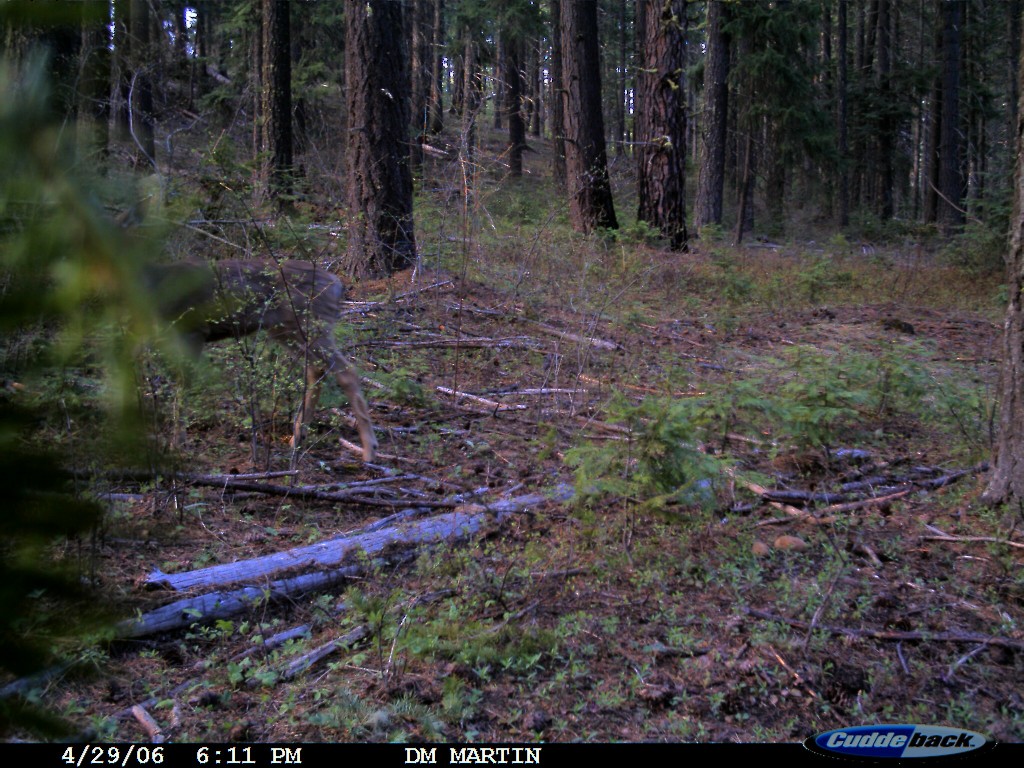
Click image for full-size version
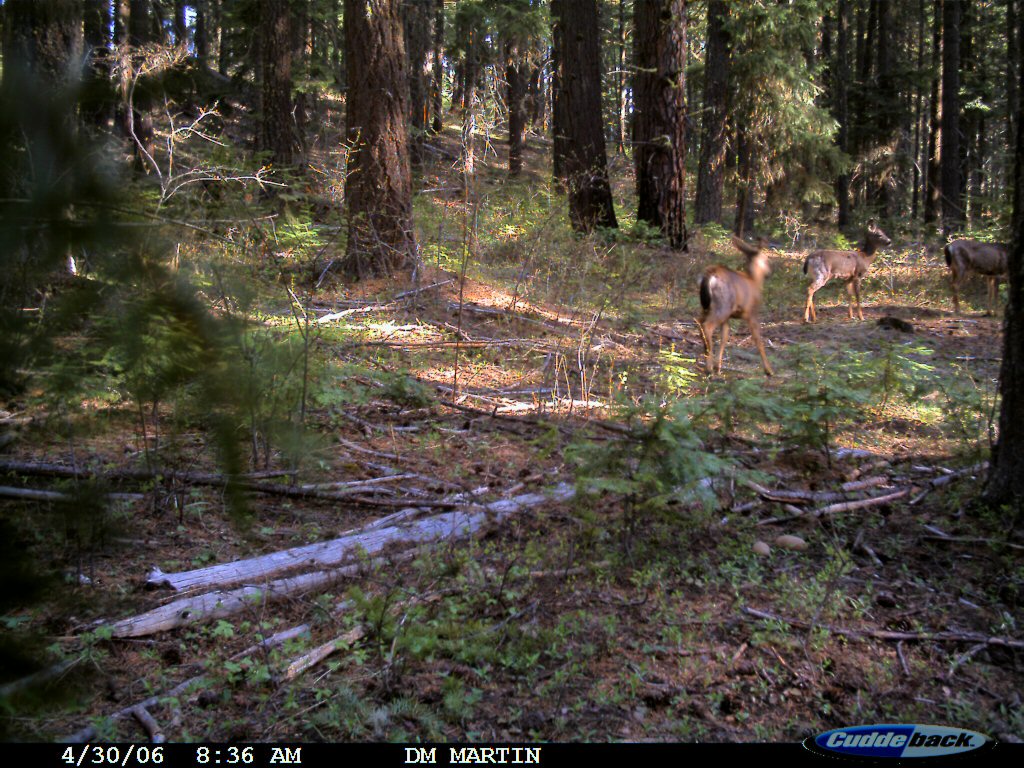
The photograph with the potential Bigfoot in a camera image that was taken between the two above can be found by clicking at "New Mt. Hood Bigfoot Photograph?"
The photographs above were taken immediately before and after the possible Bigfoot camera image.
These remote camera captures clearly show that animals, in these two specific cases, deer, set off the camera’s function. And yes, to answer a question asked about why the camera was placed there…the individuals were attempting to capture photographically a Bigfoot .

- Similar Phenomena:


So…What does this mean? are we writing off this image as deer? Or was a Sashquash following deer as we have heard many previous reports of?
So, here’s what you do: using three internet windows, blow up each picture, in order (Deer 1, Sas, Deer 2). Then click between the three - I ain’t seein’ no way how the second pic is a deer. The hair is way to shaggy, in my honest opinion.
Sorry to post twice… moreover, look at the timestamps. Five minutes is a big amount of time between pics 2 and 3. Plus, I think its significant that the deer are running away from the camera… thoughts?
Deer in the other images don’t make me assume it is a deer in the unexplained image.
But, if they were looking for Bigfoot, surely they checked the area for prints, hair, etc. didn’t they?
What other evidence do they have from this site? Why did they choose this spot?
Can the camera be set to shoot in rapid succession?
The deer photo following it is only five minutes later, so whatever was passing through didn’t hang around long enough to spook the deer, or doesn’t have a smell that would spook the deer. But there still just isn’t enough information in the original photo to say what it might be other than an amorphous something near enough the camera to cast good portions of the image in shadow (since the same area is clear in the proceeding and preceeding shots), but not wide enough to block out the trees in the upper left portion of the image.
Although the horse theory seems perfectly plausible, I’m going to place myself firmly in the “it could be anything” camp.
If you have firefox, try this. Open the full size amorphous image taken at 8:31 am in one tab, and the 8:36 a.m. deer photo in the other tab.
If both images are the same size, what you will get when clicking back and forth is a view of the “blob” and what the woods looked like five minutes later, when the deer passed through.
First off, this helps you get a better idea of what sort of space this “blob” is blocking.
But, what you may also notice, if you look at the area of the picture in the lower right corner that should not change, is that it is considerably brighter at 8:31 than it is at 8:36.
Now, granted, perhaps whatever was in front of the camera deflected flash. Perhaps clouds covered the sun. But the shadow patterns don’t look quite right to me either. Like this was maybe taken later in the day (or another day entirely) and the time changed in camera to record that it occured five minutes prior to the previous image.
I can’t be really sure, because the shadow patterns I could pick out in the “blob” image are obscured by the deer in the 8:36 image, and the other image is of 6 pm the previous evening, when the sun was in an entirely different position.
But something is really starting to smell funny to me now.
Uhhh, the two pictures above were taken over 14 hours apart, both triggered by deer. If the time stamps are accurate, that is.
As far as the other picture is concerned it could be a cryptid, but it could also be the infamous wookie suit as well. Impossible to tell. Doubt it’s a grizzly standing on its hind legs. If there has been a lot of credibly documented activity in this area - which there seems to have been - its a positive sign their efforts are well directed.
It seems quite clear to me, unfortunately, that the original image is also of a deer, not a cryptid. If you can imagine a deer, close-up and out of focus, facing the camera, head moving in an up or down direction, the resulting image is exactly what you would get. The bump towards the top is the base of the ear, and the lower bump, just before it angles in, is the eye socket.
Comparing the before and after shot- toggling bewteen two full screen windows- does show some differences on the right hand lower section in foreground- a small stick seems to dissapear and some holes look a bit different. Not sure what it means but interesting.
I seem to remember reading that animals create their own paths through the woods and that different species use them.
If this is true (and not the distorted recollection of something I read in a Mark Trail comic-book circa 1972), then an area used by deer seems like a sensible place to put a camera to photograph Bigfoot.
I wonder if roadside Bigfoot sightings are more common around known deer crossings?
I can’t agree with the deer head suggestion. I see the shape, but if it’s any animal’s head it would have to be a pony, deer do not have hair like that on the top of the head, and motion blur to the extreme to cause that appearance would have eliminated any eyesocket or ear shapes. Those are still there, if that’s indeed what they are.
Of course I have absolutely no idea what it could be. Too close to the camera. One thought that occurred to me is… what if we’re looking at the calf of a Bigfoot, facing away from the camera? Could be a muscle bulge and up to the right maybe we see the side of the knee. Big bulky, strong leg.
As someone mentioned on the Bigfoot! Group at Yahoo, well groomed. Could be the bluriness making it look more well groomed than it is though.
Spot on, rah (7). At first, looking at the image expecting a bigfoot, I thought I was seeing the back of a bigfoot as it walked away from the camera.
I couldn’t explain the wierd bumpiness at the top right (as we see it) of the animal.
Then you suggested it was a deer facing the camera and all of a sudden it makes sense. The dark blotch at the bottom of the right-most extremity (as we see it) of the animal is it’s left eye.
I agree with DVics (10) that this looks more like a pony or horse, but I also agree with you that the appearance is only due to the animal’s motion.
If you think about it, deer approaches wierd looking object, has a sniff and the object snaps a photo. Maybe the sound of the camera scared it, hence the quickly raised head, maybe it didn’t and that’s just co-incidental.
Five minutes later, no need for the deer to all run away, the thing (camera) didn’t move, it didn’t chase them, it doesn’t smell, it just made a wierd click. Whatever.
(I can’t believe I’m rationalising like a deer).
Perhaps those in control of the camera can tell as the height off the ground that it was?
I clearly think the photo is a close up of a horse’s head…. either that or the back of a beautiful brunette
Everyone needs to refer to the original post of this blog. The camera was placed about 3feet off of the ground. I agree with Ole Bub, that is a strange height to place a camera if you are looking for a Bigfoot.
I do strongly doubt however this is a pony, horse or deer. I would like to hear what the thoughts are of the camera owners. Have they been interviewed or made any statements? I’ll check for more updates….
That darn Bigfoot is always giving us the “Angles”.
(see myspace the movie and you’ll know what I’m talking about)
I don’t see a problem with a pony, horse or deer having their head at ground level (to eat grass, say) and then raising it up in front of the camera at 3 feet.
What gets me though is how the animal gets to be in front of the camera such that it is *able* to be captured in the action of raising its head, without capturing an earlier photo of the animal?
But then again, the next photo is of deer which are very clearly all over the frame. We’re told that is the next photo after our cryptid - so somehow those deer got centre-frame without this super-fast setup capturing them getting there.
Or we’re missing some photos…
So unlikely. Why would deer be ’standing around’ with some big creature. An why would there be no other photo than the single hairy horse.
Fake.
Oh, wow. It totally is an extreme deer head closeup. Oh well.
After examining the three pictures, I came to the conclusion that what is in front of the camera is the backend of a dear with the tail down.
First those are white tails, their tail when raised is white underneath and whenever they are nervous about thir surroundings, they raise their white flags to warn other deers of possible danger.
Second, in the first picture we see a deer going left not far from the cam. Then the first deer to come out from the left does it very close to the cam and maybe just move its behind first when bending its head to eat greens. The last pictures show the three deers heading out and not alarmed.
The tail of those deers are used to make flies for flyfishing and the hair is long on the top side.
I did hope it was more mystifying but can’t win them all.
Not so sure about that dear head/horse thing. If it is a squatch then it looks to me like the Left calf of one walking in from the right of the camara.
Things are though
1. is the hair really that long??/
2. where are the other photos.
3. if calf than at 3 feet this thing would be 12 or more tall.
Next would be a small one walking from L to R. The belly would be the upper right corner.
If so then.
1. where are the arms/hands??? swinging?
2. the top of the pic would have to be the hip if top right is belly. I stand 6′2″ and that close of a pic 3 feet wouldn’t catch my gut.
If you examine the pic you can tell several things.
1. the most L part is not the object of interest but you can see tree plus background through it= use corel or adobe.
2. hair is long and continous but at different levels so the top is closer to us then the bottom. again use corel/adobe and play with embossing/shadowing.
Also has anyone noticed that in the mid right of the photo just past the near tree on right and above the logs on the ground that there is a shadow that is not there 5 minutes later when the deer pass!!!!!!!!!!!!!
Interesting. Either
1. a person in this whole hoax or
2. another squatch??? if its really is that.
and if 2 is correct then maybe it is a photo of a juvenile squatch walking from L to R toward his parent of friend squatch standing off screen to the right just lateral and past that tree in the foreground.
What are ya’lls comments?
Oh yea could be chupacabras!!
Oh if a deer head then how was it able to walk up to the camera straight on without getting its photo taken.
And where is the rest of its body
And why so hairy
And where is the black streak of the nose which should be in the middle of the pic. I don’t think the left side is part of the animal..it looks distinctly background.
And why is the top right portion (aka “belly”) not in as much motion blur?
KenMD (17)
It walked up to the camera the same way that the deer in the pic 5 minutes later got into the middle of the frame without being photographed (or else we’re missing earlier photos for both cases - see my earlier comment).
Rest of body is behind it’s head. The extreme closeup means the head hides everything else. Check out another horse without a body.
Here is another example, but you have to imagine the camera being up higher, looking down at the horse’s head. That would be the same perspective as with our cryptid, where, if this is a horse or deer, it is lifting it’s head from the ground; thus a camera positioned 3 foot off the ground is looking straight at the horse’s forehead.
The black nose (if a deer) is not there because it didn’t enter the frame, as would be the case if the start of the exposure was looking at the top of the deer’s neck (head down eating grass, remember) and the end of the exposure has caught the deer just before the nose enters the frame (leaving the eye in the correct position for what can be observed in the photo).
The dark green at the left is a branch of thin leaves in between the horse and the camera. It is there on the other photos.
The grey at the top left is a tree in the background (horses have narrow heads when compared to the length of their “snout”) - that is also in the other photos.
The part that is not in as much motion blur may well be the belly of the deer/horse bulging out to the side - and that would not move much for an animal just lifting it’s head from the ground upwards.
I still say horse/deer - in fact, probably more so deer now, as that is a much more likely animal, and the tonal quality and colours match the deer in the frame 5 minutes later (taking into account less light in our “cryptid” due to it being right up against the camera lens).
Chris.
Actually, I didn’t notice it at first, but the “before” photo, from the evening before, contains a deer also and it is not standing in sunlight. It’s fur colour matches our cryptid even better than the deer in the “after” photo which are lit by the sun.
As a resident of Oregon who has hiked up in these areas, I think this new bigfoot photo is that of a passing bear. They are very common through that area of Mt Hood.
One issue… the difference in the lighting in two photos supposedly taken 5 minutes apart is not that unusual, especially if there is even a fair breeze blowing the various trees and limbs and scrub. Light and shadows can play tricks on you in the woods.
The deer don’t look the slightest bit worried about whatever passed that way just a few minutes before. If whatever the object is in the 8:31 picture is a predator, it is not one that threatens them or they wouldn’t be in the same neighborhood so soon. A bear could fit that profile or so too perhaps… a large undocumented biped.
As far as the 8:31 image itself, there’s just not enough of whatever it is to make any firm identification. It ‘could’ be a lot of things. Anything further than that is pure speculation.
My feeling is that if Big Foot truly exists, cameras such as this could eventually provide some proof of it. But then again, if Big Foot does exist, it has successfully eluded humans for centuries so we probably shouldn’t be surprised if it can find a way to continue the trend… and so here we are back at the beginning again, lol!
Much ado about nothing…
I think many posters here are not taking the context into account. Consider probablity and likelyhood:
- There is not *likely* to be a horse or a pony in the woods.
- There are deer in the shot five minutes later
- The better part of a deer is about three feet off the ground like this camera
…Logic would suggest it’s a deer.
For X sake, there are deer all over the place five minutes later! Take a hint people!
“For X sake”?
Does a bear X in the woods?
I was just playing with the 8:31 picture… there are some interesting characteristics that can be extracted by embossing the image. From there, splice in Chebaca’s head just above the X thing and… well, short of that…
@Redoubt,
X as in “Jesus X“.
Zen… yes, I sort of figured that. I just get a kick out of how we go out of our way to avoid writing certain words and phrases…especially religious references and colorful metaphors.
Thanx
Photograph 2 is a deer nosing the camera. The hair looks longer because the photo is blurred by the motion of the deer and the fact that it’s too close to the lens for the camera to properly focus.
I was thinking the top right of the object was an ear and the mid-right dark spot was an eye from a deer head. However, I pulled the image into photosthop and adjusted the levels. Now I’m leaning more towards “horse’s a$$.” I think that top right piece is the horse’s neck and you can see a little bit of mane coming off of it. However, the left side of the object bothers me with the way it changes color as you adjust levels. It looks like the hairy thing and the tree limb in the foreground were a separate layer that was pasted onto the background — could just be due to motion blurring though.
Let me get into the fray…..I can’t believe the camera is at 3′. The ground is sloping up from camera and yet you can see the top of the deer heads. Even if the ground was level and the camera was at 3′ above the ground, you wouldn’t be able to see the deers back. To see the top of the head the camera would have to be over 5′ on level ground and sloping upward as it appears in frame 3, I would estimate the camera to be at least 6′ above the ground. Maybe more. If I’m right, then that blur cannot be a deer. Horse, maybe. Also the color of the deer in frame 3 is different than the color of the blurred thing in frame 2. Possibly due to light difference, but different just the same. The tree limb in the foreground is in both frames, but in frame 3 is just a blur because the camera was focused on the background.
a) They look like blacktails to me.
b) They definitely are NOT running.
I think somebody needs to adjust their camera’s timing to snap pictures. 5 minutes is a bit absurd.
Nice hair!
If we find out what this is please let me know what conditioner it is using.
If this is REAL close to the camera and the centre of the pic is 3 foot from the ground then it looks like a 3/4 from the back view of a young girl’s head. If it is 5 or 6 feet from the camera it is more interesting, and is perhaps too wide to be a horse’s tail to me. All too finely groomed for me, but would I love to be proved wrong!
Since you know the location of the camera, logic would dictate that a forensic analyis, (Crime Scene Investigation type) be conducted, such as footprint casting, ground cover analysis: broken limbs, disturbed soil,etc, and attempt at DNA collection. Has this been done?
Jack D (32) - you *could* see the deer’s back if it was a young deer.
sausage1 (35) - “too wide to be” - we have to be careful with such assumptions; camera lenses *will* distort images in order to capture more of the view, or to zoom in (and capture less of the view).
fredfacker (31) - I use various image processing filters for similar purposes too (although not this time) - but you have to be careful. Any time you employ a filter, you *are* distorting the image based on some mathematical calculation. The change will usually depend on colour and, as in this photograph, changes in colour may have nothing to do with changes in the physical features of the objects being photographed. In this case there is motion blur, areas out of focus and dappled sunlight. Image processing filters might help you get a feel for things, but don’t be too trusting.
Those who have commented about the branch in the foreground being the wrong size, or looking like it’s been pasted there by image editing software - be sure to check out the full size version of the photo (click on it) - there is quite a difference to the one shown at the top of this thread.
Chris.
I’m 42 and I’ve owned and trained horses for over 20 years and can confidently state this is no horse. It’s not a horses tail, main, ribs, rump or any other part of a horse. Of this I am sure. I’ve been looking at a lot of rumps and tails for a long time on a daily basis.
I hope one day we do find a bigfoot. I hope for its sake its arealdy passed on as I’m sure humans will poke and prod till it can not take anymore.
youcantryreachingme
Not a chance. This time of year a young deer (blacktail) has spots. A yearling is nearly fully grown. These are not young deer. Look at the first photo (of the single deer). It is up hill from the camera. If the camera was only 3′ off the ground, you’d be looking up at its underside.
Just one more thing. I’ve downloaded the large versions of all three photos. The one containing our cryptid has been resaved, thus losing its EXIF info, but the other two appear to be originals straight from the camera.
The other two are named CDY_0006 and CDY_0008 so it would appear correct that there is one photo between these two.
We have to take the author’s/photographer’s word that it’s this cryptid photo (and we have no reason to doubt… but getting the original image would help too!)
The second thing to note is that the EXIF info gives a shutter speed of 1 second for the two photos either side of our cryptid.
Thus, in all liklihood, our cryptid also had a 1 second shutter speed; pleeeenty of time for the blur that we’re seeing.
I don’t buy the “long, straight, well groomed, shampooed and conditioned” hair argument. It’s motion blur and it’s an animal’s head.
Deer is most likely. Bear, horse and dog are all valid options. That said, bigfoot is also a valid option - even though at first we thought it was the back of one walking across the frame - hey - it might well be a bigfoot with a deer-like face stooping down to check out the camera. In which case it left the camera well alone presumably!
Chris.
You HAVE to blow the “Bigfoot” photo up in Firefox or Photoshop. Looking at it as it is on the page it looks like the dark spot at the middle center right could be an eye or even the nipple of a female bigfoots breast that is moving left to right. But when you blow it up it’s obviously just a dark/shadowed spot in the fur and is exactly that, fur. Anyone who hasn’t enlarged the photo at least 2-3x isn’t seeing what is really there to see. You also HAVE to consider the camera being only 3ft off the ground. That rules out a horses butt immediately. If the camera is that low and this is a Bigfoot then it’s either a juvenile or a leg.
Also if you blow up the photo and look at the tree in the upper left hand corner something is definitely wrong. You can compare that same tree to the other 2 photos that show the same tree and you can see the entire trunk from left to right in all 3 photos. The thing in the picture should be blocking the right edge of the tree yet it isn’t. It’s like the fur stops and the edge of the tree starts. With something that close to the camera you shouldn’t be able to see the right edge of that tree.
DirtMonkey (41) - it’s not logical to say “With something that close to the camera you shouldn’t be able to see the right edge of that tree. ”
If a fly was sitting on the lens I could probably still see the whole tree. The point is that it’s the combination of object size and proximity to the lens.
Unless you’re actually making the point: “with something *the size of a bigfoot* that close to the camera…”
In other words - it’s not bigfoot-sized.
The object in the photo is behind the leaves in the photo and obviously in front of the tree on the top left. It’s not a fly and is obviously much larger. Skip the minor details and focus on the point. The main issue is how the fur stops suddenly and the edge of that tree is visible. If you look at the other two photos the tree edge slopes from right to left at an angle. How is it that something that appears to have some decent mass to it (horse, person, bear, deer) just happens to slope at the exact same angle as the right edge of the tree so that it doesn’t obstruct it? That’s my point. Why is the entire tree visible in the upper left corner when judging from the size and location of the main object it should be obscuring the right side of that tree. Again, if you haven’t blown up the photo you won’t have the correct perspective.
I have blown up the photo and I see what you are talking about.
Agreed the creature is behind the leaves and in front of the tree.
My “fly” example was to illustrate the point that if this part of the creature was narrow enough, the tree would be visible (as it in fact is).
“The main issue is how the fur stops suddenly” - start at the tree. Go horizontally to the other side of the animal. Look at the plane nearest the camera (ie, ignore the two bulges further back). The shape of the animal here (ie the angle of the edge of the animal) is a mirror image of the angle of the edge of the tree.
If we’re looking at the forehead of a deer, you would expect one temple to be close to a mirror reflection of the other.
That’s what you’re seeing here. The fact that the angle is co-incidentally the same as the tree is just that; co-incidence.
I could remark at how co-incidental it is that the other side of the creature is almost a mirror reflection of the angle of the tree - and it wouldn’t mean anything.
You write: “Why is the entire tree visible in the upper left corner when judging from the size and location of the main object”
There’s the point - what exactly is the size of the main object? I’d say about the width of a deer-head, up against the camera.
I had a look at the enlarged photo both before and after your last post.
Chris.
Another thing that is odd is the 6:11PM photo from the 29th.
I would assume the deer wasn’t walking backwards so why did the camera take so long to take the picture that the deer is almost out of view on the left hand side of the photo? You can’t even see the deers head. It’s obviously not running so it was in the camera view for at least a few seconds before the photo took. If the camera takes that long to take a photo how do they expect to catch anything in film?
If you look at the length of the deer there is 3x the deers body length to the right meaning that the deer walked 3x it’s own body length from right to left before the photo snapped. If you’re trying to catch a Bigfoot on film shouldn’t the camera snap a photo the moment motion is detected and snap at least 1 photo per second until motion stops? The more I look at these photos the more things don’t make sense.
DirtMonkey - agreed. Which is why I do find it plausible that a deer could get up close before the photo snaps - because the other photos show exactly that; considerable movement before the photo clicks.
It’s a digital camera, so if it’s not on standby (consuming battery), then maybe it has a drawn-out start up time?
Others on this forum have suggested this is one of the best setups though.
Just as confused as you on the camera setup! Maybe we can get word from the photographers??
Chris.
Chris
I agree with you other than the fact that there is no way that’s a deer. The color and shape alone excludes a deer.
THANK YOU for posting the other photographs in the series. That to me qualifies in a MAJOR way that this is not hoaxy. If the only photo someone has just “happens” to be a bigfoot, well, unbelievable, but when there are a dozen animal photos and one bigfoot photo? Much more worthy of investigation. Control groups are a big part of establishing scientific theories.
Don
It’s interesting and a great idea. More camera’s should be set up like this all over the Pacific Northwest and anywhere else that have lots of reported sightings. However, to do this correctly the camera’s need to be set up differently or switched from snapshots to video. For starters the camera needs to be quicker on the draw. If a deer can walk almost entirely across the field of view from right to left before a photo is taken that’s just too long. The camera needs to snap immediately and continue to snap pictures as fast as possible until motion ceases. If what was posted is true it also needs to be more than 3′ off the ground. I would also suggest a wide angle lens to capture more area. I’d position a wide angle lens at least 10′ off the ground pointing at a slight downward angle to capture a large area and also capture the head of whatever creates the motion. Also even crappy video camera’s will record at 30 fps which would allow for multiple frames to be investigated rather than just one. Great idea but it needs to be tweaked if anyone expects to find something on film that can’t be torn apart by doubters. Another thing that was never mentioned is whether or not the people in charge ever checked out the area for broken branches, footprints, hair, droppings, etc. If my camera took that photo I’d be out there asap to scour that spot for anything.
I’d go one better…Two cameras on opposite sides of the trail facing each other. If there had been two here, one most likely would have captured a more complete animal or whatever it was. Might even catch a thief or vandal if only one was “discovered”.
Now for the big question. Who’s going to pay for it?

And if you’ve got some cash left over at the end, ship a few down to me so I can look for thylacines, mainland devils and mainland eastern quolls!
No deer in its right mind would go anywhere near an area that a human has been in five minutes earlier! So unless the timestamp was changed, it isn’t hoaxed.
But, Bigfoot’s smell would still be there too!
Nessie-Chaser
Not so. Blacktail deer frequent my yard every few days. They are often seen in town walking down the streets. While buck hunting in the Cascades near Waldo Lake, a doe walked up behind me a watched me from about 10′away before I turned and said “hello” and she ran off. Another time, again while buck hunting, another doe walked in front of me. We stared at each other for a few minutes before she went back to foraging and I went on hunting. Blacktail are not particularly afraid of humans as long as you don’t seem threatening to them. Buck are a little more cautious but I’ve had them bed down under a tree in my front yard.
I sense a great tendency here to monkey with the photo in Photoshop to figure out what it is. Not sure that’s going to do it, folks. Hate to say it, but Photoshop and its ilk are one major reason no photo of a sasquatch, all by itself, will ever convince a critical mass of the public. “You can do that sort of stuff in Photoshop!” Whether you can or can’t won’t matter.
What’s in the pic, as captured by the camera at the time?
I see: reddish-brown hair. Long, reddish-brown hair. It’s an ever-so-slightly out-of-focus shot of long, reddish-brown hair.
I’m a little concerned that one reason little progress gets made on figuring out whether yeti or sasquatch exist is that there’s a rush to rationalize that actually, well, takes leave of rationality. I mean, we say that if it looks like a duck and quacks like a duck it’s a duck, right? How about if it looks like a sasquatch? OK, how about if it just looks like long, reddish-brown hair?
Whatever it looks like, it is NOT a deer. That’s not motion blurring, at least not until someone shows me a clear example of how, well, motion blurring would make a deer look like THAT. I’m no photographer. But my experience is that motion blurring shows extreme evidence of extreme motion.
That’s a slightly out of focus picture — with little if any blurring from motion — of long, reddish-brown hair. Any other explanation, until someone shows me otherwise, is an overeager effort to put something there that just ain’t there. Just look at the picture, as is.
Slightly out-of-focus, long, reddish-brown hair.
Which narrows down the possible culprits. A LOT. Sasquatch. Horse. Julia Roberts in a crouch. Take your pic(k).
OK, a little wishful thinking on the precise ID of the homo sapiens. She may or may not be a dear. But she’s no deer.
“my experience is that motion blurring shows extreme evidence of extreme motion” (54)
You say you won’t believe a (motion-blurred) deer could look like that, but then you say your understanding of motion blurring is “extreme”.
A quick search for “motion blur” nets a photo of a human showing distortion just as extreme as the cryptid in question.
And a search for “slight motion blur” shows us that motion blur need not be “extreme”. In this photo of a rose, look at its right edge near the top part of the green background.
Yes, youcantry, but here’s my point: the thing in the “cryptid” shot doesn’t look anything like a deer. I cannot get “deer” from that shot, no matter how I try.
In both of the examples you include in your post, I’d be able to tell what the subject was, without your telling me.
And the recently added photo of the deer with its nostril right up against the lens looks, well, like a deer.
THAT’S my point. The “c” shot looks to me like a slightly out of focus shot of long, reddish-brown hair. Not at all like a deer in any kind of motion, extreme or other. If my use of the word “extreme” caused a problem, my bad. My point is simply that in one of those shots there is something that looks NOTHING like the deer in the other shots.
But it sure looks like — ok, like part of something else.
Hey, it’s Cryptomundo, not Deer-o-mundo! Let’s have some fun with this! I say adolescent sasquatch, grown fat on a winter of deer liver. Wot say ye?
I’ve worked quite a bit with digital photos, enhancing and repairing them, and IMHO, this is not a case of motion blur…One obvious point being that there is no blur evident at the top right corner of the animal (the bulge).
It also isn’t at all consistent with any part of a deer, or bear I can see. It could be a horse’s head, but something just doesn’t sit right with me. I have to agree with nightspy. I too have worked with horses for years, and although I can’t say it’s impossible, I have never seen this thick, long, or fine a forelock, or mane. It would also be a near miracle for it to remain this well groomed while on trail, or running wild in the bush. Not a hair seems out of place. I can only imagine this being possible with very fine hair, similar to a human’s.
Also, look at the tree trunk in the top left corner. Note the sun shine reflecting off of it? This is behind the figure, not beside it (as has been already mentioned)…Where is the rest of the horse? One would have to assume that the horse is at an angle, being that you can’t see anything of it’s shoulder, chest or leg on the right side, not to mention a bridle, or reins. This being the case, would you not have to see at least something of it on the left? There isn’t even a bulge to match the one on the right of the head… It’s not symmetrical.
For anyone not able to enhance the photo themselves, here it is with the contrast, and brightness increased. Enhanced Mounthood Photo
Note the bottom left…In the other two pics, there is nothing there, and you can clearly see the background. It would appear that the hair continues there as well, and no this can’t be motion blur either, as none of the “hair” is consistant with any components in the background seen in the other two photos. What I am unsure about is the color difference…Could this be a thin layer of hanging hair, so that the light from behind shows through?
DWA - “I cannot get “deer” from that shot, no matter how I try.” (56) - but you have to accept a large number of people posting comments to these threads are concluding ‘deer’… so a good proportion of people can in fact see it that way.
Had a laugh at your adolescent sasquatch line!
Annie (57) - there are some interesting insights there.
I still think it can be motion blur. The “bulge” may be the axis on which the deer’s head rotates. That is - if for a moment we run with the idea that the bulge is the base of the deer’s ear, then the deer has lifted it’s nose up whilst keeping its ear still. The nose would be just out of frame to the bottom.
It’s a bit like watching a car tyre roll, from a forward angle. The tread of the tyre (which is nearest to you) seems to go through a large range of motion - from the bottom to the top; the full height of the wheel - but the centre of the hub-cap would not go through a large range of motion.
As you note - the tree is behind the creature. That led me (earlier) to the conlusion that the left side of the creature (as we look at it) slopes at the same angle as the right side (notwithstanding the bulge) - and in my opinion these are symetrical sides to a deer’s forehead. The bulge, as I mentioned, I think is the base of an ear.
And then there is the question of how can a deer’s head be framed like this. In earlier comments (perhaps on the other threads) I’ve linked to photos of close-up horses heads to show how the whole body can be obscured if the horse’s head is close enough to the lens.
Recall too that the night before, and 5 minutes later, there are several deer in the area. The most likely animal to be captured on film is a deer, and the fourth photo posted (of the close-up deer) shows that the colours of our cryptid do in fact match a deer when it is close up to the camera (in the shade and blocking the light by being so close).
I don’t think that this mystery will be solved by a show of hands. That is, regardless of how many people say ‘deer’ or how many say ‘horses ass’… it really doesn’t matter. Prior to 1492, the majority had ruled the Earth was flat and the center of the universe.
Oh well, so much for popular opinion, huh?
The image of the unidentifiable hairy mass should be enough incentive for a true believer to expend some effort in the immediate area… and if someone actually does, maybe we’ll get a second chance to ogle whatever it was.
Maybe not.
Well yeah. That’s the thing with me.
Let’s just say that deer is hard enough to get from that shot for all of us to be wondering, well, what the heck it is.
I guess the only problem with sasquatch is that a lot of opinion seems to be that those guys are highly nomadic, such that it might not be likely for cameras put in that spot to ever catch another one.
But then, where else would you put one? I’d at least try another camera from another angle, eh?
youcantryreachingme, you’ve made some good arguments, but I still have to question the possibility of this being a deer.
For the photo not to include the deer’s eyes, or any of it’s other markings, only a very small portion of it’s forehead could be photographed, and therefore, would have to be at extremely close range…within inches, I’d say.
Look at the close up deer pic on the “Update: Mt. Hood Bigfoot” article. How much closer would the deer have to be, to photograph JUST a small area of it’s forehead?
I noticed something else. The branches/leaves in the foreground would obviously have to be even closer to the camera lens than the deer, yet they don’t appear to be large enough in the photo to be at that close a range.
Also, where these leaves are visible in 3 of the 4 photos, including the “sasquatch/deer/horse” photo, they are absent in the shot of the deer I linked to above. If they were that close in front of the camera, surely they would still be in this shot?
“If they were that close in front of the camera, surely they would still be in this shot?”
Not if she just ate them. I doubt he was there just to have her picture taken. That is what deer eat.
LOL! Didn’t think of that. You’re probably right, Jack D!