
Megafauna Mania
Posted by: Loren Coleman on May 9th, 2009
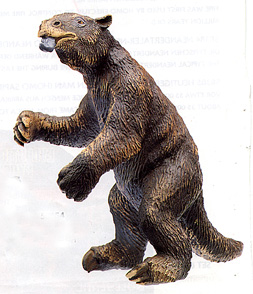
Bullyland Megatherium.
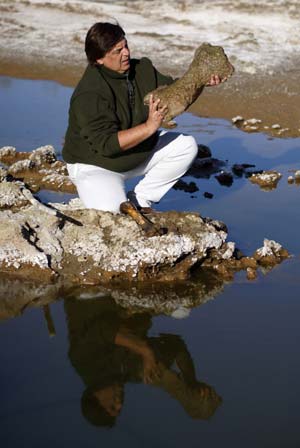
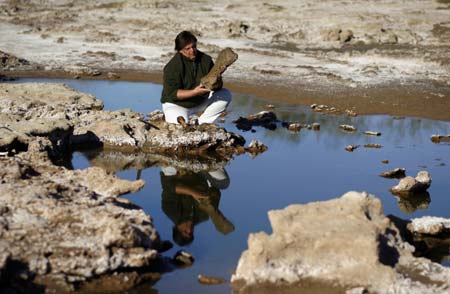
Gustavo Lara, Director of Culture of the town of Roque Perez, is shown in various photos holding a fossil bone of a Megatherium, a variety of large ground sloth, at an excavation site on the outskirts of Roque Perez, some 135 km (84 miles) south of Buenos Aires, this week.
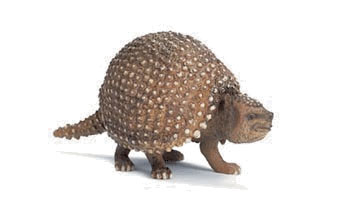
Fossil bones of a glyptodont (replica above), the nearly complete skeleton of a Megatherium and a head of a Stegomastodon dated from the Pleistocene, the epoch from 1.8 million to 10,000 years ago, were found by paleontologists in the sediments of the Salado River. Due to a drought that has been affecting the area for months, local media and Reuters reported the fossils are appearing.
Hey, the International Cryptozoology Museum would love to have large (legal) fossils of its own for exhibition, but institutional survival is the key, first and foremost.
Consider a contribution today, and merely click to…
Thank you
 About Loren Coleman
Loren Coleman is one of the world’s leading cryptozoologists, some say “the” leading living cryptozoologist. Certainly, he is acknowledged as the current living American researcher and writer who has most popularized cryptozoology in the late 20th and early 21st centuries.
Starting his fieldwork and investigations in 1960, after traveling and trekking extensively in pursuit of cryptozoological mysteries, Coleman began writing to share his experiences in 1969. An honorary member of Ivan T. Sanderson’s Society for the Investigation of the Unexplained in the 1970s, Coleman has been bestowed with similar honorary memberships of the North Idaho College Cryptozoology Club in 1983, and in subsequent years, that of the British Columbia Scientific Cryptozoology Club, CryptoSafari International, and other international organizations. He was also a Life Member and Benefactor of the International Society of Cryptozoology (now-defunct).
Loren Coleman’s daily blog, as a member of the Cryptomundo Team, served as an ongoing avenue of communication for the ever-growing body of cryptozoo news from 2005 through 2013. He returned as an infrequent contributor beginning Halloween week of 2015.
Coleman is the founder in 2003, and current director of the International Cryptozoology Museum in Portland, Maine.









“Fossil bones of a glyptodont (replica above), the nearly complete skeleton of a Megatherium and a head of a Stegomastodon dated from the Pleistocene, the epoch from 1.8 million to 10,000 years ago…” Are you saying that the creature above was alive and walking this earth at the same time as men? 10,000 years I think both sides of the debate will acknowledge the existence of mankind then. And if this one was around then, why not other dinos.
Dinosaurs are not fossil mammals, which is what is being mentioned here.
A general definition of the Pleistocene is given, of which some of that time overlaps with modern humans.
It is generally acknowledged that some forms of ground sloths and perhaps other fossil mammals might have lived at the same time as humans, of course.
The glyptodont was a prehistoric mammal and according to wikipedia:
They became extinct about 10,000 years ago. The native human population in their range is believed to have hunted them and used the shells of dead animals as shelters in inclement weather.
So really not that long ago.