
Lungless Frog Discovered
Posted by: Loren Coleman on April 8th, 2008
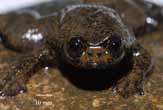
Photo of Barbourula kalimantanensis.
Researchers have confirmed the first case of complete lunglessness in a frog, according to a report in the April 8, 2008, issue of Current Biology, a publication of Cell Press. The aquatic frog Barbourula kalimantanensis apparently gets all the oxygen it needs through its skin.
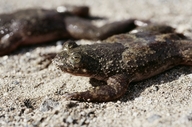
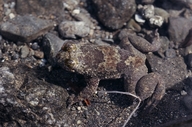 The closely related Barbourula busuangensis or Philippine Flat-headed Frog.
Previously known from only two specimens, two new populations of the aquatic frog Barbourula kalimantanensis were found by the team during a recent expedition to Indonesian Borneo.
“We knew that we would have to be very lucky just to find the frog,” said David Bickford of the National University of Singapore. “People have been trying for 30 years. But when we did and I was doing the initial dissections—right there in the field—I have to say that I was very skeptical at first. It just did not seem possible. We were all shocked when it turned out to be true for all the specimens we had from Kalimantan, Indonesia.
“The thing that struck me most then and now is that there are still major firsts (e.g., first lungless frog!) to be found out in the field,” he added. “All you have to do is go a little ways beyond what people have done before, and—voila!”
Of all tetrapods (animals with four limbs), lunglessness is only known to occur in amphibians. There are many lungless salamanders and a single species of caecilian, a limbless amphibian resembling an earthworm, known to science. Nevertheless, Bickford said, the complete loss of lungs is a particularly rare evolutionary event that has probably only occurred three times.
The discovery of lunglessness in a secretive Bornean frog supports the idea that lungs are a malleable trait in amphibians, which represent the evolutionary sister group to all other tetrapods, according to the researchers. Barboroula kalimantanensis lives in cold, fast-flowing water, they noted, so loss of lungs might be an adaptation to a combination of factors: a higher oxygen environment, the species’s presumed low metabolic rate, severe flattening of their bodies that increases the surface area of their skin, and selection for negative buoyancy—meaning that the frogs would rather sink than float.
The researchers said that further studies of this remarkable frog may be hampered by the species’s rarity and endangerment. They therefore strongly encourage conservation of the frogs’ remaining habitats.
“This is an endangered frog—that we know practically nothing about—with an amazing ability to breathe entirely through its skin, whose future is being destroyed by illegal gold mining by people who are marginalized and have no other means of supporting themselves,” Bickford said. “There are no simple answers to this problem.”
 About Loren Coleman
Loren Coleman is one of the world’s leading cryptozoologists, some say “the” leading living cryptozoologist. Certainly, he is acknowledged as the current living American researcher and writer who has most popularized cryptozoology in the late 20th and early 21st centuries.
Starting his fieldwork and investigations in 1960, after traveling and trekking extensively in pursuit of cryptozoological mysteries, Coleman began writing to share his experiences in 1969. An honorary member of Ivan T. Sanderson’s Society for the Investigation of the Unexplained in the 1970s, Coleman has been bestowed with similar honorary memberships of the North Idaho College Cryptozoology Club in 1983, and in subsequent years, that of the British Columbia Scientific Cryptozoology Club, CryptoSafari International, and other international organizations. He was also a Life Member and Benefactor of the International Society of Cryptozoology (now-defunct).
Loren Coleman’s daily blog, as a member of the Cryptomundo Team, served as an ongoing avenue of communication for the ever-growing body of cryptozoo news from 2005 through 2013. He returned as an infrequent contributor beginning Halloween week of 2015.
Coleman is the founder in 2003, and current director of the International Cryptozoology Museum in Portland, Maine.











I understand why it was done, but its still kinda sad that they hunted down this rare frog and the first thing they did was kill it.
If you don´t have a specimen you can´t prove that it exists, and are therefore hardly able to protect it.
Wow, very interesting. This frogs face reminds me of the Pig nosed turtle (Carettochelys insculpta) from Australia. This type of turtle is also in Indonesia and Papua New Guinea. I wonder if the up turned nose of this frog is used to mimic a turtle and not to breathe since the lungs are not present. Probably more research is needed. Finding frogs in their environment usually means the area is healthy and free of toxins. Lets hope this is the case in the discovery of this new species.
Thanks for the post Loren.