
Sumatran Rhinos Are Living Fossils
Posted by: Loren Coleman on September 12th, 2006

Zoologist Darren Naish has written a thoughtful essay on “Are Sumatran Rhinos Really Living Fossil?”
His blog is in response to my comments on the “living fossil” issue, discussed here. I disagree with Naish’s restrictive parameters, of course, as I see this more an issue of educational semantics influenced by zoology, not ruled by it. Darren Naish’s approach is worthy of your attention and he has every right to his very informed point of view.
Needless to say, in this case, I was employing the “living fossil” definition that this rhino species is “a living species/clade with many ‘primitive’ characteristics in appearance, in which the species has many ancestral characteristics (plesiomorphies).”
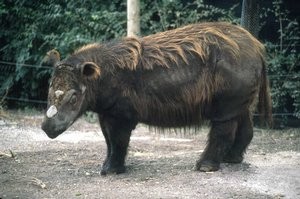
Most discussions of the Sumatran rhinoceros (Dicerorhinus) give credence to the notion that they display traits of and links to the Ice Age wooly rhinoceros (Coelodonta antiquitatis). [The Family Rhinocerotidae developed in the Late Eocene Epoch (55 to 36 million years ago) or Early Oligocene Epoch (36 to 22.5 million years ago) and spread across North America, Asia, Europe and Africa. The woolly rhinoceros appeared during the Mid-Pleistocene Epoch (about 500,000 years ago) in eastern Asia.] The Asian Rhino Specialist Group, for example, notes in their materials that the Sumatran is the last representative of the wooly rhino.
I will continue to use the “living fossil” phrase to highlight the points I wish to make, just as Charles Darwin, E. O. Wilson, Willy Ley, Bernard Heuvelmans, and Ivan T. Sanderson have before me.
🙂
 About Loren Coleman
Loren Coleman is one of the world’s leading cryptozoologists, some say “the” leading living cryptozoologist. Certainly, he is acknowledged as the current living American researcher and writer who has most popularized cryptozoology in the late 20th and early 21st centuries.
Starting his fieldwork and investigations in 1960, after traveling and trekking extensively in pursuit of cryptozoological mysteries, Coleman began writing to share his experiences in 1969. An honorary member of Ivan T. Sanderson’s Society for the Investigation of the Unexplained in the 1970s, Coleman has been bestowed with similar honorary memberships of the North Idaho College Cryptozoology Club in 1983, and in subsequent years, that of the British Columbia Scientific Cryptozoology Club, CryptoSafari International, and other international organizations. He was also a Life Member and Benefactor of the International Society of Cryptozoology (now-defunct).
Loren Coleman’s daily blog, as a member of the Cryptomundo Team, served as an ongoing avenue of communication for the ever-growing body of cryptozoo news from 2005 through 2013. He returned as an infrequent contributor beginning Halloween week of 2015.
Coleman is the founder in 2003, and current director of the International Cryptozoology Museum in Portland, Maine.











I’ll go with the term “Living Fossil.” For us non-scientist lay folks, the term accurately describes what is being referred to, a living representative that is extremely close in appearance and remarkably resembles the ancient fossil record for any given animal (or plant(i.e. the Dawn Redwood of China).
I fish for Sturgeon occasionally (catch and release). That marine animal is referred to as a *living fossil* by many fisherpersons (note the PC!) and guides on the North American West Coast due to the fact that that the fossil record of Sturgeon has changed little, if any, in over 200,000,000 years. That’s right, two hundred million years! “Living Fossil” works just fine for me.
Darren Naish seems to be a nice British fellow. My experience with the Brits (and this is not intended as an insult!) is that Brits in the Professional Ranks tend to be “Proper and Formal” all the time. True gentlemen and ladies. We just ain’t that way on this side of the pond!
As for the Sumatran Rhino, very cool animal! I had not seen a photo of one or heard of one prior to this post.
This site is far better than re-runs on the Discovery Channel!
When I first saw a picture of a Sumatran rhino I thought of it as being a small version of a wooly rhino as a passing thought.
I guess we sometimes get very carried away when we use the phrase a living fossil, referring to a good discovery, but in this case, I will call this great discovery a living fossil.
Now only if a living wooly mammoth is to be alive and well, but that’s only hopeful.
The Wooly Rhino, a Pleistocene animal of the Ice Age megafauna, may have survived until about 10,000 years ago in Siberia.
“Living fossil” to me implies something that’s been around for a long, long, long time, especially if we’ve only recently discovered it.
Shill, you’re right about not able to be a fossil and living at the same time, but the reason for the term is completely because men of science are so sure of themselves that they will find fossils, and because they have never seen one, it must be extinct. We have several “living fossils” around the world. What I think we need to look at are the similarities and differences of both creatures. I know someone above mentioned size, but the fact that something so big went all this time without being discovered gives hope that soon other things will be discovered.
It is a “well, ‘just’ what ‘do’ you mean by that” term.
I’d apply it to something really ancient with just a few modern representatives myself. (say, a monotreme)
If you’re going to apply it to something pliestiocene (did I spell that right??) then that mean beasts like reindeer, wolves, and us are living fossils.
twocentsworth: Try “angler” instead. Less cumbersome.
My take on this photo is that the rhino population is now so inbred that its reawakened its wooly rhino gene from it’s original ancestor. I believe that these wooly rhinos are on the verge of extinction once again.
Randy in CT:
Yep, angler works just fine…but I like to use words like “fisherperson” to poke a little self-indulgent sarcasm at our PC world. Another term I like is “fireperson.” That one just cracks me up for some twisted reason! Back to the term “living fossil.” Technically an oxymoron, true enough, but one that is widley used, generally accepted and understood. It is used in many lay discussions for descriptive purposes and works well. My general poor attitude toward our current PC world would make me a “living fossil” for sure! That must make me an oxymoron – or maybe just plain moron? I’m OK with that!
The croc hunter had a Sumatran Rhino on his show once. Amazing animals. Not aggressive or anything like the huge white rhinos you find in Africa. It’s a shame they are on the verge of extinction.