
Gobi Kulan Soon At Edinburgh Zoo
Posted by: Loren Coleman on February 25th, 2008
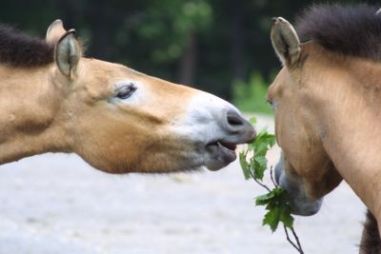
I have mentioned Przewalski’s horse before, regarding their presence in zoos (as above) and concerning their replica appearance (as below).
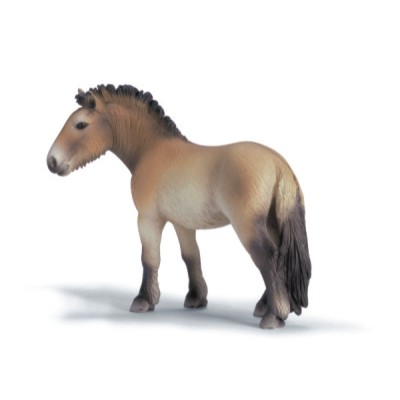
The Przewalski’s horse, a Pleistocene megafauna survivor, extinct in the wild, can be called a “living fossil,” in the popularized employment of that phrase. Certainly, this horse is of interest to cryptozoologists, as mentioned earlier.
The species (Equus ferus przewalskii, Equus caballus przewalskii, or Equus przewalski poliakov – classification is debated) is the last truly wild horse, first recognized by zoology in Mongolia in 1881.
But if you live in or visit Scotland, you can see another unique wild horse that will soon be placed on exhibition at the Edinburgh zoo.
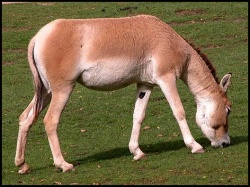
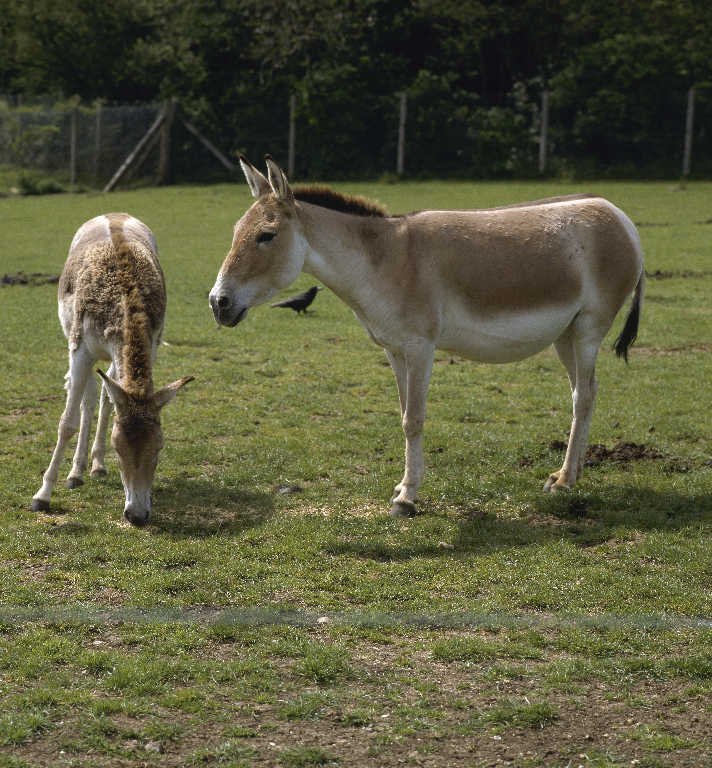
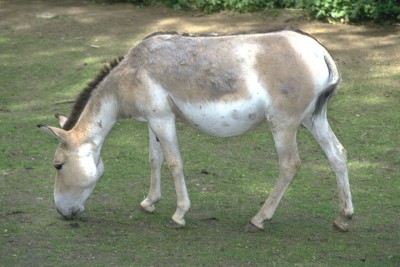
The Gobi Kulan or Dziggetai, Equus hemionus luteus (above).
The Mongolian Wild Ass (Equus hemionus hemionus, also called Khulan) is a subspecies of the Onager. It may be synonymous with the Gobi Kulan or Dziggetai subspecies (Equus hemionus luteus).
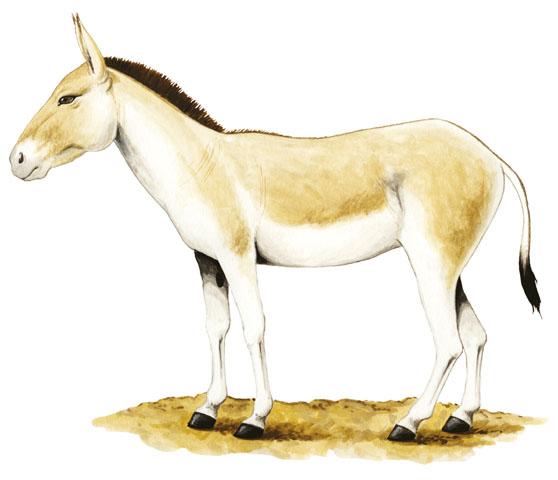
Kulan were once widespread over an immense region of the Gobi, but now are found only in small localized pockets in central Mongolia, after their numbers were cut by hunting and competition for water.
A small group of Kulan are expected to arrive at the Edinburgh Zoo later in 2008.
 About Loren Coleman
Loren Coleman is one of the world’s leading cryptozoologists, some say “the” leading living cryptozoologist. Certainly, he is acknowledged as the current living American researcher and writer who has most popularized cryptozoology in the late 20th and early 21st centuries.
Starting his fieldwork and investigations in 1960, after traveling and trekking extensively in pursuit of cryptozoological mysteries, Coleman began writing to share his experiences in 1969. An honorary member of Ivan T. Sanderson’s Society for the Investigation of the Unexplained in the 1970s, Coleman has been bestowed with similar honorary memberships of the North Idaho College Cryptozoology Club in 1983, and in subsequent years, that of the British Columbia Scientific Cryptozoology Club, CryptoSafari International, and other international organizations. He was also a Life Member and Benefactor of the International Society of Cryptozoology (now-defunct).
Loren Coleman’s daily blog, as a member of the Cryptomundo Team, served as an ongoing avenue of communication for the ever-growing body of cryptozoo news from 2005 through 2013. He returned as an infrequent contributor beginning Halloween week of 2015.
Coleman is the founder in 2003, and current director of the International Cryptozoology Museum in Portland, Maine.









Beautiful Wild ass, none in American Zoos ?
I wonder if these are the original stock that the Mongolian horse was bred from that became our domestic horses of today?
Now that’s a nice ass 😉
GKinkdano, The American Horse went extinct about 12 thousand years ago. The Horse was introduced to North america by the Spanish with their Mustangs.
Thanks for keepin’ us current on this subject, Loren. Always fascinating, and what with the recent revelations regarding the 12.9KYA impact event and the subsequent exterpation of so much of North America’s megafauna such as these equines, elephants, camels, lions, cheetahs, and who knows what else, the argument for re-establishing them or their proxies back onto their home range and once again more fully realize the true diversity and and carrying capacity of the landscape is all the more pertinent. Particularly in view of the fact that as more and more of us continue to occupy less and less land due to urbanization and intensified land use (sprawl is so last century and rural communities are being abandonned) the land is practically begging for the return of its ancient regime and inventory.
Quite frankly I salivate at the idea of seeing cheetahs and their ancestral prey, pronghorn antelope, once again in balance throughout the west and in particular the Great Basin.
Elephants in the mojave. Camels in the Sonoran…and wild horses interspersed in a reconstituted buffalo grass prarie while lions keep watch.
Were the natural imperitives seen for what they are (natural law) and not just some vague expression of a romanticized past we’d be insisting instead of just suggesting. In the mean time, zoos will have to act as repositories in hopes of human understanding catching up with the great dictates of nature. To do other is to essentially squander our inheritance.
I was wondering if the now extinct Quaga was a cross (hybrid) between a Zebra and a Wild Ass (theres a population in Asia) I have always wondered that! As a child I was given a book with all kinds of now extinct animals and mithic creatures as well but the Quaga was my favourite one to read about!
Bob, I know that the North American horses died out. What I was asking is which “wild” horse species was domesticated in Asia to form the original breeding stock of all our modern horses?
No one knows, for certain, which species went into the development of domestic horses. The fossil record is inconclusive and open to various interpretations. Some authorities say the Przewalski’s horse was a progenitor; certainly, they can and do interbreed with feral horses today. Others says that as many as four to six separate species were involved in creating Equus caballus. Still others insist that the prototypical domestic horse was a now-extinct species called Equus ferus, which diversified into four distinct subspecies, from which modern horse breeds arose in various regions.
I am more inclined to believe that several distinct species are ancestral to the horses of today. In my view it is naive to believe that the modern domestic horses – and cats and dogs too for that matter – are descended entirely from a single wild species. I believe that different groups of people began to domesticate whichever wild species was native to their region. Then as time wore on, people being the nomadic creatures that we are, we took our animals with us to new locations, where they mingled with the existing domestic and wild stock. Always people have selected among their animals, keeping odd or unusually colored or marked animals for the sake of novelty, and keeping animals that were more suited to whatever purpose to breed and perpetuate a line. Eventually that led to the many diverse breeds and types that we see today. I doubt that any of the present-day species of wild ass were involved in the development of horses, but I believe that at least four species of primitive horses were domesticated and developed into the horse breeds of today. Of course, during the last 500 years, as people developed means of world travel by which they could transport animals far and wide, there has been a great deal of interbreeding, and there are very few really pure breeds left.
I like the idea of a rewilding program for the USA, and for Canada, but I don’t think it will ever happen. There is a really nice conservation center in southeastern Ohio, where animals can live and breed, not completely wild, but with much more freedom than a zoo. It’s called The Wilds, and it’s built on the site of a former coal strip mine. Their web link is here: http://www.thewilds.org/. I would like to see more places like this. I am vehemently opposed to mountaintop removal mining; I think it should be banned outright. But there are many places where the mountains have already been truncated, which could be remade into conservation areas such as The Wilds, where animals live a much more natural existance than they do in the much smaller space of a traditional zoo.