
Karl’s Kritter: Pliciloricus shukeri
Posted by: Loren Coleman on August 24th, 2007
Congratulations to Karl Shuker!
Dr. Karl P. N. Shuker is a zoologist with a lifelong interest in cryptozoology and other animal-related anomalies. He studied zoology at the University of Leeds and obtained a Ph.D. in zoology and comparative physiology at the University of Birmingham. Due to the complications of a life that could have been hindered by a chronic form of diabetes, Shuker has continued on with his interest and passion for new animals through the written word and his documentary appearances in a dynamic fashion.

Shuker has now been honored for his efforts with the naming of a new animal – or as the Fortean Times mentions in their dispatch, “Shuker’s Microscopic Namesake,” a very, very small one.
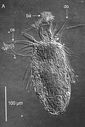
As FT notes: “The bestower of this rare honour is Prof. Reinhardt Møbjerg Kristensen – discoverer of the lorciferans, an entirely new phyla of microscopic multicellular animals – who has christened one of them Pliciloricus shukeri (pictured above top).”
The exact citation for Karl Shuker’s namesake, the bibliographical reference to the paper in which its description appears is as follows: Iben Heiner and Reinhardt Møbjerg Kristensen. 2005. “Two new species of the genus Pliciloricus (Loricifera, Pliciloricidae) from the Faroe Bank, North Atlantic.” Zoologischer Anzeiger, vol.243, no.3. pp121-138.
Outstanding! What an honor for Karl and cryptozoology to be recognized in this fashion.
 About Loren Coleman
Loren Coleman is one of the world’s leading cryptozoologists, some say “the” leading living cryptozoologist. Certainly, he is acknowledged as the current living American researcher and writer who has most popularized cryptozoology in the late 20th and early 21st centuries.
Starting his fieldwork and investigations in 1960, after traveling and trekking extensively in pursuit of cryptozoological mysteries, Coleman began writing to share his experiences in 1969. An honorary member of Ivan T. Sanderson’s Society for the Investigation of the Unexplained in the 1970s, Coleman has been bestowed with similar honorary memberships of the North Idaho College Cryptozoology Club in 1983, and in subsequent years, that of the British Columbia Scientific Cryptozoology Club, CryptoSafari International, and other international organizations. He was also a Life Member and Benefactor of the International Society of Cryptozoology (now-defunct).
Loren Coleman’s daily blog, as a member of the Cryptomundo Team, served as an ongoing avenue of communication for the ever-growing body of cryptozoo news from 2005 through 2013. He returned as an infrequent contributor beginning Halloween week of 2015.
Coleman is the founder in 2003, and current director of the International Cryptozoology Museum in Portland, Maine.









Is this the parasite that lives exclusively on the nether-regions of some kind of lobster? For some reason it rings a bell.
May the next Sea Monster be named in honor of Dr Karl Shuker, he is one of the Greats in the field of Cryptozoology.
Dear Loren,
It is, of course, very gratifying both for the cryptozoologist in question and us Forteans and cryptozoologists in general to have the “mainstream” scientific community name a newly described animal species of an itself only recently known group after a cryptozoologist. Zoologist and cryptozoologist Karl Shuker certainly has every right to be proud of loriciferan _Pliciloricus shukeri_ named for him.
However, this brings us to the question of just what is–or isn’t–a cryptid, and thus the proper subject matter of cryptozoology. Bernard Heuivelmans himself, as most of us know, defined cryptozoology as “The scientific study of hidden animals, i.e., of still unknown animal forms about which only testimonial and circumstantial evidence is available, or material evidence considered insufficient by some.” You yourself have defined it as “the study of hidden animals (whether large or small, to date not formally recognized by what is often termed Western science or formal zoology but supported in some way by testimony (in its broadest definition) from a human being.” You also cited the “general feeling” that an “important element” is “the input of local, native, explorer, and traveler traditions, sightings, tales, legends, and folklore of the as-yet unverified animals.” You added that it is “for this very reason” that “most, but not all, of the animals under pursuit are large ones”–e.g., Bigfoor, Yeti, Kaptar, Orang Pendek, “Nessie,” Sea Serpents, Mokele-Mbembe, Chupacabras, Mystery Pumas.
These definitions, however, do not seem particularly applicable to Karl Shuker’s microscopic namesake, _Pliciloricus shukeri_, or any of its relatives in the phylum Loricifera. They are microscopically small animals living in sea-bottom habitats, which until their quite recent discovery and description by marine biologists were quite unknown to “testimony (in its widest definition from a human being.” There was never any “input of local, native, explorer, and traveler traditions, sightings, tales, legends, and folklore” about Loricifera, certainly no native legends or travelers’ takes about _Pliciloricus_! In this respect, the Loricifera are QUITE unlike Bigfoot, “Nessie,” or Mokele-Mbembe!
–Cheers, T. Peter