
For Easter: Thoughts of Jackalopes & Wolpertingers
Posted by: Loren Coleman on April 4th, 2010
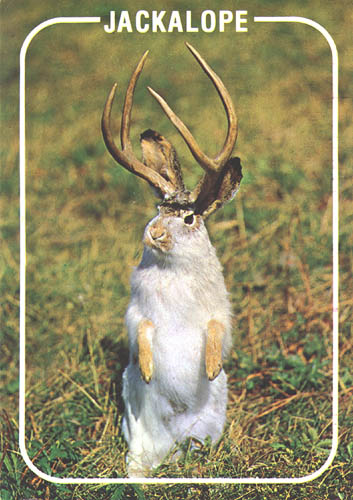
Jackalopes may be real?
The San Francisco Chronicle posted an interesting article in December 2009, by John Flinn, telling of the factual background behind jackalopes. Here’s some highlights of his discussion:
John Colter, a member of the Lewis and Clark expedition, is the first American to claim a jackalope sighting. His announcement drew mostly bemused shrugs. Compared with his tall tales of spouting geysers and bubbling mud pots along the Yellowstone River, a horned rabbit wasn’t exactly front-page news.
The creature probably would have bunny-hopped off into the mists of mythology had it not been for Douglas Herrick, a young rancher in Douglas, Wyo., with a mail-order taxidermy degree.
Doug and Ralph Herrick turned their faux taxidermy item, a “rabbit with horns” into a massive industry, shipping, for example, 1,200 a year to Wall Drug stores.
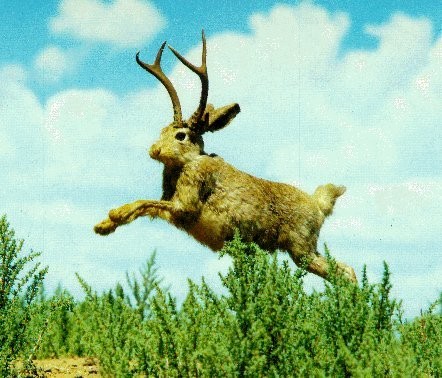
Flinn continues,
But is the jackalope really a creature of mythology? Surprisingly, wildlife biologists say no.
Sightings of a jackalope-like creature have been reported in Europe for centuries. In Bavaria it was known as a wolpertinger; in Austria they called it a raurackl; in Switzerland it was a dillsapp.
A woodcut picture of a hare with horns appeared as far back as 1575 in a zoology treatise titled “Animalia Qvadrvpedia et Reptilia (Terra).” Another showed up in the Encyclopedie Methodique, a popular, 206-volume French encyclopedia published between 1782 and 1832.
On a hunting trip in the 1930s in the western United States, Dr. Richard Shope of Rockefeller University heard a friend talk of seeing rabbits sporting horns. He asked his friend to send him some of these horns, which under the microscope turned out to be warts that formed horn-like protrusions on the hare’s head.
Shope and other scientists eventually tracked the cause to a virus called papillomavirus, which in humans causes cervical cancer. This set researchers down the long path that in 2006 led to the cervical cancer vaccine approved by the Food and Drug Administration.
Read more of Flinn’s article here.
The Wolpertinger of Bavaria has been seen as the cultural precursor of the Jackalope, and I am still in pursuit of one of the taxidermy examples for the museum.
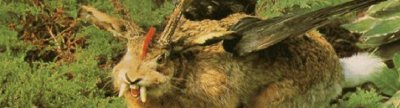
Wolpertingers, supposedly from the Black Forest of Bavaria, were constructed from the body of a hare with the horns of a roebuck, the wings of a jay and the feet of a duck.
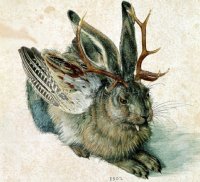
The origins of the Wolpertinger reports, supposedly, are diseased hares having the Shope Papilloma virus producing horny, cancerous growths on the animal’s head and body, giving it the appearance of having antlers.
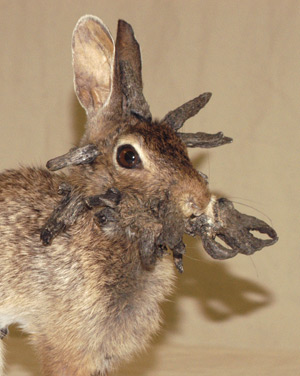
Was the virus – see the effects above – the cause of the inspiration for the Wolpertinger and the Jackalope?

 About Loren Coleman
Loren Coleman is one of the world’s leading cryptozoologists, some say “the” leading living cryptozoologist. Certainly, he is acknowledged as the current living American researcher and writer who has most popularized cryptozoology in the late 20th and early 21st centuries.
Starting his fieldwork and investigations in 1960, after traveling and trekking extensively in pursuit of cryptozoological mysteries, Coleman began writing to share his experiences in 1969. An honorary member of Ivan T. Sanderson’s Society for the Investigation of the Unexplained in the 1970s, Coleman has been bestowed with similar honorary memberships of the North Idaho College Cryptozoology Club in 1983, and in subsequent years, that of the British Columbia Scientific Cryptozoology Club, CryptoSafari International, and other international organizations. He was also a Life Member and Benefactor of the International Society of Cryptozoology (now-defunct).
Loren Coleman’s daily blog, as a member of the Cryptomundo Team, served as an ongoing avenue of communication for the ever-growing body of cryptozoo news from 2005 through 2013. He returned as an infrequent contributor beginning Halloween week of 2015.
Coleman is the founder in 2003, and current director of the International Cryptozoology Museum in Portland, Maine.










I was stationed at Lackland AFB outside San Antonio from 84-87. One of my fellow airman was from Brooklyn, NY. He kept asking me about these funny dogs they had running around base. I asked if he meant the coyotes and he then pointed at a jackrabbit. I shook my head and chuckled in disbelief and told that was a jackrabbit. He was stunned that a ‘wild bunny’ could be that big. I can imagine the European settlers reaction at their first sighting of a tall lean plains or desert jack rabbit. Their size and gait is totally different than those familiar cottontails of the woods and meadows of the eastern US.
So…I guess the only other question would be, “How? How does a rabbit get that particular virus on its head?”