
New Species Being Raided For Private Pet Trade
Posted by: Loren Coleman on December 16th, 2011
The bubble has burst.
There are so many new animals being discovered, you had to wonder when the evil that humans do would catch up with all the good news.
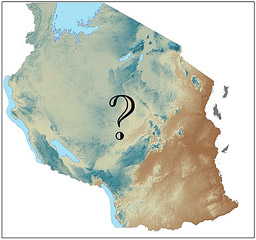
There is breaking news on December 15th of a new species of a uniquely-colored horned viper measuring over two feet long (643 millimeters) being discovered. But where exactly it lives in Tanzania is not being discussed.
But the shocking revelation that has been paired with this announcement is that past news of this kind has resulted in large scale raiding operations in the locations described. New species apparently have been targeted by pet collectors to supply a large-scale underground in exciting new animals for private collections. For example, due to this fact, the new viper’s location is “a closely-guarded secret,” say the discoverers.
Announcements about discoveries of new species are often given with great fanfare. Just this week, Voice of America published an article entitled “208 New Species Discovered in Southeast Asia,” National Geographic on “Smallest Frogs Found—Each Tinier Than an M&M (in Papua New Guinea),” and UPI that “Calif. academy named 140 species in ’11.”
What appears to be happening is that as soon as a new species is “discovered,” in rush the illegal pet trade folks to turn a profit.
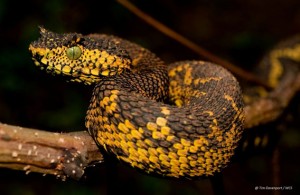
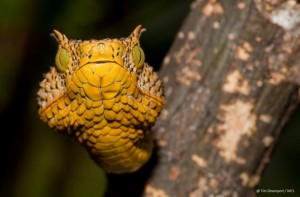
Matilda’s horned viper (Atheris matildae). Photo by: Tim Davenport.
The Wildlife Conversation Society (WCS) has this to say about this:
Wildlife trade is now the second largest illegal trade in the world after drugs, with the global trade, both legal and illegal, estimated to be currently around US$159 billion a year. Reptiles play a large part in this and unfortunately the illegal trade – especially in wild-caught reptiles – is having a devastating effect on wild populations. So much so that in many parts of Africa it is the single biggest threat to the existence of many species in the wild. The colourful, fascinating African bush vipers of the genus Atheris are popular pet snakes in many countries, however, their natural habitat is seriously threatened and the numbers of wild caught animals destined for the pet trade continues to be unsustainable.
It is often the case that the first few specimens of a newly discovered bush viper can be worth a high price and this can have a very damaging impact on the population, In the case of Matilda’s Horned Viper, a sudden rush to collect as many specimens as possible could actually extirpate the species in the wild. To avoid the unsustainable collection of such a rare snake, we have agreed with the editor of the scientific journal Zootaxa – where the species description is published – to keep the locality as vague as possible (only very general information is given), with the possibility of more specific information provided by the authors on request, for scientific purposes only. Such a practice should be taken into consideration by taxonomists every time a new, rare species of potential commercial interest is described.
The Mongabay article notes: “To keep the new species safe, researchers collected eleven snakes for a captive breeding program: four males, five females, and two juveniles. The offspring of these snakes are meant to be an insurance against extinction. Along with keeping its exact location in the wild quiet, the conservationists are also going one step further to anticipate the illegal pet trade.”
“We are planning to make available the first few dozen offspring from the captive population free of charge, in order to provide the market with captive-bred specimens of the new species. The aim is to avoid collection of wild caught specimens, lower the price of the animal and encourage responsible captive breeding by keepers in the most highly demanding countries,” explains Tim Davenport of the WCS. “The ultimate goal is also to raise awareness and support for a community-based forest conservation program. Matilda’s horned viper will, it is hoped, be a flagship species for this initiative.”
 About Loren Coleman
Loren Coleman is one of the world’s leading cryptozoologists, some say “the” leading living cryptozoologist. Certainly, he is acknowledged as the current living American researcher and writer who has most popularized cryptozoology in the late 20th and early 21st centuries.
Starting his fieldwork and investigations in 1960, after traveling and trekking extensively in pursuit of cryptozoological mysteries, Coleman began writing to share his experiences in 1969. An honorary member of Ivan T. Sanderson’s Society for the Investigation of the Unexplained in the 1970s, Coleman has been bestowed with similar honorary memberships of the North Idaho College Cryptozoology Club in 1983, and in subsequent years, that of the British Columbia Scientific Cryptozoology Club, CryptoSafari International, and other international organizations. He was also a Life Member and Benefactor of the International Society of Cryptozoology (now-defunct).
Loren Coleman’s daily blog, as a member of the Cryptomundo Team, served as an ongoing avenue of communication for the ever-growing body of cryptozoo news from 2005 through 2013. He returned as an infrequent contributor beginning Halloween week of 2015.
Coleman is the founder in 2003, and current director of the International Cryptozoology Museum in Portland, Maine.











This gives ‘legs’ to those who insist Bigfoot information made public severely put the creatures at high risk! And on the other side of the coin this article also gives ‘legs’ to those who insist Bigfoot would not be kept a secret for long for the mere reason that too much fame and fortune would come from the discovery. So needless to say, the Bigfoot debate will continue ~ business as usual.
Domesticating animals is not evil. It is what humans do.
Basics… To be acknowledged from science every new species has to be officially described. So here’s the paper from Atheris matildae.
Markus is correct. The paper he posted very specifically notes the area where this new species is found. However, if the mainstream media refrain from making a big deal out of publishing where they are found, perhaps the thought is that this will prevent illegal pet trade collectors/merchants from rushing there. Protecting the habitat site would help too, as well as placing stricter limits and enforcement on import/export of endangered new species.
The gist of this article was the absolute proof that some people really do have more money than brains. Considering the status (?) attached to the owning of such a new and colorful snake, the price will be high no matter how many of the first offspring will be provided. Plus, it’s nice to know from so early a date just what Florida’s next invasive species will be.
I have recently read two excellent books about the illegal reptile smuggling business..
What concerned me more than anything was just how guilty many of the larger zoos are in this despicable practice.
Many of those non indigenous snakes and lizards roaming the everglades have been left there by non scrupulous smugglers who bring legal reptiles into the country [to disguise the illegal ones they really want] and then let the ones they don`t want go free in the wild.