
Elephantopotamus Discovered
Posted by: Loren Coleman on April 16th, 2008
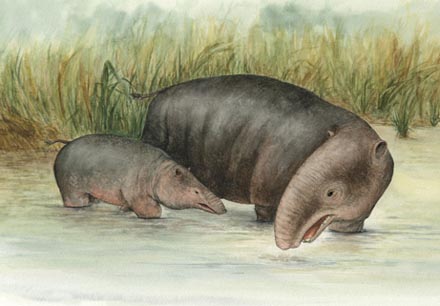
At least one species of proboscidean, a prehistoric relative of the elephant, lived in an aquatic environment, according to a new study published in the Proceedings of the National Academy of Sciences. The extinct water-lover, which belonged to the genus Moeritherium and lived around 37 million years ago, appears to have munched on freshwater plants and spent most of its days in swamps or river systems, according to Alexander Liu, an earth sciences expert at the University of Oxford and the lead author of the study.
The research team based its findings on a group of fossilized teeth found in northern Egypt. By analyzing the patterns of different oxygen and carbon isotopes in the tooth enamel, Liu and his crew were able to identify the animal’s diet and lifestyle. The Oxford scientist was particularly intrigued by the possibility that a mammal could have started out terrestrial (as did all mammals) and evolved into an aquatic species, then reverted back to terrestrial—with the end result being modern elephants, lumbering across the plain and visiting their ancestral graveyards.
Ironically, while the creature is related to the elephant and enjoyed a hippo’s lifestyle, it reportedly had hooves and looked like a “cross between a horse and a rhino.” So perhaps a more appropriate title would be “equaphantopotonocerous.”
Sources: Discover Magazine; Image courtesy of Luci Betti-Nash, Stony Brook University/PNAS.
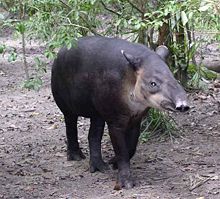
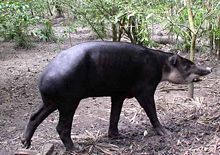
Directly above are two photographs of Baird’s Tapir (Tapirus bairdii), which is one of the three species of tapir found in Latin America.
 About Loren Coleman
Loren Coleman is one of the world’s leading cryptozoologists, some say “the” leading living cryptozoologist. Certainly, he is acknowledged as the current living American researcher and writer who has most popularized cryptozoology in the late 20th and early 21st centuries.
Starting his fieldwork and investigations in 1960, after traveling and trekking extensively in pursuit of cryptozoological mysteries, Coleman began writing to share his experiences in 1969. An honorary member of Ivan T. Sanderson’s Society for the Investigation of the Unexplained in the 1970s, Coleman has been bestowed with similar honorary memberships of the North Idaho College Cryptozoology Club in 1983, and in subsequent years, that of the British Columbia Scientific Cryptozoology Club, CryptoSafari International, and other international organizations. He was also a Life Member and Benefactor of the International Society of Cryptozoology (now-defunct).
Loren Coleman’s daily blog, as a member of the Cryptomundo Team, served as an ongoing avenue of communication for the ever-growing body of cryptozoo news from 2005 through 2013. He returned as an infrequent contributor beginning Halloween week of 2015.
Coleman is the founder in 2003, and current director of the International Cryptozoology Museum in Portland, Maine.










Someone please explain by looking at teeth how do you know if this animal had hooves. Or what this animal looks like. New discoveries are great but without fossils or bones, not just teeth, no one in this world can really say what any animal looks like. They can only speculate! Good science is what I am after not speculation.
Horses have hooves and if their hooves are wet for extended periods they start to get infected and soften up. I don’t think hoofed animals do very well in aquatic enviroments. I may be wrong.
No, they based their ideas on what the animal ate by looking at the teeth. It’s appearance most likely comes from the rest of the skeleton. As for the water thing, there are many hoofed animals like moose and water buffalo that spend their time in wet enviroment and do so without rotting off their hooves. It’s a matter of adaption.
Thanks koipond. I did not know they have a skeleton based on the info given above. You are right about the moose and water buff. I just do not get those who base things on teeth and only teeth. A chimp for example. They were thought to be herbivores until they were caught on film hunting a monkey. The same goes for the Hippo. etc. I read the blog again and no skeleton is mentioned. So again by just looking at teeth you can not in any way tell what the feet look like. This is the point I am making. Thanks again for your comment.
Looks like a really big cousin of the tapir to me.
Nice animal
What makes them think animals like this (or elephants for that matter) went from terrestial to aquatic and back to terrestial? So it liked to munch on water plants. When the first surfer develops gills I’ll start believing all this stuff.