
Grover’s Back!
Posted by: Loren Coleman on April 22nd, 2009
I fully accept the Patterson film. [Bigfoot’s loping gait is] consistent with a 500-pound biped. I’ve attempted to imitate it, and I really can’t do it worth a damn. – Grover Krantz, 1999
Don’t be surprised if you hear people talking about Grover Krantz again.
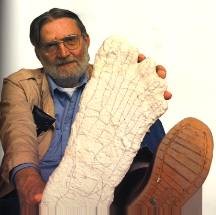
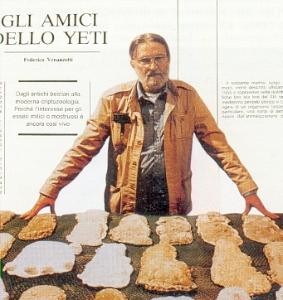
The anthropologist who wrote or edited four books, The Scientist Looks at the Sasquatch (Moscow: University Press of Idaho, 1977, with anthropologist Roderick Sprague), The Scientist Looks at the Sasquatch II (Moscow: University Press of Idaho, 1979, with Roderick Sprague), The Sasquatch and Other Unknown Hominoids (Calgary: Western Publishing, 1984, with archaeologist Vladimir Markotic) and Big Footprints (Boulder: Johnson, 1992), revised as Bigfoot Sasquatch Evidence (Seattle: Hancock House, 1999) is back.
Grover S. Krantz (1931-2002) died from pancreatic cancer on Valentine’s Day, seven years ago. The always active Grover Krantz went into decline soon after he told me on December 6, 2001: “Medicine men differ as to whether I have months or years to live.” Such reflected the final uphill battle that Grover faced in a life of challenges. Diane Horton, his wife, was with him constantly, to the end.
Following Krantz’s wishes, Diane Horton held no local services. Grover’s body, instead, was sent to the Body Farm at the University of Tennessee and then his skeleton was transferred to the Smithsonian Institution along with most of his academic materials. As he helped students in life, his skeleton and materials will be available to serious scholars in death.
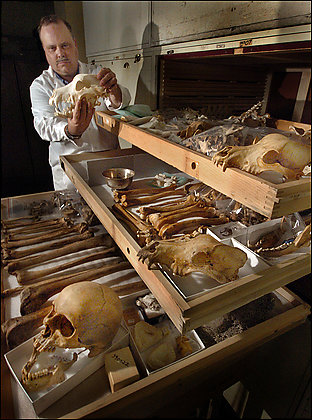
A few years ago, Smithsonian’s Museum of Natural History anthropologist David Hunt is shown opening a green cabinet and pulling out a collection of dog and human bones. That was Grover Krantz in the bottom drawer, and his skull was over to the left, up front. Hunt held one of Krantz’s wolfhounds, which was also in the collection, according to Krantz’s wishes.
Now, in 2009, Grover’s bones are on display, to capture him again, as a mirror of the following image.
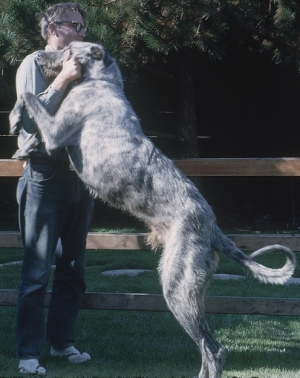
The skeleton model at the Museum of Natural History was based on the above photo of Grover Krantz, a professor of physical anthropology and student of bones at the Washington State University. “It was an outlandish wish,” his wife said recently. But “he wanted his bones someplace. … He thought he would be a good teaching specimen.” (Grover Krantz Papers — National Anthropological Archives.)
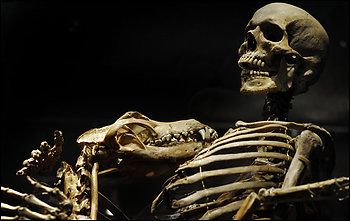
Gordon Krantz and his wolfhound, as the scholar wanted to be preserved. (Washington Post photo by Linda Davidson.)
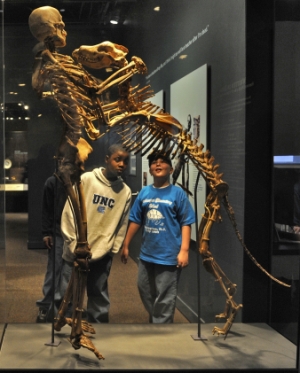
Fifth-graders from Charlotte, N.C., take in the display at “Written in Bone,” a forensic anthropology study, at the Smithsonian Museum of Natural History. The skeletons of professor Grover Krantz and his beloved Irish wolfhound, Clyde, are the realization of Krantz’s ultimate wish. (Washington Post photo by Linda Davidson.)
To read the full story of the Krantz display, see: “Professor’s dying wish granted at Natural History Museum exhibit,” by Michael E. Ruane, The Washington Post.
Keep research happening…
 About Loren Coleman
Loren Coleman is one of the world’s leading cryptozoologists, some say “the” leading living cryptozoologist. Certainly, he is acknowledged as the current living American researcher and writer who has most popularized cryptozoology in the late 20th and early 21st centuries.
Starting his fieldwork and investigations in 1960, after traveling and trekking extensively in pursuit of cryptozoological mysteries, Coleman began writing to share his experiences in 1969. An honorary member of Ivan T. Sanderson’s Society for the Investigation of the Unexplained in the 1970s, Coleman has been bestowed with similar honorary memberships of the North Idaho College Cryptozoology Club in 1983, and in subsequent years, that of the British Columbia Scientific Cryptozoology Club, CryptoSafari International, and other international organizations. He was also a Life Member and Benefactor of the International Society of Cryptozoology (now-defunct).
Loren Coleman’s daily blog, as a member of the Cryptomundo Team, served as an ongoing avenue of communication for the ever-growing body of cryptozoo news from 2005 through 2013. He returned as an infrequent contributor beginning Halloween week of 2015.
Coleman is the founder in 2003, and current director of the International Cryptozoology Museum in Portland, Maine.








Oh man, I just visited the Smithsonian and didn’t go in the forensic exhibit! I’m certainly going back to see this. His “Big Footprints” was what convinced me Bigfoot required serious consideration.
How marvelously touching! An excellent memorial to both of them.
I don’t know about this. The creep factor is off the charts for me. I just keep saying ewwww.
A great ending spot for a great person, and, I am sure, a great dog.
A true educator who continues to teach lessons from beyond the grave.
His “Big Foot Prints” was a milestone…
Now if only a Sasquatch skeleton could be added.
This creeps me out too. But if that was his wish, who am I to quibble? It’s no more bizarre than embalming a body, prepping it for display, and then burying it in a sealed coffin and vault.
“Big Footprints” Is why I took serious consideration of Bigfoot also. “The skeletons of professor Grover Krantz and his beloved Irish wolfhound, Clyde, are the realization of Krantz’s ultimate wish. “…..thats totally cool, Thank You Grover Krantz, again.
Eh, its no creepier than the real cadavers used in the “Bodies” exhibits, or whatever its called.
Personally, its kind of heartwarming in a bizare way. A man reunited in death with his beloved man’s best friend.