
Glory Days Of The Globsters Are Gone
Posted by: Loren Coleman on January 6th, 2011
Globsters formerly were a staple of cryptozoological wonders. Large masses of unknown origin would be found beached in exotic locations around the world. Local wags would scratch their heads and big city experts would state their confusion to the media.
Articles written and book comments would repeat the stories over and over again that Globsters were perhaps Sea Serpents or other unknown marine monsters. If only we could get a sample of such and such a Globster, we were told, perhaps a final determination could be made.
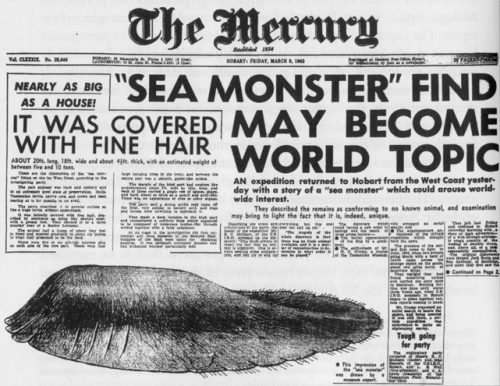
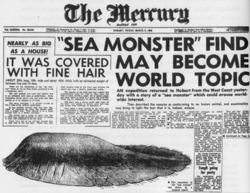
The term “Globster” was coined in 1962 by zoologist Ivan T. Sanderson to describe the 1960 carcass (shown above in the news clipping), which today is known as the “Tasmanian Globster.” It was a large unidentified carcass that washed ashore in western Tasmania, in August 1960. It measured 20 by 18 feet (6 m by 5.5 m) and was estimated to weigh between 5 and 10 tons. The mass lacked eyes and in place of a mouth, had “soft, tusk-like protuberances,” with a spine and six soft, fleshy “arms.” The remarkable stiff, white bristles covering its body were always mentioned as adding to the mystery of what this could be.
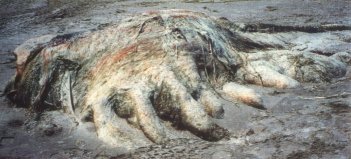
Another such beaching (directly above) was called the “Four Mile Globster,” and described as an unidentified mass washed ashore on Four Mile Beach, Tasmania, in 1997.
However, today, findings, DNA sampling, and better tracking of beaches internationally have almost assuredly linked Globsters to extremely decomposed whales.
One recent find, which looks similar to all the old Globsters was not even mentioned as mysterious. See two angles of it below:
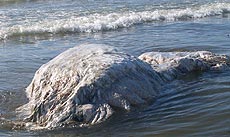
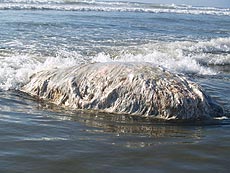
(Photos by Tiffany Boothe, Seaside Aquarium.)
In an article of during mid-September 2007, entitled “Decomposed Whale Beaches on Oregon Coast…,” no doubt was expressed about the origins of this mass. It was stated to be a whale by the staff of the Seaside Aquarium at Seaside, Oregon. As the article observed, it was…
…one very nasty decomposed whale that washed up Tuesday on Del Rey Beach – just north of Gearhart. It was so badly decomposed that staff from the Seaside Aquarium had few clues from which to identify it. Manager Keith Chandler guessed it might be a gray whale, although Deb Duffield from the Marine Mammal Stranding Network headquarters at Portland State University said she thought it might be a humpback whale. She received the photos via email from Tiffany Boothe at the Seaside Aquarium.
It was about ten feet long and thoroughly unrecognizable, Chandler said.
He said it could be the dead whale that was seen last week floating about two miles offshore from Depoe Bay.
The whale was extremely bad smelling, said Chandler. “It’s just a hunk of rotting flesh,” he said. “It’s just a blob. The skin is so bad and slimy it looks like fur.”
They could not get near it on Tuesday because of high tide. “The last thing you want is that decomposed thing to roll over on you or just touch you, when it’s being knocked around by the tide,” said Boothe.
Boothe and Chandler will attempt to collect flesh and blubber samples from the creature at low tide on Wednesday morning. There is a possibility representatives from the Marine Mammal Stranding Network will come out to investigate as well.
There is no word how it may be disposed of.

The glory days of Globsters appear to be gone. The mystery and glamour of the Globster is a thing of history.
Or so it seems.
The mystery of the St. Augustine, Florida, stranding of 1896, could indeed be a “Giant Octopus,” according to Roy P. Mackal’s analysis of the material on file in the Smithsonian archives. But more recent findings, especially as noted by French cryptozoologist Michel Raynal, indeed, nicely compares the blob found in Chile, which was definitely found to be part of the carcass of a sperm whale to that of the St. Augustine beaching of 1896.
 About Loren Coleman
Loren Coleman is one of the world’s leading cryptozoologists, some say “the” leading living cryptozoologist. Certainly, he is acknowledged as the current living American researcher and writer who has most popularized cryptozoology in the late 20th and early 21st centuries.
Starting his fieldwork and investigations in 1960, after traveling and trekking extensively in pursuit of cryptozoological mysteries, Coleman began writing to share his experiences in 1969. An honorary member of Ivan T. Sanderson’s Society for the Investigation of the Unexplained in the 1970s, Coleman has been bestowed with similar honorary memberships of the North Idaho College Cryptozoology Club in 1983, and in subsequent years, that of the British Columbia Scientific Cryptozoology Club, CryptoSafari International, and other international organizations. He was also a Life Member and Benefactor of the International Society of Cryptozoology (now-defunct).
Loren Coleman’s daily blog, as a member of the Cryptomundo Team, served as an ongoing avenue of communication for the ever-growing body of cryptozoo news from 2005 through 2013. He returned as an infrequent contributor beginning Halloween week of 2015.
Coleman is the founder in 2003, and current director of the International Cryptozoology Museum in Portland, Maine.











This is worth considering because it underscores the fact that animals can undergo quite a dramatic change in appearance when decomposed or left lying around for awhile. Decomposition, as well as the bloating and loss of hair that can occur during this process, can change an animal carcass into something completely unrecognizable from what it really is.
Not only decomposition, but the work of scavengers can go a long way towards drastically changing the appearance of an animal carcass. For instance, scavengers generally start with eating away the soft tissues, such as lips, which can change the appearance to quite a striking degree.
The process of decomposition and the work of scavengers can turn the carcass of a known, mundane animal into something that appears to be something new or mysterious, and this has popped up in cryptozoology time and time again. We have the globsters mentioned here (probably almost all whales) as well as things like the “Montauk Monster” (raccoon), the famous Japanese Zuiyo-Maru “plesiosaur” carcass (most likely a basking shark), and a myriad of other cases involving what turned out to be various decomposed dogs, whales, basking sharks, and other animals.
Of course in these days of DNA testing and other more exacting scientific techniques for identifying such carcasses we can more accurately come to an understanding of what is going on. However, in the days before such innovations, there were most likely a great many strange carcasses found that were labelled as new and mysterious monsters that could have in all likelihood been decomposed mundane animals.
Likewise, one wonders how many such animals even in more modern times were uncovered and the carcasses not able to be procured for proper study. In such cases it is easy to imagine even now these animals could garner a reputation for being mysterious new animals when in fact they may just be misidentified due to their strange appearance. It always seems prudent to me to hold off on pronouncing any seemingly strange carcass as being a “monster” or something new until we can adequately confirm that one way or another.
In both instances, we may never know the real answer to what these things were, so it is neat to see that in a case like the age old tales of globsters, at least we have looked deeply into the matter and come to some answers. It may not be the “sexy” answer of new sea monsters that we all hope for, but at least we are getting to the truth and that is what I should hope all us at Cryptomundo would want.
I was going to say “fortunately, more of these can be sampled to determine,” but it looks like now people are going to go back to ignoring masses of tissue that wash up, and so again, most will go un-analyzed…so that if something other than whale tissue would wash up, we’ll never know, because everyone will just assume it’s whale.
And scoftics and civilians wonder why cryptozoology has such a hard time getting proof of things…
springheeledjack- Well, I wasn’t really trying to dismiss all mysterious carcasses as mundane animals. That is certainly not an approach I would advocate. Rather I was trying to illustrate how known animal carcasses can become mysterious with decomposition and that cases of reported strange carcasses where we have no ability to investigate further could be attributed to this without necessarily having to grasp for unknown causes.
Some of the mysterious blobs and what not could have been new species, but look at what we know and don’t know. We know that animal carcasses can undergo dramatic transformations in appearance due to decomposition and the work of scavengers. We don’t know whether there are new giant octopuses or other “sea monsters” at this point in time.
In light of this, any new mysterious carcass that washes up has to be held up to this, and it has to be investigated with the knowledge that it could indeed be something more mundane. What I mentioned in my post above is that I think that any proof we gather has to be done in a scientific way, mindful of what nature has up its sleeve with regards to things like decomposition and such.
I would never dismiss a mysterious carcass out of hand, but I do think there has to be a scientific approach and a realization that carcasses can and do change appearance due to various factors. I think that where cryptozoology will have a harder time is not in getting the proof, but doing it in the right way.
We shouldn’t dismiss the idea that these globsters could be new creatures, but neither can we assume that they are in light of everything we know about the effects of decomposition on animal carcasses. Science can entertain the unknown, but we also have to contend with the known, in this case decomposition and the effects of scavengers. I would rather find the truth and lean towards what we know in the absence of further evidence than assume something carelessly without evidence to that effect.
In my opinion the problem facing cryptozoology is not in getting the proof. If done properly, it won’t matter if someone wants to dismiss the findings because we will have come to those findings in a legitimate and indisputable scientific way. Where cryptozoology can have a bigger problem is jumping to conclusions that something like a globster is mysterious without considering that it may not be. If we want to be taken seriously as a field, this is crucial, it’s something we must do.
I say if we can investigate these globsters through samples, then yes let’s do so. However, let’s not come to premature conclusions without doing so. Careful, yet open minded, that’s the way to go in my opinion.