
Gigantopithecus News
Posted by: Loren Coleman on November 10th, 2011

Fig.1: The mandibles of Gigantopithecus blacki from Juyuandong Cave of Liucheng, Guangxi Province, China.
The extinct giant ape, Gigantopithecus blacki, is a species of large hominoids that dominated the Pleistocene of South China. Its massive mandible, large postcanine teeth and extremely thick enamel always spark people’s curiosity about what a diet for this giant ape was. The precise diet and habitat of Gigantopithecus remains unknown so far. Whether Gigantopithecus survives today, as Yeti, Sasquatch, or other forms of unknown hairy hominoids is the source of much debate in cryptozoology, anthropology, and zoology.
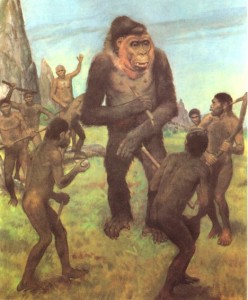
News on Gigantopithecus is infrequent, so we are happy to see on November 10, 2011, some news of research being conducted on this species.
Drs. Zhao LingXia, Zhang LiZhao and Wu XinZhi, Institute of Vertebrate Paleontology and Paleoanthropology, Chinese Academy of Sciences, and Zhang FuSong from Institute of Geology and Geophysics, Chinese Academy of Sciences, analyze enamel stable carbon isotope values of G. blacki and the associated mammalian megafauna from two sites in South China, and find that this giant ape and other large mammals solely fed on C3 biomass, and lived in forest habitats, as reported in the journal of Chinese Science Bulletin, 2011(56), No.33:3590-3595.
Zhao and her collaborators prepared and analyzed a total of 32 tooth samples for their study. Four teeth of G. blacki and 24 teeth of associated large mammals were from Longgudong Cave, Jianshi, Hubei Province, and the other 4 teeth of G. blacki were taken from Juyuandong Cave of Liucheng, Guangxi Province. They discovered that Gigantopithecus and the affiliated megafauna, such as browsers (Cervus sp. and Tapirus sinensis), grazers (Equus sp. and Leptobos sp.) and carnivores (Pachycrocuta licenti and Ursus sp.), all derived their carbon from solely C3 biomass sources. Zhao and her collaborators suggested that Gigantopithecus lived in closed forest habitat and not an open habitat, which is consistent with the associated faunal and floral analyses.
For more detailed analysis, see here.
It is noteworthy that Dr. ZHAO LingXia, the lead author and research designer, said: “The diet and habitat of Gigantopithecus blacki was significantly different from that of early hominins in Africa, such as Australopithecus and Paranthropus, which could consume both C3 and C4resources and live in open habitats, although they all somehow showsimilar powerful mastication morphology . Dependence on forest habitat might be an important factor that made Gigantopithecus extinct when the climate and environment changed dramatically during the Pleistocene.”
Provided by Institute of Vertebrae Paleontology and Paleoanthropology
 About Loren Coleman
Loren Coleman is one of the world’s leading cryptozoologists, some say “the” leading living cryptozoologist. Certainly, he is acknowledged as the current living American researcher and writer who has most popularized cryptozoology in the late 20th and early 21st centuries.
Starting his fieldwork and investigations in 1960, after traveling and trekking extensively in pursuit of cryptozoological mysteries, Coleman began writing to share his experiences in 1969. An honorary member of Ivan T. Sanderson’s Society for the Investigation of the Unexplained in the 1970s, Coleman has been bestowed with similar honorary memberships of the North Idaho College Cryptozoology Club in 1983, and in subsequent years, that of the British Columbia Scientific Cryptozoology Club, CryptoSafari International, and other international organizations. He was also a Life Member and Benefactor of the International Society of Cryptozoology (now-defunct).
Loren Coleman’s daily blog, as a member of the Cryptomundo Team, served as an ongoing avenue of communication for the ever-growing body of cryptozoo news from 2005 through 2013. He returned as an infrequent contributor beginning Halloween week of 2015.
Coleman is the founder in 2003, and current director of the International Cryptozoology Museum in Portland, Maine.









Notice the degreed expert states that Gigantopithus went extinct.
any chance we could get C3 and C4 Biomass translated into english? 🙂
C3 and C4 refer to two different varieties of photosynthesis, basically c4 plants are mostly grass and c3 plants are leafy things, like trees, and older ferns and conifers. The two different processes generate different forms of carbon, and when animals eat the plants (or eat animals that ate the plants) the carbon gets incorporated into their teeth and bones, where we can study it later.
Gigantopithecus was probably a bamboo (c3) eater, like the slightly luckier Giant Panda, so this finding isn’t particularly shocking.
Thanks, JE!
🙂
True Giants!