
Attack of the Giant Otter
Posted by: Loren Coleman on June 10th, 2012

An exhibition cleaner at Hamburg, Germany’s Hagenbeck Zoo has been hospitalized after being attacked by an escaped giant otter. The giant otter (Pteronura brasiliensis) is a South American carnivorous mammal. It is the longest member of the Mustelidae, or weasel family, with males being 4.9 and 5.6 ft long, and females, 3.3 and 4.9 ft, from head to base of tail. The tail adds another 28 inches to the total body length.
The attack happened June 2, 2012, as the zoo cleaner, whose name was not reported, scrubbed benches, Germany media reported Friday, June 8, 2012.
“We have no idea how the giant otter escaped,” zoo spokeswoman Eveline Dustersiek told Germany’s The Local. “Somehow it must have pushed a hole through the fence, which is strange because the fence is metal.”
When the zoo cleaner saw the animal, she screamed and the six-foot-long giant otter pounced on her.
There remains no good explanation for the escape and sudden appearance of the otter.
The Hagenbeck Zoo (Tierpark Hagenbeck) is named after Carl Hagenbeck, whose life and that of his son have been intertwined with the early history of modern cryptozoology.
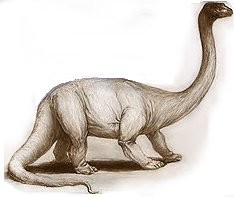
In 1909, zoo animal collector and naturalist Carl Hagenbeck (June 10, 1844 – April 14, 1913) recounted in his autobiography, Beasts and Men, how two separate individuals – a German named Hans Schomburgk and an English hunter – told him about a “huge monster, half elephant, half dragon,” which lived in the Congo swamps. Joseph Menges, another naturalist, told Hagenbeck that “some kind of dinosaur, seemingly akin to the brontosaurs,” lived in the swamps. Hagenbeck sent an expedition in 1909 to the Congo to search for the monster, but the effort was quickly aborted due to disease and hostile natives. Hans Schomburgk also recounted to Hagenbeck that hippopotamus were absent from Lake Bangweulu; the natives said this was because of the depredations of a monster which inhabited the lake. In the Dilolo swamps, he heard tales of a similar creature which the natives called chimpekwe. Today, we usually know this information in terms of Mokele-mbembe.
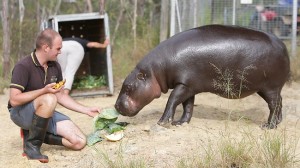
Hagenbeck established his zoological garden near Hamburg as the prototype of the modern open-air zoo in 1907. In 1909, Hagenbeck sent German explorer Hans Schomburgk to Liberia to check on rumors about a “giant black pig.” After two years of jungle pursuit, Schomburgk finally spotted the animal 30 ft in front of him. It was big, shiny and black, but the animal was clearly related to the hippopotamus, not the pig. Unable to catch it, he went home to Hamburg empty-handed. In 1912, Hans Schomburgk returned to Liberia, and to the dismay of his critics, came back with five live pygmy hippos. A full-grown pygmy hippopotamus weighs only about 400 lb, a tenth of the weight of the average adult hippopotamus.
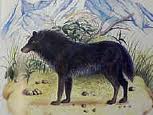
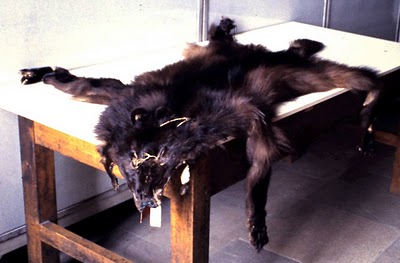
The Andean Wolf, or Hagenbeck’s Wolf is an unsubstantited wolf-like canid, reportedly from the Andes. It was named after Lorenz Hagenbeck (1882-1956), the son of Carl Hagenbeck. The Andean Wolf was first discovered with only a skin bought by German animal-dealer Lorenz Hagenbeck in Buenos Aires in 1926.
 About Loren Coleman
Loren Coleman is one of the world’s leading cryptozoologists, some say “the” leading living cryptozoologist. Certainly, he is acknowledged as the current living American researcher and writer who has most popularized cryptozoology in the late 20th and early 21st centuries.
Starting his fieldwork and investigations in 1960, after traveling and trekking extensively in pursuit of cryptozoological mysteries, Coleman began writing to share his experiences in 1969. An honorary member of Ivan T. Sanderson’s Society for the Investigation of the Unexplained in the 1970s, Coleman has been bestowed with similar honorary memberships of the North Idaho College Cryptozoology Club in 1983, and in subsequent years, that of the British Columbia Scientific Cryptozoology Club, CryptoSafari International, and other international organizations. He was also a Life Member and Benefactor of the International Society of Cryptozoology (now-defunct).
Loren Coleman’s daily blog, as a member of the Cryptomundo Team, served as an ongoing avenue of communication for the ever-growing body of cryptozoo news from 2005 through 2013. He returned as an infrequent contributor beginning Halloween week of 2015.
Coleman is the founder in 2003, and current director of the International Cryptozoology Museum in Portland, Maine.










I have recently noticed that otters can be quite aggressive, towards humans, occasionally.
For example, this Giant Otter attack reminds me of the Dobhar-Chu, a cryptid from Ireland. I remember reading somewhere that, sometime during the 18th Century, it attacked and killed a woman, and that her grave says that she was killed by a Dobhar-Chu. I wonder if the Dobhar-Chu is somehow related to this Giant Otter?
Anyway, this is a very interesting incident, and it will hopefully help to shed some new light, on the behaviour of otters! 🙂
According to press the women had to be placed in temporary coma at first but now is awake. But it is not clear at the moment if she can use her arm ever again. Beside the heavily wounded exhibition cleaner also two zookeeper who tried to help her were bitten.
It is according to the zoo after 50 years the first incident with such serious violations.
The Giant South American Otter is also called the River Wolf, and for good reason: it kills and eats, among other animals, piranhas, anacondas and caimans. Its an apex river predator.
The River Wolf/Giant Otter, due to its size and ferocity, is the Dobhar-Chu (Pronounced “Durra-Goo”) of the New World.
I have to agree with the others regarding the Dobhar-Chu, as they are known to attack without warning or provocation, mauling their victims. I know the stories usually peg the Dobhar-Chu as 7 feet or more, but legends tend to be exaggerated. So it look as though now we have even more proof that the Irish Crocodile is a large river otter as opposed to some sort of pinniped. Wonder if any of them still exist in the wild? I don’t ever recall hearing of a mass killing of them, and if the legends of them being white and black are true their fur would tend to stand out if it were made into a coat.
Possible fossil of a Dobhar-Chu Apparently they were a transitional form of seal. Not sure how accurate the artists rendering is, but the description of the animal surely fits. The scientific name is puijila darwinii.