
Georgia Gators, 1910
Posted by: Loren Coleman on February 21st, 2009
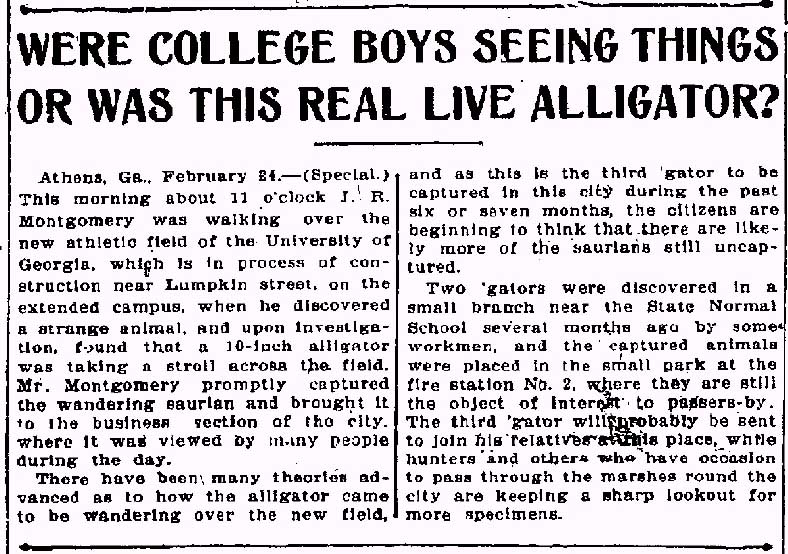
Source: Atlanta, Georgia, The Atlanta Constitution, February 25, 1910.
Thanks to Theo Paijmans.
 About Loren Coleman
Loren Coleman is one of the world’s leading cryptozoologists, some say “the” leading living cryptozoologist. Certainly, he is acknowledged as the current living American researcher and writer who has most popularized cryptozoology in the late 20th and early 21st centuries.
Starting his fieldwork and investigations in 1960, after traveling and trekking extensively in pursuit of cryptozoological mysteries, Coleman began writing to share his experiences in 1969. An honorary member of Ivan T. Sanderson’s Society for the Investigation of the Unexplained in the 1970s, Coleman has been bestowed with similar honorary memberships of the North Idaho College Cryptozoology Club in 1983, and in subsequent years, that of the British Columbia Scientific Cryptozoology Club, CryptoSafari International, and other international organizations. He was also a Life Member and Benefactor of the International Society of Cryptozoology (now-defunct).
Loren Coleman’s daily blog, as a member of the Cryptomundo Team, served as an ongoing avenue of communication for the ever-growing body of cryptozoo news from 2005 through 2013. He returned as an infrequent contributor beginning Halloween week of 2015.
Coleman is the founder in 2003, and current director of the International Cryptozoology Museum in Portland, Maine.











Actually, Athens, GA, lies near the border of the alligator range map at wikipedia. But given that the #1 rival of the University of Georgia is the Florida Gators, the possibility of some sort of student prank has to be considered, too.
Athens is just a little bit outside the range, but alligators, particularly males during mating season have been known to range long distances. Fluctuating weather conditions also tend to make them move around. So this probably was a wild gator.
In Arkansas, alligators have been found within 30 miles of the Missouri border. Not common, but it has happened. A few obscure sources claim that historically, alligators occasionally turned up in southern Illinois, but that has been hard to verify. Sometimes I think the accounts are getting the crocodilian mixed up with alligator gar or the alligator snapping turtle. Alligators appear to be creeping back into the Dismal Swamp of Virginia after an absence of maybe 200 years. So, they are pretty mobile animals.
One of my best friends is native to Oklahoma. His Grandfather is also an Oklahoma native and he’s told me stories of finding wild gators there in ponds and rivers. They may have been released pets, but it seems to me people often underestimate the range of many species. A gator found in Athens doesn’t really sound surprising to me.
Either way it’s a neat old story.
Alligators are actually native to southeast Oklahoma, although they have been absent or extremely for much of the past century. With added legal protection there is evidence that they are moving further up the Red River valley and some its tributary streams, reoccupying former habitat. There has been some expansion in Texas with alligators showing up in man made stock ponds and small lakes in the central part of the state. Formerly they were restricted to the eastern part of the state, obviously because there was more water there.