
Maine’s “Fossilized Bigfoot Tracks”
Posted by: Loren Coleman on May 5th, 2007
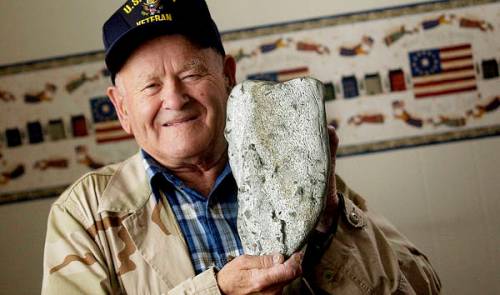
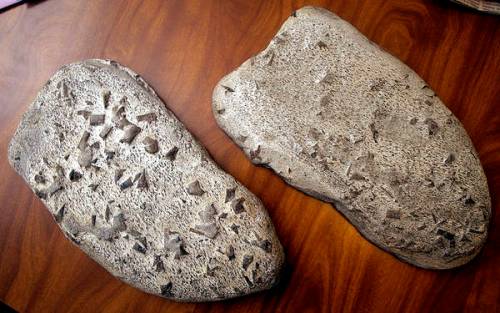
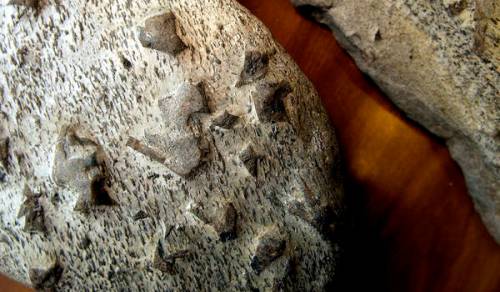
These are images of Mainer Tom Martin’s “fossilized Bigfoot tracks” as noted in the blog, “Ah, Bigfoot and ME”. See that posting for more details.
 About Loren Coleman
Loren Coleman is one of the world’s leading cryptozoologists, some say “the” leading living cryptozoologist. Certainly, he is acknowledged as the current living American researcher and writer who has most popularized cryptozoology in the late 20th and early 21st centuries.
Starting his fieldwork and investigations in 1960, after traveling and trekking extensively in pursuit of cryptozoological mysteries, Coleman began writing to share his experiences in 1969. An honorary member of Ivan T. Sanderson’s Society for the Investigation of the Unexplained in the 1970s, Coleman has been bestowed with similar honorary memberships of the North Idaho College Cryptozoology Club in 1983, and in subsequent years, that of the British Columbia Scientific Cryptozoology Club, CryptoSafari International, and other international organizations. He was also a Life Member and Benefactor of the International Society of Cryptozoology (now-defunct).
Loren Coleman’s daily blog, as a member of the Cryptomundo Team, served as an ongoing avenue of communication for the ever-growing body of cryptozoo news from 2005 through 2013. He returned as an infrequent contributor beginning Halloween week of 2015.
Coleman is the founder in 2003, and current director of the International Cryptozoology Museum in Portland, Maine.










ummm. hmph.
Hmm, I guess Bigfoot didn’t have toes back then, maybe he was more like a Ducksquatch. These “fossils” don’t look like anything special.
Ok. They’re odd all right. That’s about all I can say at this point, I think.
“Ducksquatch”……I love it! Thanks for that one.
Beauty is in the eye of the beholder.
Arts Foundation Course; 3-Dimensional work. Bare pass at top.
But fossilized footprints??
Hmmmmmmmmm… yeah…
hey everyone this is a wonderful article those photos of maine sasquatch footprints plaster casts are very inpressive. thanks bill 🙂
Those “footprints” remind me of the pointy rocks people bring me and insist are projectile points. Bill – those aren’t prints, casts, or fossils…they are just sedimentary rock.
they are just sedimentary rock.
They’re not even that, they look to be staurolite mica schists, likely weathered smooth in a stream bed.
Schists are rocks produced by fairly high grade metamorphism (heating and pressure) of fine-grained sedimentary rocks until the clays recrystalize to mica grains and iron and manganese silicates grow into staurolite crystals. Staurolites often, but not always, grow in the shape of little crosses, hence the name.
Here’s a photo.
Not sure where Mr. Martin found his rocks in Maine, but my guess would be somewhere in the southern half to two-thirds of the state. This portion is pretty much all within the Peidmont physiogeogrpahic province of the Atlantic Coast and consists mostly of metamorphic rock and igneous intrusions.
Simplified Bedrock Geologic Map of Maine.
Dr. Tachyon