
Fiji Ground Frog Rediscovered
Posted by: Loren Coleman on December 13th, 2008
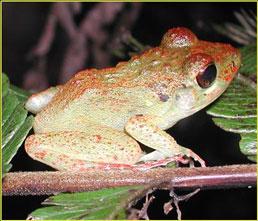
Fiji ground frog. Credit Nature Fiji.
Fiji’s endangered and endemic Fiji Ground Frog (Platymantis vitianus) has been rediscovered in an expedition into the Nakauvadra Range by local scientists.
The Fiji ground frog (locally known as Dreli, Boto ni Viti, or Ula) is one of Fiji’s three endemic frogs. Naturalists working in Fiji over the past 20 years had widely accepted that two species: the Fiji ground frog (P. vitianus) and the Megabotoniviti (P. megabotoniviti) had been eaten to extinction by introduced mongooses and humans on Vanua Levu and Viti Levu and were thought to only persist on the mongoose-free islands of Gau, Ovalau, Taveuni and Viwa (Tailevu). In 2003 there was the rediscovery of a population of the Fiji ground frogs in the Waisali Forest Reserve by the South Pacific Regional Herbarium.
Unsuccessful surveys
Local herpetologists have in the past five years searched for surviving populations of the ground frogs in likely frog habitats on Viti Levu. The Viti Levu surveys into the Savura, Sovi Basin, Wabu and Tomaniivi Forest reserves were unsuccessful in locating any surviving populations and suggested that these frogs had indeed perished on Viti Levu.
A ten day expedition into the Nakauvadra Mountains by a team of researchers from the 17th to 28th November, 2008 has revealed otherwise. The rediscovery of the Fiji ground frogs was made in the first night near the expedition campsite.
“This rediscovery highlights the fact that we know so little about our own forests and the animals that inhabit them. Imagine how much more we would discover if we got our young people involved in learning about our plants and animals and their habitat. It is expeditions and research such as these that paint a more accurate picture of our unique wildlife in Fiji” Ms Nunia Thomas – NatureFiji-MareqetiViti coordinator and Herpetofauna team leader.
For more background information, see Wildlife Extra.
 About Loren Coleman
Loren Coleman is one of the world’s leading cryptozoologists, some say “the” leading living cryptozoologist. Certainly, he is acknowledged as the current living American researcher and writer who has most popularized cryptozoology in the late 20th and early 21st centuries.
Starting his fieldwork and investigations in 1960, after traveling and trekking extensively in pursuit of cryptozoological mysteries, Coleman began writing to share his experiences in 1969. An honorary member of Ivan T. Sanderson’s Society for the Investigation of the Unexplained in the 1970s, Coleman has been bestowed with similar honorary memberships of the North Idaho College Cryptozoology Club in 1983, and in subsequent years, that of the British Columbia Scientific Cryptozoology Club, CryptoSafari International, and other international organizations. He was also a Life Member and Benefactor of the International Society of Cryptozoology (now-defunct).
Loren Coleman’s daily blog, as a member of the Cryptomundo Team, served as an ongoing avenue of communication for the ever-growing body of cryptozoo news from 2005 through 2013. He returned as an infrequent contributor beginning Halloween week of 2015.
Coleman is the founder in 2003, and current director of the International Cryptozoology Museum in Portland, Maine.











There is a big difference between P. vitianus and P. botoniviti. The first one was only for a comparably short time thought to be extinct, but the second one was only known from some fragmentary bones found in a cave, which possibly even predates the arrival of the first people on Fiji. The much bigger species P. botoniviti was probably already extinct several centuries ago. It seems that humans played the main part in its extinction, but to a distinct degree probably also the introduced rats Rattus exulans and Rattus preator. When mungos were introduced, P. botoniviti was probably already extinct.
While it is always good to hear of these developments, it seems that several species of frogs in particular have been making a “comeback” (so to speak). In widely separated locations as well – South & Central America, Australia and now Fiji.
What could be the significance of this, when up to a few years ago there was considerable discussion (and research) in mainstream zoology on the declining populations of amphibians worldwide?