
Museum’s Newest Arrival: An Elephant Bird Egg
Posted by: Loren Coleman on March 6th, 2010
It will soon be Easter, a day associated with eggs. It thus seems totally appropriate that on Friday, March 5, 2010, the International Cryptozoology Museum received delivery to its collection of a high quality, lifesize reproduction of the largest bird egg in the world ~ that of Aepyornis maximus. (We would like to thank Illinois educator Jerry Clemens for the partial donation of this item.)
Aaron Spriggs, who works at the Denver Museum of Nature and Science (formerly the Denver Museum of Natural History), and I discussed the topic of these eggs two years ago, in preparation for his illustrated lecture on “Cryptozoology.” Spriggs noted that there are only 16 elephant bird eggs in the world, and the DMNS owns two intact ones.
The DMNS should be proud. Any museum with a display on elephant birds and their eggs is a worthwhile place to visit. I just learned of a new exhibition at the Peabody Museum in Cambridge on the larger flightless birds, which I shall have to visit myself.
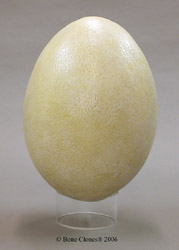
The Bone Clones replica is now to be seen at the ICM.
This new addition to the museum joins the farm-grown hen, emu, rhea, and ostrich eggs exhibited at the Portland, Maine museum. A cassowary egg is en route, a partial donation from Kathy Lamb at The Eggery Place.
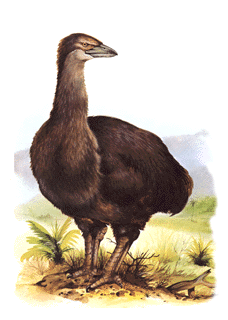
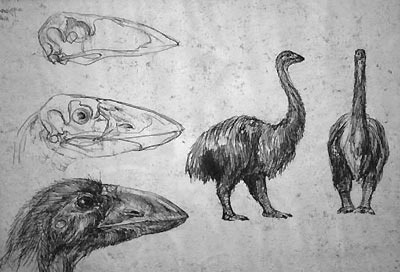
Here are some photos of the remarkable Elephant Bird eggs, and what the bird looked like that issued these eggs. This bird might be the last great instance of what must have been a near-modern version of the “terror birds.”
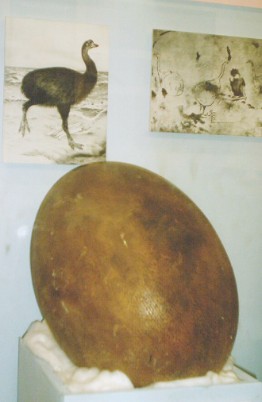
Reconstruction of an elephant bird egg, Ipswich Museum, England.
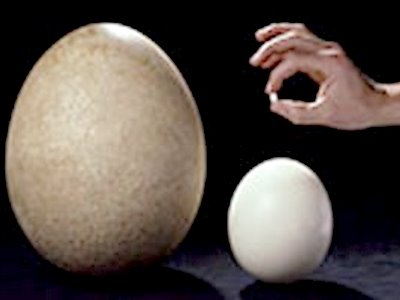
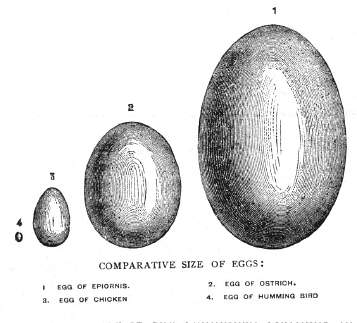
An elephant bird egg compared with an ostrich and hummingbird egg.
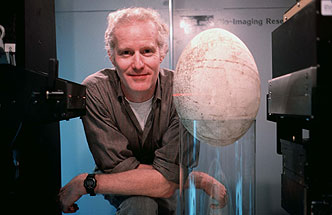
Dr. Timothy Rowe (above) University of Texas poses inside the CT scanner with the National Geographic Society’s elephant bird egg, on loan from Washington D. C.
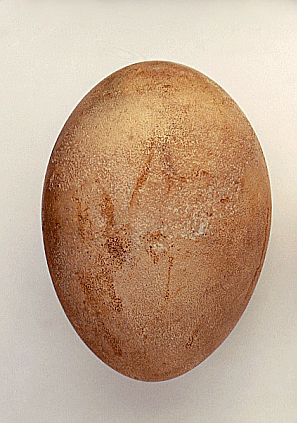
Colin Keates (c) Dorling Kindersley, Courtesy of the Natural History Museum, London.
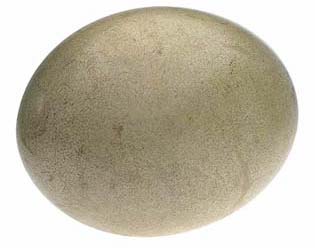
Egg of the giant elephant bird. Registration No. NMV B.3273. Museum Victoria, Australia.
The size of the elephant bird’s egg was enormous ~ 15 times larger than an ostrich egg and 10,000 times larger than a hummingbird egg.
The elephant birds of Madagascar reportedly mostly ate forest fruits.
The giant moas of New Zealand may have been a more diverse diet. Preserved stomach contents have shown that the moa ate a diet of twigs, seeds, leaves, fruit and leaves, and browsed on shrubs, rather than grazed on grass.
Ostriches, the largest ground-dwelling bird around today, eat various seeds, grasses, bushes and forage on trees. They supplement this diet with animal food such as invertebrates and small vertebrates.
Considering that the elephant bird supposedly became extinct in the 16th-17th century, the full extent of their diet probably is not clearly known. Due to the size of the elephant birds, I would suggest they may have eaten small invertebrates and little vertebrates, as the opportunity presented itself.
Some reports have surfaced that sightings of Elephant Birds continued long past their usual stated extinct date in the 16th or 17th century. Also, speculation is widespread that the legend of the Roc may have been based on sightings of the Elephant Bird, or conjecture on what bird could have produced their eggs, found in situ without the bird being seen.
The International Cryptozoology Museum is now proud to share the viewing of its newest addition, a full-sized Elephant Egg museum-quality replica, with the general public, in a new exhibition case.
Assist the museum by turning your small and large fiscal donations through PayPal into the small fee that is often needed to be paired with partial gifters’ reduced pricing for a new exhibition item. This is the way we may expand our collection in a reasonable matter. Also, we are slowly upgrading our exhibitions from inexpensive wooden bookshelves to partially donated, fully contributed, and reduced priced glass, lighted display cases. Please help by clicking below, on the following button…
Remember, no donation is too small. We got this far by way of all of your $10 and $20 contributions. Know that we need to keep receiving them to maintain operations, as well as to enhance the exhibits. Thank you!
 About Loren Coleman
Loren Coleman is one of the world’s leading cryptozoologists, some say “the” leading living cryptozoologist. Certainly, he is acknowledged as the current living American researcher and writer who has most popularized cryptozoology in the late 20th and early 21st centuries.
Starting his fieldwork and investigations in 1960, after traveling and trekking extensively in pursuit of cryptozoological mysteries, Coleman began writing to share his experiences in 1969. An honorary member of Ivan T. Sanderson’s Society for the Investigation of the Unexplained in the 1970s, Coleman has been bestowed with similar honorary memberships of the North Idaho College Cryptozoology Club in 1983, and in subsequent years, that of the British Columbia Scientific Cryptozoology Club, CryptoSafari International, and other international organizations. He was also a Life Member and Benefactor of the International Society of Cryptozoology (now-defunct).
Loren Coleman’s daily blog, as a member of the Cryptomundo Team, served as an ongoing avenue of communication for the ever-growing body of cryptozoo news from 2005 through 2013. He returned as an infrequent contributor beginning Halloween week of 2015.
Coleman is the founder in 2003, and current director of the International Cryptozoology Museum in Portland, Maine.








Hi Loren – and Happy Easter! Were Elephant Birds carnivores, or did they feed their massive bodies on fruit and grain? The same question would apply to the Moas of New Zealand.
Thanks!
Mike
Big flightless birds like ratides but also mainly ground-dwelling birds like galliformes have in general an adaption of their diet when they grow older. Young birds mainly eat insects and other nutritious food, but the larger they grow, the more plant material they eat. This has general reasons. Much proteins enable a fast growth during the first months of the life. Furthermore young and therefore smaller birds can in general better life from a mainly carnivorous or omnivorous diet than larger birds. A big bird like an ostrich could get easily problems if it would only eat small animals, so they prefer plant material which is available in much bigger masses and eat small animals only on occasion.
I have seen an Aepyornis egg in the Museum of Natural History at Vienna, but I don’t know if it is real. But they have a true femur of an Aepyornis and among many other recently extinct animals five Moa skeletons, including Dinornis maximus.
Man! Just imagine the omelette 😉
DNA? If so, then maybe an ostrich could bear a reconstruct? Or over generations breed up to it? I suppose the Ostrich is the closest likely relative.
Is this bird not the Roc of legend?
What RED_PILL_JUNKIE said.
In somewhat the same vein—
This reminds me of one of the last skits CHAPELLE made before he quit his brilliant (and much missed) show. In the skit, Chappelle got hold of a DINOSAUR EGG and managed to hatch it.
Just as the baby dinosaur emerged form the cracked shell—and to the accompaniment of the 2001: A SPACE ODYSSEY music, Chappelle cut off the critter’s head and started drinking its blood!!! He also fried and ate another dinosaur egg!
I guess one has to see to appreciate it, but I was laughing my A** off!!!
If one saw that skit, one would know what I’m talking about. So funny.
Anyway—COULD this be the ROC of legend as SSCHAPER said?
Well cryptidsrus, I couldn’t find the video you mentioned, but it reminded me of the funny ‘pterodactyl egg’ scene from the movie ‘Caveman’ with Ringo Starr, which you can find at Youtube (type ‘giant egg, caveman’) 😉
What awesome new additions to the ICM. At the rate the ICM is growing, Loren may have to look for more space.
Thank you to all the contributors!
Of course, right now, to make certain we continue to exist in this shaky economy, we rely on donations, contributions, and other sources of my income to support the major expenses of the museum. Until the admission flow stabilizes and we are assured of a steady number of visitors, we have to make do with the space we are renting.
Thus, some decisions have been made to “expand” upward (up the walls, on the ceiling) and in more concentrated ways (by moving from bookcase shelving to well-lit museum display cases, as they become inexpensively available or are donated). In that way, we can actually show and exhibit more items in the space we have. Through a combination of those two dimension-expanding design factors, we are actually enlarging the museum almost daily.
I thank PhotoExpert for his Paranthropus bust donation, again, and his other fiscal support that has helped us greatly, as I do to all others!
Congratulations Loren. The egg will make an impressive addition to the collection. The down side – you get to hear the same omelet joke over and over and over…haha
Aaron
I bet that would make a mighty big….oh, damn Aaronious…