
Dwarf Hippo Fossils Discovered
Posted by: Loren Coleman on December 7th, 2007
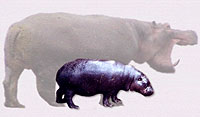
Paleontologists have unearthed an estimated 80 dwarf hippo’ fossils in recent digs at the site just outside the resort of Ayia Napa on Cyprus’ southeastern coast.
The dwarf hippopotamuses were herbivores, like their modern cousins, but were only about 2 1/2 feet (0.76 m) tall and 4 feet long (1.21 m). Unlike modern hippos, whose upturned nostrils seem designed for swimming, “Cypriot hippos” had low-slung nostrils better suited to foraging on land.
Scientists said the fossils show the Cypriot hippos had legs and feet adapted to land, enabling them to stand on their hind legs to reach tree branches.
Experts believe hippos arrived on Cyprus between 100,000 to 250,000 years ago, and likely got smaller to adapt to the hilly island landscape. But scientists do not know how the animals reached Cyprus, which has never been physically linked to another land mass.
Paleontologists theorize hippos may have swum or floated here during a Pleistocene ice age from land that is now Turkey or Syria. They may have clung to tree trunks and other debris during the crossing.
80 dwarf hippo fossils found on Cyprus’ coast
Editor: Han Lin
Source: www.chinaview.cn (Xinhuanet)
 About Loren Coleman
Loren Coleman is one of the world’s leading cryptozoologists, some say “the” leading living cryptozoologist. Certainly, he is acknowledged as the current living American researcher and writer who has most popularized cryptozoology in the late 20th and early 21st centuries.
Starting his fieldwork and investigations in 1960, after traveling and trekking extensively in pursuit of cryptozoological mysteries, Coleman began writing to share his experiences in 1969. An honorary member of Ivan T. Sanderson’s Society for the Investigation of the Unexplained in the 1970s, Coleman has been bestowed with similar honorary memberships of the North Idaho College Cryptozoology Club in 1983, and in subsequent years, that of the British Columbia Scientific Cryptozoology Club, CryptoSafari International, and other international organizations. He was also a Life Member and Benefactor of the International Society of Cryptozoology (now-defunct).
Loren Coleman’s daily blog, as a member of the Cryptomundo Team, served as an ongoing avenue of communication for the ever-growing body of cryptozoo news from 2005 through 2013. He returned as an infrequent contributor beginning Halloween week of 2015.
Coleman is the founder in 2003, and current director of the International Cryptozoology Museum in Portland, Maine.











Hippos were in several cases among the only big animals which arrived on islands. Together with some elephants and deer, which can also cross several miles over the sea, the hippos colonized several islands of the prehistoric Mediteranean sea and evolved into pygmy forms.
Madagascar was also colonized at least three times by hippos which evolved into different species, two small amphibious species and one small terrestrial species, Hippopotamus madagascariensis.
Hippos normally don´t swim, but sometimes they float from rivers to the sea. In one case a hippo even managed to swim to Zanzibar.
I am not surprised that hippos would adapt to be smaller in an island environment. I won’t delve into details here, but the “islandization” of species, where they tend to evolve smaller, more miniaturized forms in island habitats is a well documented phenomenon.
More news involving these tricky fossils. It is reports like these that put more nails into the argument that lack of fossil evidence equals lack of a creature ever existing in a place. I have no doubt the future holds its fair share of surprising and interesting fossil discoveries.
Well, pygmy hippos from cyprus are known since many decades, this is no new discovery.
Cyprus was never physically linked to any other land mass? Is it a volcanic island?
No, it was no volcanic island.
Interesting…..
And cuuuuute!!!