Dire Wolves, Shunka Warak’ins, and Waheelas
Posted by: Loren Coleman on December 6th, 2007

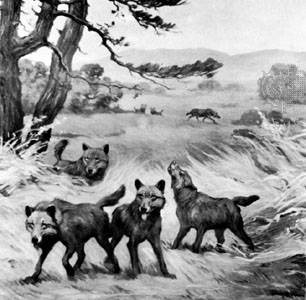
Dire wolf from Rancho La Brea, Calif.; detail of a mural by Charles R. Knight, 1922.

The Bullyland replica of the Dire Wolf (Canis dirus) from Link and Pin Hobbies.
Last night, MonsterQuest broadcast their “Mutant Canines” episodes.
Up in Maine, many people watched, as the story line involved local people and Pine State encounters. Maine remains the most wooded state in the United States, a little known fact to most of America’s residents. Indeed, 95% of the state’s surface is covered in trees and only a million people live in a state that is the size of all of the rest of New England. But enough about how great I think this state is for leftover megafauna, like moose, wolves, and cougars.
I do have some morning-after reactions to MonsterQuest.
A few people watching seem to think, due to editing, that I said the Maine canid creatures could be Pleistocene or Ice Age survivors, specifically the dire wolves (Canis dirus). Needless to say, I never said that I thought the “Maine Mutant” was a dire wolf. Any narrator notions that the nostrils even looked like a wolf, let alone a dire wolf, were off-base. That animal on the ground in Turner was a dead dog, which due to initial decomposition, showed more teeth that usual because the lips do pull back on dead carcasses.
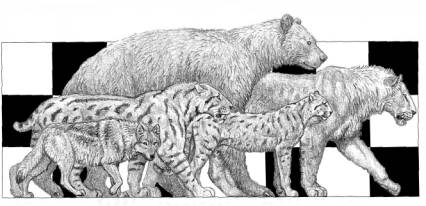
The Carnivores of Rancho La Brea.
From left to right. The dire wolf (Canis dirus), the sabre-toothed cat (Smilodon fatalis), the short-faced bear (Arctodus simus), the cheetah-like cat (Miracinonyx sp.), and the American lion (Panthera leo atrox). Modified from Turner, A., and Anton, M., The Big Cats and Their Fossil Relatives. Columbia University Press: New York, 1997.
In any comprehensive media interview about reports of canid cryptids (Skunka Warak’in to Waheela), which are researched for decades, obviously, I would discuss all the theories and candidates being thrown out there. That is why there would be a mention of dire wolves. But that does not mean that I seriously would consider it an option for the reports in, say, Maine. Interviews are edited and conversations are shortened for television.
Regarding the dead animal found in Turner, for melodramatic effect, its identity was teased for some time on the MonsterQuest program. But everyone knew it was a dog as soon as that show began pre-production, as well as shooting in Maine.
I found it curious that despite the fact that two labs had already given us a DNA “dog” verdict with fresh tissue samples in 2006, here we find that MonsterQuest did another DNA round of testing with old, dried tissue, at a NYU lab in 2007. I take it this was done to create documentary tension, and so they could film the process and the lab scientist’s “new” final results. It makes for good television, I suppose.
Overall, though, I thought the “Mutant Canines” program was sort of one of those middle of the road episodes for the MonsterQuest series. It really is too bad they weren’t able to do an “update,” as often appeared on the old “In Search of…” series. In such a bulletin, MonsterQuest could have told about the discovery, 121 years later, of the Shunka Warak’in taxidermy mount recently.
Also, perhaps with more time, they could have included details of the compelling story of the sightings of the Waheela, which definitely overlap with the rest of the material in the program.
The Waheela is a ghostly, snow-white wolf-like cryptid reported by Inuits, Indians, and EuroAmerican trappers from Alaska and Canada, especially in the Nahanni Valley in the Northwest Territories. Zoologist Ivan Sanderson, who collected stories from his friends, thought that the Waheela might represent a relict population of Amphicyonids, prehistoric bear-dogs, or even the dire wolves.
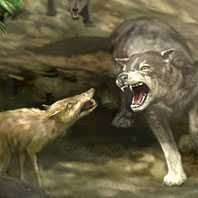
Dire wolf. NOVA image.
Explorer Frank Graves described the Waheela as 3.5 feet high at the shoulders with a wide head and short legs, covered in a shaggy white coat. He saw it in the mid-1960s in the Nahanni Valley. Another Sanderson friend, photojournalist Tex Zeigler reportedly saw a Waheela on the tundra of Alaska. These northern reports also match the tales of the Amarok, a giant wolf from Inuktitut mythology.
When I was working with Sanderson, I shared with him the similar stories I gathered from the Indiana University archives. One specifically was of three trappers in northern Michigan who encountered a phantom-like giant white wolf that mirrored the Waheela sightings.
As to the program’s statements about whether the Shunka-Warak’in travels in packs, no one knows. The one sighting that is well-documented is from the 1880s, and that could have been one individual animal. Wolves, well-known pack animals, are seen individually too.
The oft-repeated statement that “it is known” that dire wolves traveled in packs is pure speculation. The number one animal found in the La Brea tar pits was the dire wolf (3,600 individuals), and that is often used as some kind of verification that the dire wolves were pack animals, especially if aligned with modern timber wolf behavior.
But do you know what the number two most frequent animal found in the tar pits is? It is the saber-tooth cat, Smilodon. Does that mean that saber-tooths traveled in packs? No, of course, not. All it means is that dire wolves and saber-tooths, in large numbers, were attracted to feed on the other animals stuck in the tar pits and then became trapped themselves.
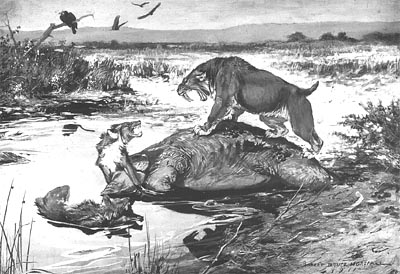
At the tar pits, a dire wolf and saber-tooth cat fight over the same morsel.
Megafauna mysteries come in many packages.

Random Posts
- Similar Phenomena:

Loren-I was not under the impression that you said anyting about the Maine mutant being a Dire Wolf. I hope there hasn’t been a misunderstanding. I was just saying that I thought it was a bit silly that the narrator was suggesting it was. In my opinion, these creatures are probably hybrids between a wolf and some large breed of dog like a mastiff. It is extremely unlikely that Dire Wolves still exist, but they were around only 10,000 years ago, which is really not a long time at all.
I thought they told the story well and doled out the sources effectively. A lot of the people featured were sources I hadn’t talked to in years. And of course, today there are new sources with new stories and photos. Of course, I’ll pass along anything interesting to Loren.
Editorial liberties aside, another great “Monster Quest”. Good recent information on a not often considered cryptid (as far as TV is concerned anyway).
Assuming that there will be a second series, I suspect that they will revisit previous investigations for updates on things like the Shunka Warakâin taxidermy mount discovery.
10,000 years is nothing in geological terms, and with so much natural habitat left in certain areas. (Isolated pockets, granted) there is a SLIM possibility that larger mammals are still out there waiting to be discovered / rediscovered.
I know Pennsylvania has our own version of the Black Forest (due to the density of old growth) in the NorthWestern part of the state. I’ve heard a lot of reports of giant birds and other ‘odd’ animals coming from there. With the large deer population it wouldn’t be too far of a stretch to see it supporting a viable population of cryptocanines or other cryptomammals. I’m sure other states have similar areas, Mr. Coleman already stated that Maine is 95% forest, if even half of that area is deep forest, away from large human settlements I would think that the possibility of finding ’something’ would be fairly high.
And if there is any sort of ‘corridor’ along the Eastern Coast (like the Appalachia Trail) migration may be a factor too.
It seems to me that Occam’s Razor should rule out on this one. We have no way of knowing how rebounding wolf populations are going to interact with feral dog packs, or in what ways the changing environment will change the wolves themselves.
I understand that finding existing animals from once thought extinct species is like the ‘holy grail’ of cryptozoology, but in this case I think it safe to say that nothing which was covered in the MonsterQuest episode couldn’t explained by either wolves, dogs, or some new mix of the two.
I find the stories of Waheela to be particularly interesting though, it could it be that beside wolves there is another – as yet unidentified – species of canid roaming N America.
Great episode, despite the “liberties.”
I DO remember you already identifying the Turner Beast some time back. Pure dramatics for the show.
Despite the dog identification, it STILL seems there is some sort of dog-eating “thing” out there that has not been identified.
This, like the Champ episode, was iffy. So far, the only good one that came back with credible evidence was the Bigfoot episode. I wouldn’t buy into the idea of any out-of-the-ordinary canid in the New England area. The evidence is severely lacking, and there are simply too many things up there that could be mistaken for a “mutant canine.”
On a side-note, I noticed that most of the show was an overplay on the only piece of “good” evidence; the dead dog. Cryptozoology aside, as a television show, it simply wasn’t gripping enough. Even if I wasn’t willing to humor a specific cryptid, I would still want some more pieces of evidence, simply for more entertaining television.
Good appearance, though, Loren. Of all of the episodes to have seen you on, though, this seemed like my least likely candidate. Also, I doubt anyone really thinks that “dire wolf” is a viable explanation.
At the very least, though, these Monster Quest shows are good documentary and are [hopefully] opening peoples eyes to the world of cryptozoology.
It figures. I miss the episode Loren is on. Good thing we have reruns.
Arctic wolves are white, but they have long legs, and behave a lot like Scots collies (from what I’ve seen on TV of the former).
The shape of the waheela sounds like a mustelid. Are they supposed to be extremely frightening and ravenous?
Most canids do travel in packs, though sometimes males are kicked out on their own.
Monster Quest is not a horrible show by any means, but it’s often irritating, last night’s show doubly so. I know it’s not a program aimed at the type of people who read this blog, but it was so obviously a dog, and I have to assume that half the people watching the show knew the creature in question was a dog long before it was “revealed” to them.
Other than the first Bigfoot episode, none of the expeditions profiled have been successful, or even relavent. While wathing the program you know that they are all going to fail too. If any of these groups out in the wilderness had actually found anything, we would have heard about it a year ago, when the series was actually being filmed.
I wish all of these monster shows would get away from “looking” for the creature, and just focus on what is already known about the creature. Analyze the evidence that exists, talk to experts, and stop setting up motion sensitive cameras everywhere. These shows would save a lot of money and put together a more interesting product.
I love the show, hands down, but it seems like it is really geared for exciting and upsetting the city-dwellers who don’t have a clue about the “wilds”… I suppose everything in the dark woods is scary and makes for good TV to them, but sheesh, it’s only a dog! What is all the fuss about?! Even the suburbs out here have this stuff going on every day with coyotes and raccoons… so it really is more about a sociological event that a real one concerning a cryptid. Has to do more with societal difficulties of the modern age in adjusting with so-called wilderness than it does with an actual animal…
I am really suprised at the seeming ignorance of some of the witnesses – they clearly live out in the country but evidently have no historical background knowlege or “culture” of what living near to the wilderness entails. Is this due to editing “for effect”, i.e., the target audience of know-nothings? I think it reflects our affinity for “country living” with none of the background learning that those raised in the country would understand. So, yes, ignorant people living near to wilderness are likely to get suprised when the inevitable “stuff” happens. And because they don’t understand and/or are unfamiliar with it, it must be a “monster” or unknown cryptid that did it!
For instance, the couple cowering in their bed because something was “huffing and puffing” outside – didn’t even look out to see what the heck was making that sound – astonishing! Where I come from, it’s grab the shotgun (ESPECIALLY if you haven’t heard anything like that before!) – and flashlight – so you can see what it is and check it out. Now that doesn’t mean necessarily kill it – could be the neighbor’s horse that got out and came calling (especially if you have a horse) – but no way would I let some unknown and possibly dangerous critter being allowed to roam freely in close proximity to the house and thereby potentially threatening any of my livestock, pets, or family if I could help it. Predators need to be scared off at the very least or they may become emboldened and require extra attention later. You definately do not want to allow a pattern to develop.
Anyway, I would think deer or an elk as a first choice. Horse or pony second. They snort and huff and puff after running around at night, which they tend to do and are very, very good at it. But to not even look out to see what it was?! I don’t understand that!
The “Sasquach Attack” Monster Quest episode did the same thing, more or less, huddling inside the cabin, so are we looking at more editorializing for effect? Bad science, and not even very good TV in my opinion.
But not even looking out a window or turning on the porch light?! Move back to the city, folks! So much for being (at the very least) what I would consider a “believable” or “compelling” witness. So that went, LITERALLY and pun intended, out the window…
So for the scairdy cats out there: 1) there are critters that see in the dark better than you, and 2) they kill things for a living. If you have your family pet on a chain of in a pen, etc. it cannot get away, so it is more than likely going to become food. That is an undeniable fact, and the fault for loss is your own, and not really whatever predator might have taken it. The predator is just doing what its meant to do, and you set up the situation whether out of ignorance or not, but the responsibility is yours. You cannot change a predator, but you can, to some degree, alter its behavior by making your spread “not easy” pickings.
Even a raccoon will tear up a dog 3 times its size, regardless of how big and bad- ass that dog might be, and particularly if the dog is on a chain, it’s just food. A coyote will take your cat, eat your dog, work the fence line, open gates, and dig holes, whatever it needs to do, if its easier than running down something, it will do it if it gets hungry enough. You also need to understand when YOU are making it easy for them. If it is easy enough, they don’t even need to be that hungry!
I thought that the show could have been much better and apparently the so-called science bits were just thrown in to add an air of legitimacy for the uninformed.
I love this subject and enjoy the intelligent speculation about vestigal populations from this period before the pleistocene extinction 13kya. Maybe because I was fortunate to spend hours staring into Charles Knights paintings at the Field Museum as a child in Chicago…and the dioramas in which canids and other now extinct predators figured prominently were of course among the favorites.
When I’ve been fortunate enough later in life to actually be inside of one of the great remaining wildernesses like the Hayden Valley in Yellowstone, as great as it is with its free ranging herds of elk and bison and wolves, I still feel a little impoverished, with a sense of longing and always have the distinct feeling that there must have been a lot of small but interesting vestigal populations of all kinds of creatures in the mosaic of advancing and reteating ecotones and a more complete spectrum of different morphologies echoing the differnt niches available as habitat and resident animals shift areas and spread across the landscape. Too bad that by the time the first modern inventory was even feebly attemted, the diversity had already taken the plunge with the introduction of commercial harvest of wild animal products. I suspect a lot of really interesting examples held on for a while and could be the foundation for a lot of these stories, just because things do tend to linger and adapt and hold on until some final push. I suppose there’s a lesson there somewhere but it’s of little consolation.
I have said it before, I don’t understand the big deal about these “dog” cryptids. Why do people spend so much time trying to find a mystery when there, most likely isn’t one? These are most likely a normal animal …i.e. dogs, wolves, coyotes. Why try to make more out of it than should be? I’m not trying to belittle anybody that is doing serious research into this subject, I’m just trying to understand what they see that is so “cryptid” about it! I’ve had the same problem with people asking me “What’s the big deal with this Sasquatch thing”! I guess it’s the same, no matter what you are into! Again, I’m not trashing anybody. I just don’t see the big deal.
Squatchtoba- Well, just as not all sasquatch sightings jibe with the “man in suit” or “bear” explanation, neither do all mystery canine sightings match up with the mundane wolf, coyote, or dog explanation. The descriptions of some of these cryptid canines are very different than those known animals and many are hard to just explain away that easily. Although misidentifications most likely do happen, I don’t think there is necessarily any making more out of it than there is. I also think that although these cryptids are more obscure and maybe not as spectacular to some, I personally see them as every bit as worthy of attention as sasquatch sightings.
I don’t feel saying they are just “dog” cryptids really does them justice and that sort of downplays the incredible diversity shown among canine species in the present and through the ages. They are not all just “dogs”, it is more exciting and complex than that. Canines have shown a mind boggling array of sizes, shapes, forms, and adaptations. There are many extinct types of canines and similar animals that once roamed the North American landscape and not all of them are similar to wolves or coyotes. If there are any surviving populations of these creatures out there, I think that is a big deal and worthy of the time to look into the matter. Remember, cryptids are not only the “rock star” cases like Nessie and sasquatch. Previously thought to be extinct animals qualify as cryptids too and a type of canid that supposedly died out thousands of years ago possibly surviving in present day is as much a cryptid as anything. That’s what I think anyway.
Dogu4- I like this topic too. I have no doubt that remnant populations of these prehistoric North American species coexisted to a certain extent. Speciation and adaptation are not sudden, overnight things, and it is very easy to imagine isolated patches of one species remaining relatively unchanged as their line branched out into new forms. We already have evidence that early types of hominids coexisted together for some time, and the same thing could happen here too with these ancient canines. What a tapestry of life that would have been woven across the landscape! I’d love to just spend one day studying these environments and species in their pristine states, at their height.
As I said, speciation is typically a long and gradual process. Some might also not be aware that in evolution, one species does not simply rise up as the previous one dies out. It is much more complex than that. If there are places and ecosystems in North America that were favorable for the survival of these creatures, where they could feasibly remain hidden, it is not so far fetched to think that these populations could have remained essentially unchanged into the present day. Whether this has actually happened or not is entirely debatable, but it is from a biological standpoint quite possible in my opinion.
Well Mystery Man, while we’re extending our minds back into time with appreciation of nature’s fullness, there are others that are looking into the future. We’ll never have a time machine in a practical sense, but as our understanding of how our genetics operate the likelihood that a lost landscape,particularly one as recent as the Pleistocene, and will work towards re-creating some of those incredible expressions of adaptation, and I hope in the mean time that those good folks at the ReWilding Institute have made progress in re-patching the tattered remains of our once complete natural systems. Seems like a pipe dream now, but our capacity to imagine the future and make it happen has never been greater, shows no sign of levelling off, and if we can survive our short-sighted focus on the immediate, maybe one day we will once again see the diversity and intricate complexity that is the hallmark of a truely productive and intact world.
I think it really hurts eyewitness cases when that one lady says what she saw was nothing like a dog and it had huge eyes and was like nothing she’s ever seen before, then in the next scene she say’s the dead animal is definatly what she saw, and when it shows the “creature” its obviously a damn dog. probably a chow mix. Not at all the mental picture you when you hear her explain this monster creature in her yard. It shows how the average person knows nothing about animals and can easily mistake a normal animal for somthing completely different. This lady saw a dog in broad daylight 10 feet away and she thought it was a monster. Ridiculous.
All I’ll say is I’m rooting for the waheela.
Dmoore—
I don’t necessarily think that the couple was stupid—they simply encountered something that scared them so much that they could not get out of bed. Not everyone acts like you want them to act.
My opinion, which nobody asked for.
Same for the “Sasquatch” episode. You can’t really know what you would have done in that situation. You were not there. Like I said once before, FEAR, particularly of the unknown, is a great motivator.
I simply refuse to “judge” those people. I probably would have both peed in my pants AND soiled myself. Plus fainted.
I’m not saying you may not have a point, or that you would not acted the way you say you would have—it’s just that not everybody would have done it like you.
Again, my opinion.
There IS good evidence for Smilodons being pack animals- namely, that many skeletons have been found with injuries or diseases that should have prevented them from finding food themselves, yet seem to have lived for quite some time in a debilitated condition, evidence that they were cared for by others. I’m not saying that this means that Dire Wolves were, I simply don’t know much about them, but it’s my understanding that the modern scientific consensus is that the Sabre-Tooths did.
The Shunka Warak’in interests me greatly, and I’d love to hear more about the Waheena and Amarok, as I had not previously heard of them. Keep up the good work.
This episode of monster quest was a good one , mystery really surrounds the sightings of mutant dogs i dont really have an opinion if there is strange mutant dogs out there boy i would like to see a clear good picture of one. As you saw in the show the scientists are working hard to prove they exist.
Boy, if those mutant dogs exist and are very large than any dog or wolf i hope the hunters are well prepared.
Hello all -
Concerning the “fearful” actions of the Monster Quest crew, in taking shelter in the cabin, all I can say is that if I’m in a situation where someone or something is heaving stones at me, I’d prefer to have a roof over my head.
Assume that they were not being confronted by an 8-foot-tall, 500 lb. Pleistocene-holdover living fossil, but instead by a more mundane 6-foot-tall, 200 lb. Homo Sapiens teenager out to spook the “tourists.” I still would hate the idea of getting beaned in the head by a well-thrown, baseball-sized rock.
Now, maybe if I was wearing catcher’s gear…
Talk about convergence of synchronocities! Heard about the Shunka Warak’in being found in the Idaho State Museum as I thought it might.
Glad somebody got a response from them. They sure didn’t respond to my inquiries way back last summer.
Glad you posted about it on your website. The head does look very much like a black wolf though.
PS. “Amarok” is just Inupiat/Inuit (“Eskimo”) for “wolf”
No way, Mr. Coleman! When I saw that dog carcass on TV, I knew immediately that this was no ordinary looking dog. It had an oddly shaped, short muzzle, large eyes, and it didn’t seem to resemble any known breed I had ever seen, but what clinched it was the unusual muzzle. I have seen dead dogs before, even up close, but this “dog” completely blew me away, I mean either it’s a new hybrid mix or the camera’s playing tricks.
While I realize these comments come about two years after this conversation has petered out, I feel compelled to write about shunka warak’in. I first became aware of the existence of the stuffed example when it popped up a couple of years ago. When I saw the photos, I said, “That’s what we saw.” In the early 1980s (probably fall of 1983 or 1984), my brother, myself, and a friend were walking in from hunting (plinking really) with our .22 rifles in a large undeveloped tract southeast of Laredo, TX. We were walking through an area that had been cleared by bulldozing 50-75 yard wide swaths parallel through the brush. These swaths would become streets as the area was developed. We walked downhill and down the middle of one of these swaths when the shunka warak’in crossed the opening about one hundred yards in front of us and at the bottom of the hill. When I saw it I instantly thought “hyena.” Mainly this was because of the shape of the animal. It was taller at the shoulder than the rump and it loped along much like a hyena. My brother and I stared while our friend proceeded to empty his rifle at the thing. It moved across the gap in about 10-15 seconds and did not respond in any way to the shooting (our friend wasn’t a very good shot). Anyway, I just thought I should share this.