
Dhole Liberation Front
Posted by: Loren Coleman on February 12th, 2009
A pair of dholes (Cuon alpinus), also known as Asiatic wild dogs, Indian wild dogs or red dogs, are still free, reports the Sussex Express in Lewes, UK, on February 12, 2009.
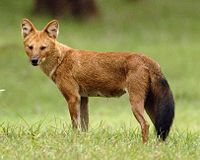
Photo: Wikipedia.
A group of dholes got out of their enclosure at Howletts Wild Animal Park in Bekesbourne, near Canterbury, at about 9.30 am on Wednesday, February 11, 2009, with all but two now recaptured.
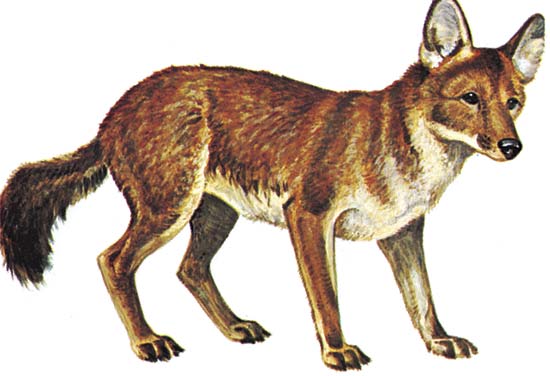
Art by cryptozoologist Richard Ellis.
Anyone who sees the dogs, which originate from Asia and are of a similar coloring, size and temperament to native foxes, should not approach them but report the sighting (to Kent Police at 01622 690690).
A spokeswoman for the park, which – combined with its sister zoo Port Lympne, near Ashford – is home to 1,000 animals and 90 different species, said the dholes were bred in captivity.
“If anything, they’ll be wanting to find their way back,” said the spokesperson. One of the dholes had been shot, but it could not be confirmed whether it had been tranquillised or killed.
The spokeswoman said the other two dogs still on the loose are believed to have run off in different directions but emphasized that they pose “minimal” risk to the public.
“We’re advising people not to approach them any more than they would a stray dog or a fox,” she said.
 About Loren Coleman
Loren Coleman is one of the world’s leading cryptozoologists, some say “the” leading living cryptozoologist. Certainly, he is acknowledged as the current living American researcher and writer who has most popularized cryptozoology in the late 20th and early 21st centuries.
Starting his fieldwork and investigations in 1960, after traveling and trekking extensively in pursuit of cryptozoological mysteries, Coleman began writing to share his experiences in 1969. An honorary member of Ivan T. Sanderson’s Society for the Investigation of the Unexplained in the 1970s, Coleman has been bestowed with similar honorary memberships of the North Idaho College Cryptozoology Club in 1983, and in subsequent years, that of the British Columbia Scientific Cryptozoology Club, CryptoSafari International, and other international organizations. He was also a Life Member and Benefactor of the International Society of Cryptozoology (now-defunct).
Loren Coleman’s daily blog, as a member of the Cryptomundo Team, served as an ongoing avenue of communication for the ever-growing body of cryptozoo news from 2005 through 2013. He returned as an infrequent contributor beginning Halloween week of 2015.
Coleman is the founder in 2003, and current director of the International Cryptozoology Museum in Portland, Maine.








I love dholes! There is so much that is unknown about them, and so much misinformation presented as “facts”.
I’m convinced that dholes were involved in the development of some types of domestic dogs. I think that an ancient dhole cross may have been responsible for some of the attributes of Molosser (mastiff-type) dogs, such as chows and Tibetan mastiffs. Not as direct ancestors, of course, and probably not a deliberate crossbreeding via human intervention. But in much the same way that a dog cross may have contributed to the North American wolves’ gene pool, (see here), random crosses with dholes influenced the evolution of some of the ancient types of Asian dogs. I don’t have any references to back that up; it’s a conclusion I’ve reached based on research, years of studying living dogs, educated guesses and plain old contemplation.