
The Evolution of Cryptozoology Drawings
Posted by: Loren Coleman on April 3rd, 2006
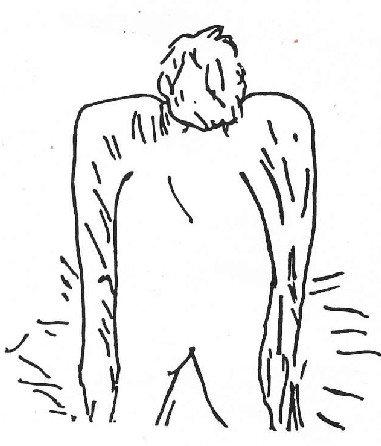
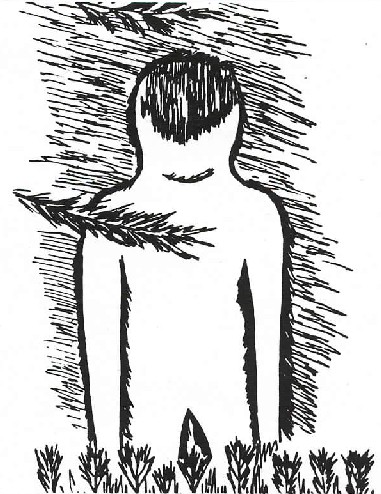
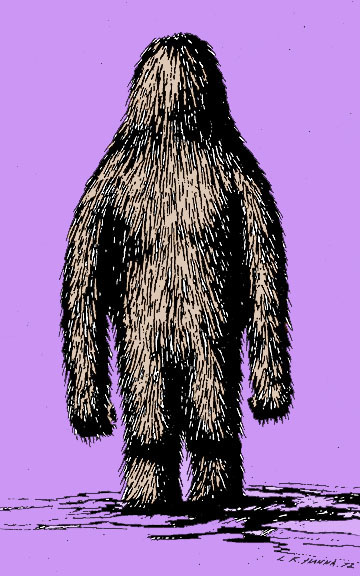
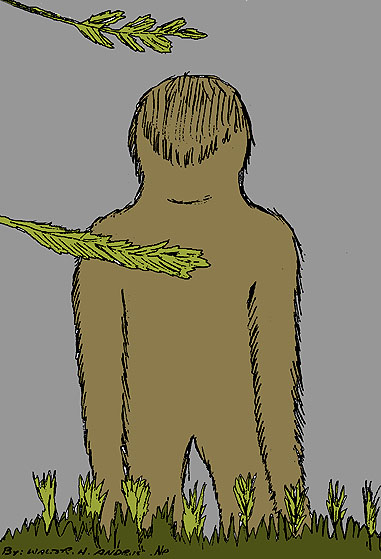
How do eyewitness drawings evolve into what we often see in the media?
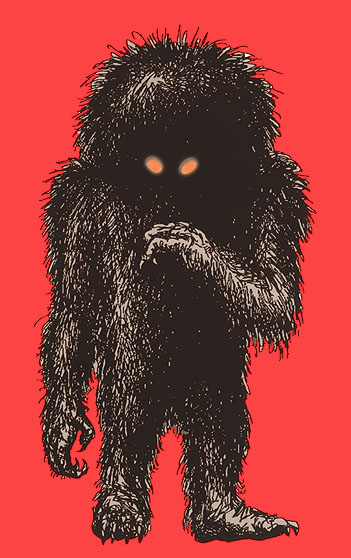
Take a look at the development of the sketches and illustrations of Momo (the Missouri Monster, a 1972 Bigfoot-like cryptid) from the time of the initial eyewitnesses’ attempts to capture what they saw, through the artwork created by later illustrators, some with their own agendas. I have discussed this issue in talks at the Texas Bigfoot Research Group’s 2005 conference and at the Bates College’s cryptozoology symposium, last October.
In essence, the pure experience of the eyewitness – one that is often diffuse and elementary, filled with questions – begins to quickly take on the artifacts of culture, bias, and possible hypotheses of the investigators and artists. Questions are replaced with filled in spaces and answers that may have nothing to do with the emptiness that is there in the first encounter.
For more on eyewitness sketches at the June-October 2006 Bates exhibition, please click here.
Details about the Momo sighting and another drawing of Momo can be found on pages 50-51 of The Field Guide to Bigfoot and Other Mystery Primates.
 About Loren Coleman
Loren Coleman is one of the world’s leading cryptozoologists, some say “the” leading living cryptozoologist. Certainly, he is acknowledged as the current living American researcher and writer who has most popularized cryptozoology in the late 20th and early 21st centuries.
Starting his fieldwork and investigations in 1960, after traveling and trekking extensively in pursuit of cryptozoological mysteries, Coleman began writing to share his experiences in 1969. An honorary member of Ivan T. Sanderson’s Society for the Investigation of the Unexplained in the 1970s, Coleman has been bestowed with similar honorary memberships of the North Idaho College Cryptozoology Club in 1983, and in subsequent years, that of the British Columbia Scientific Cryptozoology Club, CryptoSafari International, and other international organizations. He was also a Life Member and Benefactor of the International Society of Cryptozoology (now-defunct).
Loren Coleman’s daily blog, as a member of the Cryptomundo Team, served as an ongoing avenue of communication for the ever-growing body of cryptozoo news from 2005 through 2013. He returned as an infrequent contributor beginning Halloween week of 2015.
Coleman is the founder in 2003, and current director of the International Cryptozoology Museum in Portland, Maine.








It would be helpful to label or give some background to the individual illustrations, such as who drew them, when and where they appeared, etc. I assume the top one is by an eyewitness, or from an eyewitness description, while the bottom is the most embellished. I think I may have even seen the bottom drawing in UFO related material.
Wow, it is amazing how the artist’s agenda or idea can change the picture so drastically. Is the change usually toward a more monstrous version?
Labeling? Ha, you’ll have to come to my lecture on this and the Bates exhibition. 🙂
But seriously (I guess), I want the drawings to speak for themselves here, although, yes, the evolution is from the actual eyewitnesses’ drawings to the more elaborate versions being by artists and theorists.
More info is given live and in person. This is for the visual impact.
The boundary that seperates non-fiction and fiction in writing does not exist for some reason when it comes to artwork. I think it’s clearly obvious as the drawings progress, that the artists themselves depicted what they feel the subject would or should look like, and not what the actual witness saw. It certainly seems to take a more monsterous or alien type form. I think it would be interesting to see some clay models sculpted from eye witness reports in the same fashion people do police sketches.
They’ll be ga-ga at the go-go when they see me with Momo.