
So You Want To Be A Cryptozoologist?
Posted by: Loren Coleman on February 22nd, 2009
One of the most frequent, oft-repeated questions I’m asked is, “How can I become a cryptozoologist?”
That is usually quickly followed by, “How can I study cryptozoology (in high school) (in college)?”
“What kind of volunteer work could I do?” is another one I’m asked.
The answers are anything but simple, as being a cryptozoologist depends on your point of view. There are no credit courses in cryptozoology that are directly linked to a career in cryptozoology. There are no internships out there to learn how to become a cryptozoologist. There is no doctorate in cryptozoology or even a masters degree.
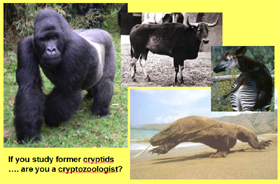
Even Darren Naish’s question above can be answered differently by various individuals, although I’m of the school that learning about new cryptids can be enhanced by studying what I call the “classic animals of discovery” in cryptozoology.
In high school, studying any of the following subjects will assist you with gaining a vocation that is aligned to cryptozoology: biology, zoology, anthropology, psychology (for interviewing), criminal investigations, and so forth. Then you can build on those courses or ones near them for college.
It is about the same for picking a college or unversity. There are none doing anything special with cryptozoology through the length of a two year or four year stay; you have to choose a good college, in general, that will focus your interests.
Yes, I know there are various people who have or are teaching individual or a few courses in cryptozoology, but there is no major, minor, or department in cryptozoology.
The best way to follow an interest, for instance, about the Loch Ness Monster is to study hard, and stay on track to get into a college that has courses on Aquatic Studies or a Marine Mammal program.
With your parents and/or a guidance counselor at your school, you can ask about what good universities exist in your state or area that have an outstanding, for example, Biology Department for general cryptozoology, Aquatic Studies or Marine Sciences for Lake or Sea Monster work, and Anthropology Department for Bigfoot and Yeti research.
You also might wish to think about working or volunteering at a zoo or an aquarium when you can, during middle or high school. Working as a volunteer with a vet or pet rescue agency might be a stepping stone in your career plans.
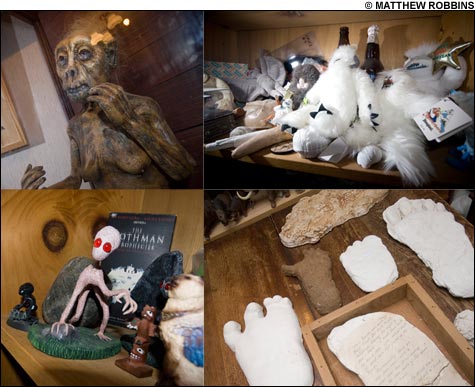
For example, I’m still looking for a very organized, obsessive volunteer for my cryptozoology museum in Maine who likes to sort through boxes or work on cataloguing the collection. Most people don’t like to do such tasks, as they are boring or not glamorous ~ but write me directly, if you are interested ~ at lcoleman@maine.rr.com Summer is coming.
Taking writing courses or joining your student newspaper could give you practice for turning breaking cryptid sightings into stories, articles and essays.
You can research online places near your home to look into work or volunteer opportunities that will get you closer to becoming a cryptozoologist.
In general, few people in the world work in the field of cryptozoology on a full-time basis. I do, and a couple other people perhaps, but most individuals I know “doing” cryptozoology happen to have another job and squeeze their cryptozoology in on the side.
The truth is, cryptozoology does not really pay much, and you have to scratch by selling books or giving talks, now and then. Some people in documentary filmmaking make good money, but they usually consider themselves as filmmakers or producers, not cryptozoologists.
Most cryptozoologists, unless they are independently wealthy, barely make a living. No grants in cryptozoology are given for folks to do this work. There is a great misunderstandings about when cryptozoologists do need to make money to support their work.

You also have to deal with people threatening you with lawsuits because they ask for attention and then might not like what you write about them. It is a mixed bag.
The rewards in being a cryptozoologist are not financial or media-driven ones, but involve the passionate pursuit of discovering new information on a world of animals yet to be revealed.
Being a cryptozoologist is to be a modern adventurer, but if you are getting into this field to make money, you might be better off going into another field.


Lil’ Bigfoot Cartoon Credit: Cunningham/Pittz
 About Loren Coleman
Loren Coleman is one of the world’s leading cryptozoologists, some say “the” leading living cryptozoologist. Certainly, he is acknowledged as the current living American researcher and writer who has most popularized cryptozoology in the late 20th and early 21st centuries.
Starting his fieldwork and investigations in 1960, after traveling and trekking extensively in pursuit of cryptozoological mysteries, Coleman began writing to share his experiences in 1969. An honorary member of Ivan T. Sanderson’s Society for the Investigation of the Unexplained in the 1970s, Coleman has been bestowed with similar honorary memberships of the North Idaho College Cryptozoology Club in 1983, and in subsequent years, that of the British Columbia Scientific Cryptozoology Club, CryptoSafari International, and other international organizations. He was also a Life Member and Benefactor of the International Society of Cryptozoology (now-defunct).
Loren Coleman’s daily blog, as a member of the Cryptomundo Team, served as an ongoing avenue of communication for the ever-growing body of cryptozoo news from 2005 through 2013. He returned as an infrequent contributor beginning Halloween week of 2015.
Coleman is the founder in 2003, and current director of the International Cryptozoology Museum in Portland, Maine.










My nephew,12, who lives in Massachusetts told me this weekend he wants to go to the University of Maine because he knows they offer a degree in Zoology. For several years now he’s been an aspiring Cryptozoologist.
If there is no ‘certificate program’ or ‘internship’ or ‘doctorate’, at what point, can a person consider themselves a cryptozoologist?
Granted I have no degree in anthropology, zoology or biology, but what is stopping me from proclaiming myself a cryptozoologist?
I do have the people giving me skeptical looks, and rolling their eyes at me. I love finding out about new species, and sharing that with others, much to my co-workers dismay. So maybe I could be a 45 yr old cryptozoologist-in-training?
And if I lived in Maine, I would totally jump on that offer to volunteer to catalog all the things others consider mundane. Because you never know what little thing that seems unimportant, may break a case wide open.
Just like any “freelance” field, you are considered “amateur” until you get paid.
Therefore, do your homework, do your research, get out in the field and do some exploration.
I hate to keep harping on this, but understanding how to do INTELLIGENT RESEARCH is vitally important. For some this may require university training (regardless of the field), others may find it comes naturally. Understanding HOW to research a subject and understanding such things as logical fallacies is vital in presenting a solid, sound, and comprehensive argument.
TOO MANY so called “bigfoot researchers” (for example) couldn’t put together a sensible case if their lives depended on it. They may have what they think is evidence but their conclusions are flawed due to faulty technique. HOWEVER, others are expert thinkers that can convey their findings with a perceptive flow that demands acceptance.
Just putting on camo, a cool vest and hat does not make one a cryptozoologist. Like the field of archeology, as much work has to be done in the lab/library as in the field. In an arena without an official “degree”, acceptance is based on peer review. Once your peers and/or the public consider you an “expert” (or sometimes just more knowledgeable than they are) then you can consider yourself a true/professional cryptozoologist.
Keep in mind my opening sentence, you are still an “amateur” until someone (outside your family) considers your research/work worthy of financial reciprocation.
Just MHO…
There are amateur paleontologists, herpetologists, and astronomers, just to name a few. Some of these people have made important discoveries and are taken quite seriously by the degreed professionals. Others are just enjoying researching what they love.
Granted, there are no professionals with degrees that say “cryptozoology,” but don’t let that stay your interest. (And remember there are at least a few degreed professionals in zoology and related disciplines (Shuker, van Roosmalen, and a few others) who use the label “cryptozoologist.”)
If you are interested in cryptozoology, I would echo Loren’s advice: read, take relevant courses, engage with others. Do what you love even though the money will likely NOT follow. (I have written two books on cryptozoology that will likely never earn back their research costs, but I’m proud of the quality of my contributions to the field, and that’s quite enough renumeration.)
To branch off on a related topic, I will venture the personal opinion that, if you are going to call yourself a cryptozoologist, you have a moral obligation to the others in the field to take it with some seriousness: that is, to be well-read and to approach it scientifically, with an open mind but not with a credulous, wide-eyed embrace of any and every cryptid tale. When dealing with one’s fellows, and especially if you happen to have dealings with the press, don’t go beyond your limits. I appeared on a TV program on odd bears because I thought I was as well-informed as anyone available on that topic. (It happened that the fellow I recommended as the top expert, Dr. James Halfpenny, was unavailable.) I turned down an appearance I would have enjoyed because I simply was not qualified to analyze the topic they needed help on, which was sasquatch trackways.
I realize the standard I am suggesting is subjective, but I’ll throw it out there anyway to see what others think.
(Quote) “There is no doctorate in cryptozoology or even a masters degree.”
Or a Bachelor’s or even an AA?
Hey Loren,
I enjoyed this post, very insightful. As a researcher, I would agree that keeping to strict scientific and anthropological standards separates the true cryptozoologists from the plain adventurers.
If I had to recommend any college courses it would most likely be the ones that focus on scientific writing. Understanding a peer reviewed and published scientific article drives one’s research principles to respected quality. Working in a lab or in the field professionally as a scientist can also help. Many mistakes that engineers, technicians, biologists, and journalists make are in proper technique and documentation.
I recently got laid-off, and besides looking for a new job, I’ve been looking for ways to fill the day… so, I signed up for a Cryptozoology course at Flamel College – which is a dubious institution to say the least. The course is basically a copy of Loren’s Cryptozoology A to Z book and a small pamphlet/test. It looks pretty weak (not the book obviously) — but hey, I’ll be a “certified” Cryptozoologist when I’m done.
i would love to be in the Cryptid section. 🙂 i mean Cryptozoology.
I Know you Loren Coleman you are on lost tapes you are the one who inspired me to be intrested about windigo zombie dover demon and way more.
Thank You,
Your biggest fan,
Quzapa
O and i forgot to say i am going to study most of my time on windigo i live in wisconsin so cross my fingers i don’t die from beast of bray road or windigo
Thanks again,
Quzapa
I also want to be a cryptozoologist. However, because there aren’t any colleges that offer a degree in cryptozoology, I am just going to be a Zoologist. There are many researchers, out there (for example, Dr. Karl Shuker) with Zoology degrees, who call themselves cryptozoologists.
The American Institute of Metaphysics offers cryptozoology degrees, http://www.instituteofmetaphysics.com, as well as the many other credit and non-credit courses listed by Carol Ettinger in her 2008 Cryptomundo post. I know I’m a bit late to the game here, and these programs may be dubious, but like all courses and all institutions, you get out of them what you put in. I personally think that these courses combined with a solid background in general zoology are worthwhile if you are willing to also make the personal investment in extensive research in the field. I would hate to discourage budding cryptozoologists with a blanket claim that no such programs exist. Like our cryptid friends, finding them takes some digging and assessment of their legitimacy is incumbent upon the conscientious researcher.